
March 21, 2025
History of Artificial Intelligence Timeline (1950–2026) + Infographic

Last updated: November 2026. Now with a 25-milestone “at a glance” table, plus the AI winters, AlexNet, the Transformer, GPT-3 and AlphaFold.
A Brief History of AI
AI is not new. The history of artificial intelligence spans more than 70 years: Alan Turing asked “Can machines think?” in 1950, the field got its name at Dartmouth in 1956, and after two “AI winters” deep learning took off in 2012. Large language models then reached the public with ChatGPT in 2022.
Below is the full history of artificial intelligence as a timeline: an infographic you can share, a quick table of 25 milestones, and the story behind each one.
Artificial Intelligence Timeline Infographic
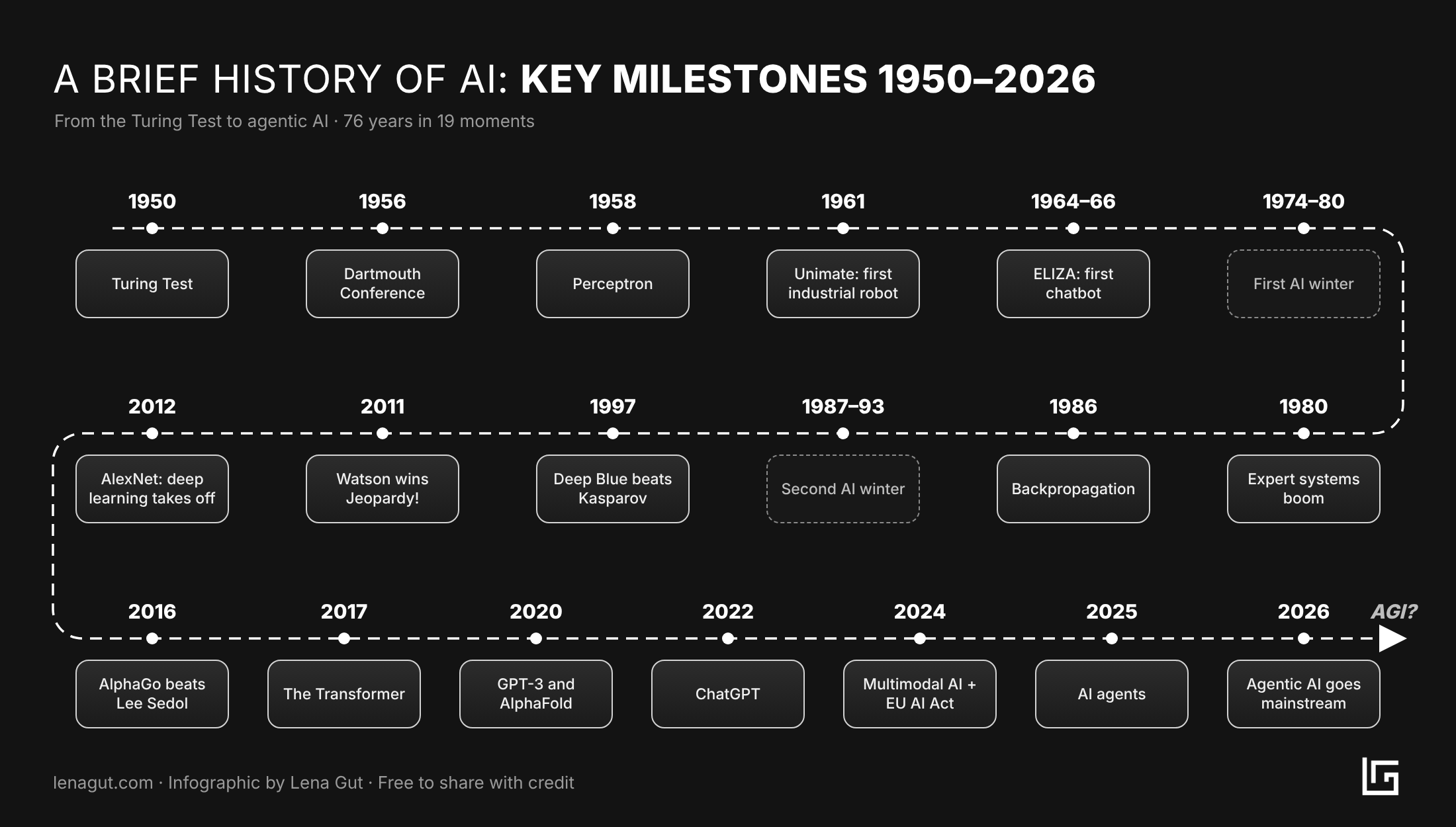
AI Timeline at a Glance
| Year | Milestone | Why it matters |
|---|---|---|
| 1950 | Turing Test | Asked whether machines can think |
| 1956 | Dartmouth workshop | The term “artificial intelligence” is coined |
| 1956 | Logic Theorist | Often called the first AI program |
| 1958 | Perceptron | Frank Rosenblatt’s early neural network |
| 1961 | Unimate | First industrial robot, at General Motors |
| 1964–66 | ELIZA | First chatbot |
| 1966–72 | Shakey the robot | First mobile robot that reasoned about its actions |
| 1974–80 | First AI winter | Funding collapses |
| 1980 | Expert systems (XCON) | First commercial AI boom |
| 1986 | Backpropagation | Neural networks learn from their errors |
| 1987–93 | Second AI winter | Expert-systems market collapses |
| 1997 | Deep Blue beats Kasparov | AI beats a world chess champion |
| 2006 | Deep learning revival | Hinton’s deep belief networks |
| 2011 | Watson wins Jeopardy! | AI handles natural-language questions |
| 2012 | AlexNet | The deep learning boom starts |
| 2014 | GANs | AI starts generating realistic images |
| 2016 | AlphaGo beats Lee Sedol | AI masters Go |
| 2017 | Transformer | The architecture behind today’s LLMs |
| 2018 | BERT | Transformers reshape search and NLP |
| 2020 | GPT-3 and AlphaFold | Large language models; protein folding |
| 2022 | ChatGPT | AI goes mainstream |
| 2023 | GPT-4 | Multimodal frontier models |
| 2024 | Multimodal AI; EU AI Act in force | First comprehensive AI law |
| 2025 | AI agents | AI completes whole workflows |
| 2026 | Agentic AI goes mainstream | Agents use tools and standards like MCP |
1950: The Turing Test – The First Big Idea
Alan Turing, a mathematician and one of the earliest minds in computing, asked a fundamental question: Can machines think?
→ His idea was simple: If a computer could hold a conversation with a human and fool them into believing it was another person, it could be considered intelligent.
→ This concept laid the foundation for everything AI-related today.
1956: The Term “Artificial Intelligence” is Born
The term Artificial Intelligence was officially coined at the Dartmouth Conference.
→ This was when AI stopped being just an idea and became a real scientific field.
→ Researchers believed they could teach machines to think, but they had one major problem—computers weren’t powerful enough yet.
1961: Unimate, the First Industrial Robot
The first industrial robot, Unimate, was introduced at a General Motors factory.
→ It wasn’t intelligent, but it could perform repetitive tasks perfectly.
→ This marked the first wave of automation in manufacturing.
→ Robots like Unimate are the ancestors of today’s physical AI.
1964: ELIZA, the First Chatbot
Joseph Weizenbaum creates ELIZA at MIT.
→ A groundbreaking program that mimicked a psychotherapist using scripted responses.
→ Laid the groundwork for natural language processing (NLP) and today’s conversational AI.
1974–1980 and 1987–1993: The AI Winters
Big promises met slow computers and little data.
→ Funding dried up twice, and AI research went quiet for years.
→ The lesson still matters today: hype without results doesn’t last.
1986: Backpropagation Brings Neural Networks Back
Rumelhart, Hinton and Williams popularised backpropagation, a way for neural networks to learn from their mistakes.
→ It became the foundation of almost every modern AI model.
1997: Deep Blue Beats Kasparov
IBM’s Deep Blue defeated Garry Kasparov, the world chess champion.
→ Chess was considered a purely human intellectual game, yet a machine won.
→ This was the first time AI outperformed a human in a complex strategic task.
2011: Watson Wins Jeopardy!
IBM’s Watson AI won Jeopardy!—beating the best human players.
→ Unlike chess, Jeopardy! required understanding language, nuance, and context.
→ AI had moved beyond numbers and was now processing real-world information.
2012: AlexNet Starts the Deep Learning Boom
A neural network called AlexNet crushed the ImageNet image-recognition competition.
→ GPUs plus big data plus deep learning suddenly worked.
→ This is the moment modern AI really took off.
2016: AlphaGo Beats the Go Champion
Google’s AlphaGo defeated Lee Sedol, one of the world’s best players, in a 2016 match of Go—a game with more possible moves than there are atoms in the universe.
→ AI didn’t win by memorizing moves. It learned from experience.
→ This was a major turning point—AI wasn’t just following rules, it was teaching itself.
2017: The Transformer Is Invented
Google researchers published “Attention Is All You Need” and introduced the Transformer.
→ It is the “T” in GPT, and the architecture behind today’s large language models.
2020: GPT-3 and AlphaFold
GPT-3 showed that a single model could write, summarise and code.
→ The same year, DeepMind’s AlphaFold solved a 50-year-old biology problem: predicting how proteins fold.
→ AI was no longer just playing games. It was doing science.
2022: ChatGPT Changes Everything
OpenAI released ChatGPT, and suddenly, AI wasn’t just for researchers and tech companies. It was for everyone.
→ AI could now write, answer questions, summarize information, and even create new content.
→ People started using it to automate tasks, streamline work, and generate ideas in seconds.
2024: The Rise of Multimodal AI
OpenAI, Google DeepMind, and Anthropic released multimodal AI models that can process text, images, audio, and video in a single system.
→ AI is no longer just about words—it can now see, hear, and understand across different types of media.
→ Companies started integrating AI into real-time video editing, voice synthesis, and AI-powered customer interactions.
2025: AI Agents and Automated Workflows
If LLMs are the brains, agents are the arms and legs that can now complete entire workflows without human input.
→ AI-powered agents can now plan, execute, and optimize tasks across multiple applications.
→ Instead of just responding to commands, AI proactively makes decisions, troubleshoots issues, and refines strategies.
→ New to the idea? Here’s what agentic AI is.
2026: Agentic AI Goes Mainstream
AI stopped being just a chat window.
In 2026, AI agents plan multi-step work, use tools, browse the web, write and test their own code, and collaborate with other agents. Standards like MCP (Model Context Protocol) let them plug into the software companies already use.
At the same time, research is pushing beyond language: world models and spatial intelligence aim to give AI an understanding of the physical, 3D world — a key step for robotics.
The Road to AGI
Artificial General Intelligence (AGI) is the next frontier.
→ AGI will be capable of reasoning, problem-solving, and learning across any task, just like a human.
Artificial Intelligence Is Evolving Fast
Artificial Intelligence didn’t just show up one day.
It’s the result of decades of human curiosity, creativity, and determination, as you can see in this artificial intelligence timeline infographic.
From early concepts in the 1950s to the incredible tools we use today, the AI timeline is filled with breakthroughs that have shaped how we live and work.
And the truth is… we’re only getting started.
AI is evolving faster than any technology in history.
As we move toward things like Artificial General Intelligence (AGI), we need to lead with intention.
That means creating with purpose.
It means building responsibly.
And it means making space for conversations around ethics, inclusion, and impact.
Learning AI, and understanding where it started is how we shape what’s next.
FAQ: History of Artificial Intelligence
What is the history of artificial intelligence in short?
AI research began in 1950 with Alan Turing’s question “Can machines think?” and became a field at the 1956 Dartmouth workshop. After two AI winters (1974–80 and 1987–93) and the deep learning boom from 2012, the Transformer (2017) led to ChatGPT (2022) and today’s AI agents. New to the terms? See my AI glossary.
When was AI invented?
The field officially started in 1956 at the Dartmouth workshop, where John McCarthy coined the term “artificial intelligence”. Alan Turing had already asked “Can machines think?” in 1950.
What was the first AI program?
Logic Theorist (1955–56) by Allen Newell, Herbert Simon and Cliff Shaw is usually called the first AI program. It proved mathematical theorems.
What were the AI winters?
Two periods, roughly 1974–1980 and 1987–1993, when funding and interest in AI collapsed because results didn’t match the hype.
What are the biggest milestones in AI history?
The Turing Test (1950), the Dartmouth workshop (1956), Deep Blue (1997), AlexNet (2012), AlphaGo (2016), the Transformer (2017), ChatGPT (2022) and the rise of AI agents (2025–2026).
Share this infographic on your site
Want to use this timeline in your own article or deck? You’re welcome to — just copy the embed code below and credit the source.
<a href="https://lenagut.com/artificial-intelligence-timeline-infographic/"><img src="/__l5e/assets-v1/c0946268-c208-4dc2-9e4a-1d633f96aa99/history-of-ai-timeline-infographic-1950-2026-1024x582.png" alt="Artificial Intelligence Timeline Infographic by Lena Gut" width="1024" /></a><p>Infographic by <a href="https://lenagut.com/">Lena Gut</a></p>Join the newsletter
Practical insights on AI, leadership and innovation — every week.