
September 28, 2025
5 Reasons This AI Enterprise Transformation Isn’t Like the Last Ones

AI Transformation: Why is it so different?
Last week, I was speaking about AI Transformation with one of our customers, a CIO at a mid-sized enterprise in the Nordics. What started as a technical discussion quickly turned into something else entirely.
He paused, looked across the table, and said:
“We can’t even finish drafting an AI strategy before the tech has already changed. Our teams are adapting in real time. It feels like we’re always two steps behind. It’s like trying to build the plane while flying it, and the runway keeps moving.”
It’s a feeling I’ve heard echoed again and again over the past few months.
Enterprise leaders aren’t just facing complexity, they’re facing velocity.
The technology is moving so fast that even the most prepared organizations are struggling to keep up. The pace of transformation is staggering: the global AI market is projected to reach $391 billion by 2025, with employees already reporting 40% productivity gains and companies cutting 20–40% of inefficiencies, saving millions in the process.
And all around them, headlines flash with news of mass layoffs in big tech, massive shifts in job roles, and pressure from boards and investors to “get on top of AI.”
AI Transformations are different
But how do you plan when the ground is moving under your feet?
How do you prioritize when everything feels like it might be obsolete tomorrow?
This isn’t like past transformations (cloud, mobile or SaaS) where transformation was linear and largely controllable.
This one is faster.
It’s more distributed.
And it’s arriving before most organizations are ready.
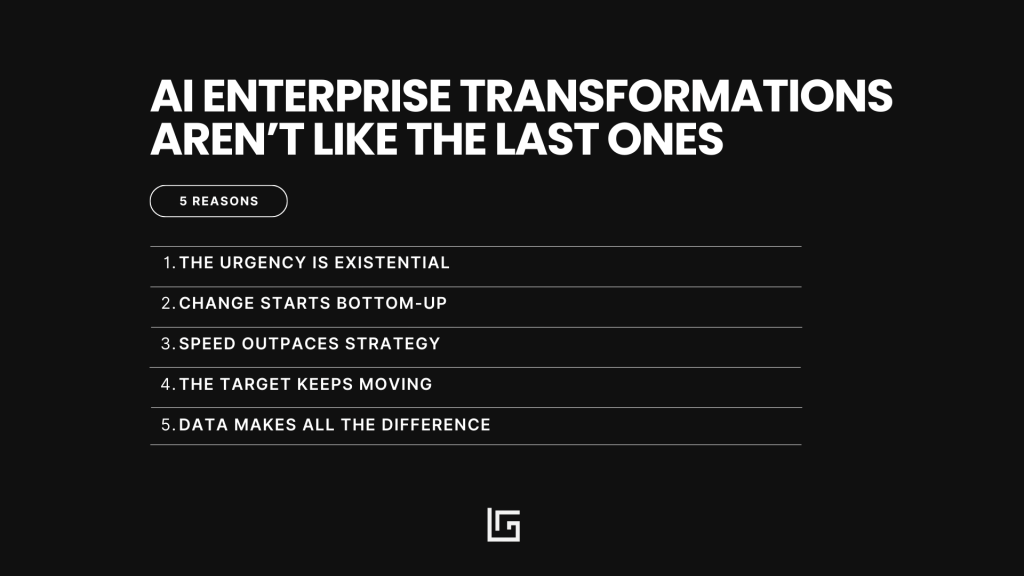
In this article, I’ll break down five reasons why I believe this AI enterprise transformation is different and what it means for leaders who are navigating change in real time.
Let’s dive in.
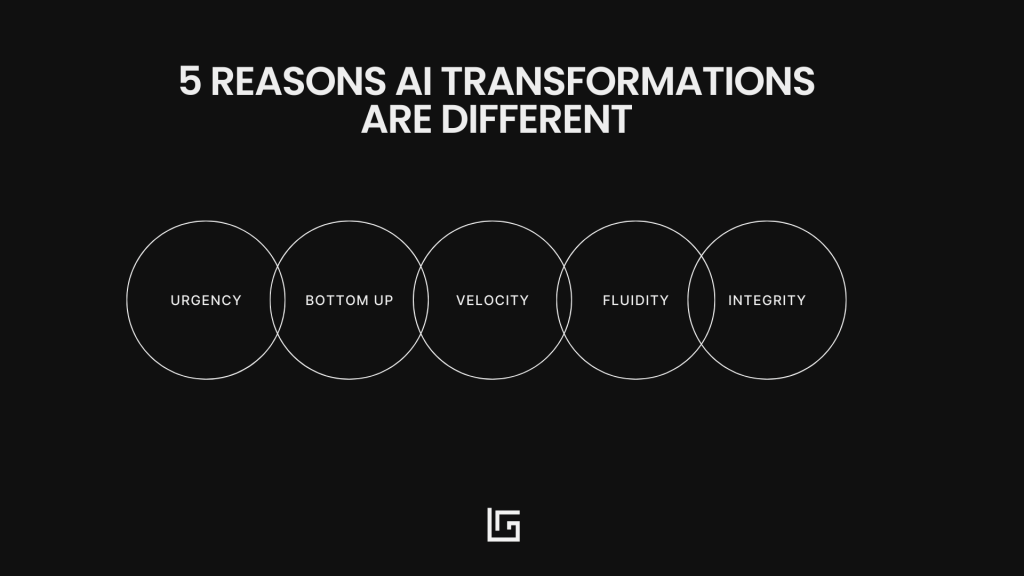
#1 Change at Gunpoint: The Fear Factor Is Real
In previous transformations, we had time.
We made a business case, weighed the cost-benefit and movilized stakeholders.
And we moved cautiously but deliberately.
This time the pressure isn’t theoretical.
It’s visceral.
Jobs are shifting.
Markets are accelerating.
Competitors are retooling at warp speed.
This is no longer just about digital optimization, it’s about existential adaptation.
If you’re a leader, you’re probably feeling it: that sense that the ground is moving under your feet faster than your team can respond.
The fear is real and not unfounded.
AI doesn’t just improve the way we do business, it reshapes the entire playing field. Transformation used to start with thought strategy, and now,it feels more like survival.
#2 Your People Are Already Building the Future (Bottoms-Up Tsunami)
Remember when transformation was led by IT or a special task force?
They rolled out the solution, trained the teams, and set the governance guardrails.
That model is broken.
This time, your people got there first.
The transformation didn’t start in the boardroom, it started on the frontlines.
Employees began experimenting with AI tools on their own. They weren’t waiting for permission. They were building shortcuts, automations, and workflows. Quietly. Quickly. Effectively.
This shift is consumer-led, not corporate-mandated.
People are no longer passive recipients of technology, they’re active participants in shaping how work gets done.
AI started with the consumer, and now your employees are ahead of your strategy. They’ve already experimented with ChatGPT, Copilot, Midjourney.
They often get access to the tools, settings, and models before leadership even knows they exist.They’re eliminating the soul-crushing parts of their day,automating tasks, and prototyping workflows without a project plan.
This is bottom-up transformation at scale .
And in this era, the best ideas might not come from the strategy deck.
They might come from the product manager who automated her sprint planning, or the analyst who built a mini co-pilot over lunch.
Transformation used to be something you deployed.
Now, it’s something you unlock.
And it requires a new kind of leadership: one that listens, amplifies what’s working, and creates alignment without killing the magic that made it happen in the first place.
If your teams are experimenting in silos, that’s not a threat to control. It’s a signal of momentum. Your challenge is to channel that grassroots innovation into enterprise-wide impact.
3. The Pace of Change Is Unlike Anything Before
In previous eras, organizations had the luxury of ramp-up time.
Cloud migrations took years. Mobile adoption unfolded over a decade.
This time, foundational models are improving month over month, and entirely new capabilities emerge weekly. Your team might be building a product on top of today’s model, only to find it’s obsolete before it reaches market.
The velocity isn’t just technical, it’s strategic.
AI is changing how products are delivered, what customers expect, and who makes money.
In the words of futurist Ray Kurzweil:
“The 21st century won’t just bring 100 years of progress. Because of how fast technology is growing, it will feel more like 20,000 years of change packed into one century.”
And in that reality:
- Your 12-month roadmap might be outdated in three.
- What feels “cutting edge” today may be foundational by next quarter
- The “wait and see” approach is a recipe for failure
This isn’t about being reactive, it’s about building the muscle of reinvention.
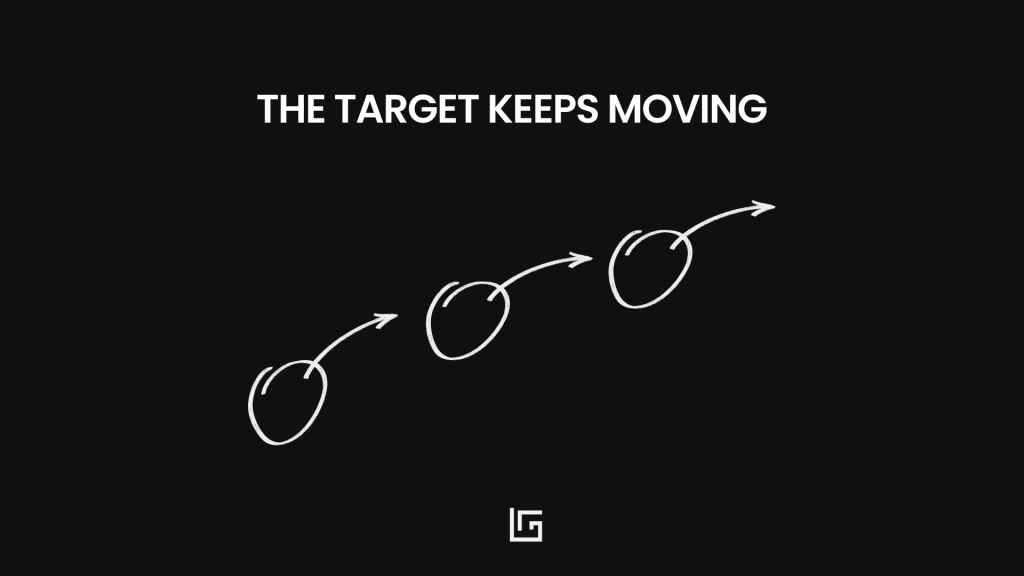
4. The Target Is Moving
In traditional transformations, you defined your goal upfront.
Migrate to the cloud. Standardize on one platform. Automate a set of tasks.
There was a beginning, middle, and end.
We knew what success looked like.
We knew what we were aiming for.
That’s no longer the case.
In AI transformations, the destination is constantly evolving.
The goalposts are kind of fluid.
The tools are changing. The opportunities are shifting. The risks are emerging as we go.
You’re no longer building toward a fixed end state, you’re building systems and cultures that can evolve continuously.
This landscape, demands a new mindset: one where iteration is strategy.
And leaders must become architects of continuous transformation, not just finish-line chasers.
5. The Stakes Are in the Data — Power, Privacy, and Precision
Let’s talk about what’s really fueling this shift: your data.
AI models live and die by the quality of what they’re trained on.
And in the rush to innovate, many organizations are throwing open the vault — often without realizing what’s inside.
Employees are uploading sensitive documents into chatbots.
Developers are plugging internal data into APIs they don’t fully control.
Teams are fine-tuning models without clear governance or precision.
This isn’t just risky. It’s potentially catastrophic.
At the same time, companies that do get their data house in order are sitting on a massive competitive advantage.
Internal knowledge bases, customer service logs, process documentation, all of this becomes raw material for differentiated, private AI systems that others can’t replicate.
The question is simple but critical:
Are you training your future advantage or someone else’s?
It’s time to treat data with the precision, protection, and intentionality it deserves.
Leading Through This Requires a New Kind of Leadership
This AI transformation isn’t like the last ones.
It’s faster.
It’s deeper.
And it’s already happening.
The leaders who succeed now won’t wait for clarity.
They’ll be the ones who move forward with urgency, who listen deeply and who lead with both conviction and soul.
This is not about having all the answers.
It’s about building a team and an operating model that can respond to permanent change.
You can’t afford to sit back and wait for things to settle.
If you’re reading this, you already know that.
So don’t wait.
Step in.
Set the tone.
And build something better: not just for efficiency, but for the future of your business.
You’ve got everything you need to begin.
Free tool
Build your AI enablement plan in 3 minutes
Answer 10 questions and get an ACES roadmap — Awareness, Capability, Experimentation, Scale — in six-week sprints.
Open the plan builder →Join the newsletter
Practical insights on AI, leadership and innovation — every week.