
June 1, 2026
AI and jobs: Finding Value in the Age of AI

A few weeks ago, I was sitting with my team reviewing some client work.
We had just delivered a workshop, a training course, a training library, a presentation, and a communication package for a transformation initiative.
The client was happy.
The quality was good.
But something felt different.
The amount of work we had produced in a short period of time was astonishing.
Tasks that would have taken us weeks only a year ago had been completed in days.
Some activities had taken hours.
Others had taken minutes.
For years, much of our business was built around helping organizations navigate change. Part of that work involved creating presentations, training courses, workshop materials, websites, videos, communication campaigns, and learning experiences that helped people understand new technologies and new ways of working.
These deliverables required expertise.
But they also required time.
Then AI arrived.
And suddenly the timelines started collapsing.
An eLearning course that once took weeks could be created in days.
A first draft of a presentation appeared before we had even agreed on the structure.
Images, videos, websites, and learning materials could be be produced at a speed that would have seemed impossible only a few years ago.
At first, it felt like a superpower.
Then it felt uncomfortable.
Because behind every hour saved was a question that was becoming harder to ignore: If AI can now do many of the things we used to charge for, where does our value come from?
AI and jobs: What Is Your Value?
One afternoon, after yet another discussion about AI, we found ourselves asking a question that completely changed the conversation.
Not how do we use AI.
Not which tools should we adopt.
Not how can we become more productive.
The question was much simpler.
What is our value?
For decades, many of us have measured our value through output.
The reports we write.
The presentations we create.
The designs we produce.
The knowledge we accumulate.
But what happens when those outputs become dramatically easier to create?
AI is forcing us to separate the work we do from the value we create.
And those are not always the same thing.
The challenge is no longer producing something.
The challenge is knowing what matters, where to focus, how to connect ideas, and how to help people move forward.
What History Teaches Us About Big Technology Revolutions
The good news is that we have seen this story before.
The agricultural revolution reduced the number of people needed to produce food.
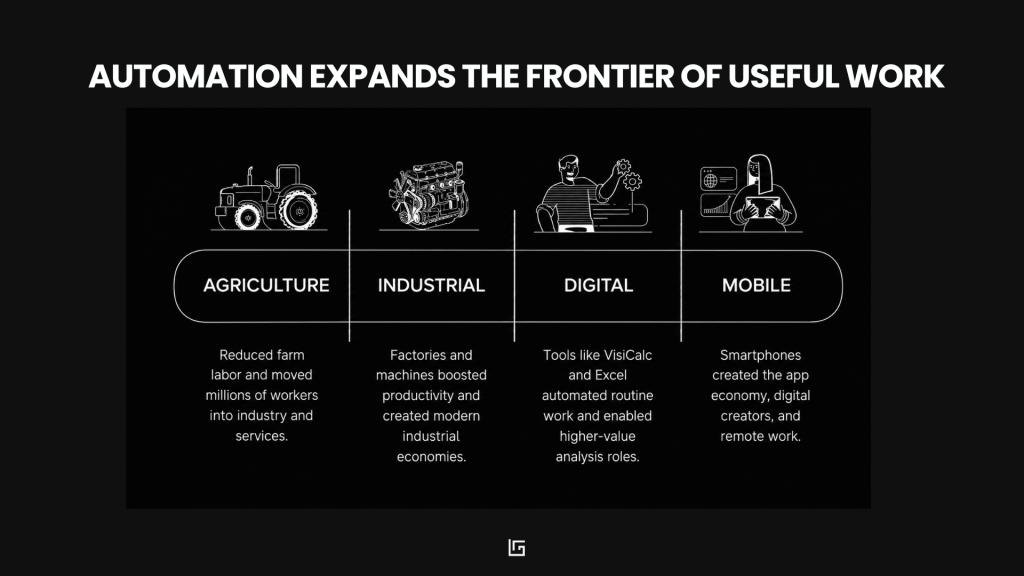
The industrial revolution transformed manufacturing.
Computers automated calculations and administrative work.
The internet changed communication, commerce, and access to information.
Every one of these transformations followed a similar pattern.
Technology automated existing work.
Productivity increased.
Some jobs disappeared and new jobs emerged.
But in general, the economy expanded.
Technology does not simply destroy work.
It reallocates value.
History suggests that technological revolutions rarely make the economy smaller.
They expand it.
The question is not whether value will continue to exist.
The question is where that value is moving.
The Big Value Reallocation: The Rise of the Relational Economy
What if AI is not simply automating work? What if it is reallocating value?
Throughout history, whenever technology reduces the cost of producing something, value moves somewhere else.
When products become abundant, experiences become valuable.
When information becomes abundant, trust becomes valuable.
When content becomes abundant, relationships become valuable.
At the Share PLM Summit in Jerez, people came to discuss AI, automation, and the future of work. Yet afterwards, what they remembered most were the conversations, the relationships, and the ideas exchanged with other people.
People came for the technology and the content.
They left talking about the people.
As knowledge becomes abundant, relationships become scarce.
And scarce things tend to become valuable.
I believe value is increasingly moving toward things that are difficult to automate: trust, connection, community, coaching, facilitation, leadership, empathy, and belonging.
AI and jobs: Finding Your Value in the New AI Era
One exercise helped us enormously.
We created a simple map of everything we do. On one side were activities such as content creation, presentation design, eLearning development, website creation, graphic design, and research.
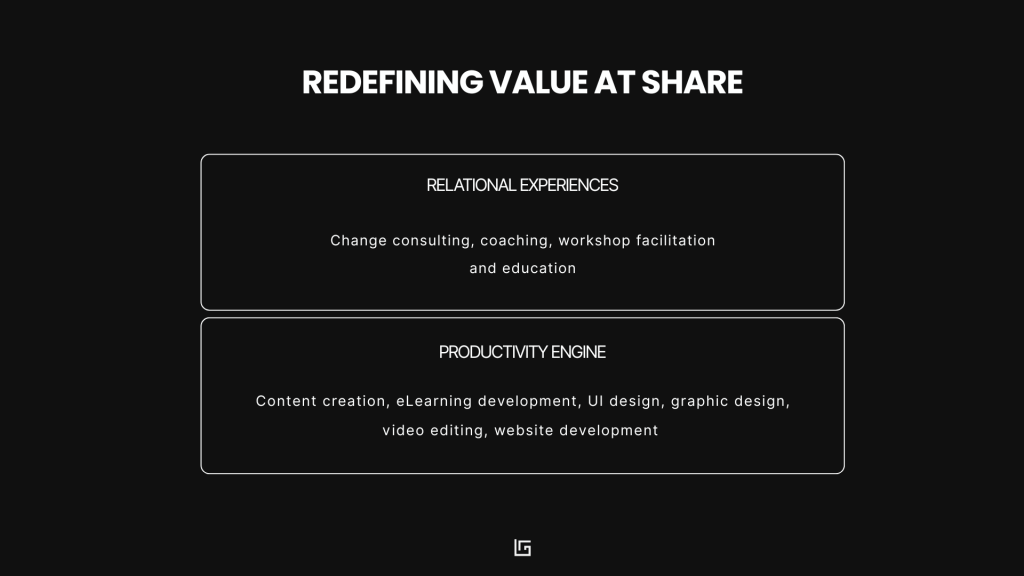
On the other side were activities that happen when humans work directly with other humans: facilitation, coaching, leadership development, change consulting, building trust, creating alignment, and helping people navigate uncertainty.
Many production activities are becoming dramatically cheaper. That does not mean they disappear. It simply means they stop being the primary source of differentiation.
The human side of work is becoming more valuable, not less.
So next time you have a quiet Sunday morning, grab a coffee and take a notebook with you.
Then spend some time thinking about three questions.
- What am I doing today that AI can automate?
- What is my intrinsic and unique value?
- And what parts of my work do I genuinely enjoy the most?
These questions may seem simple, but they are becoming increasingly important. Because AI is changing the economics of work, and that means many of us will need to redesign the way we create value.
In many ways, AI is turning all of us into startups again, and we’ll have to rediscover our product-market fit.
The sooner we start asking these questions, the better prepared we will be for the opportunities that are coming next.
AIfy to Humanize
The AI and jobs topic is a difficult one. Some people believe the answer is to resist AI.
I think the opposite is true.
To become more human, we need to aggressively embrace technology.
For the first time, small teams can achieve what previously required large organizations with significant budgets and resources. A handful of people equipped with the right AI tools can now create products, services, content, and experiences that would have taken entire departments only a few years ago.
I believe this is one of the biggest opportunities created by AI.
But the real opportunity is not producing more.
It is focusing on what matters most.
Less time creating slides, writing reports and doing repetitive work.
More time understanding people, solving problems, building relationships, and helping each other.
I don’t think the winners of the AI era will necessarily be the biggest companies.
They will be the organizations that best combine technology and humanity.
They will be small, nimble teams empowered by AI.
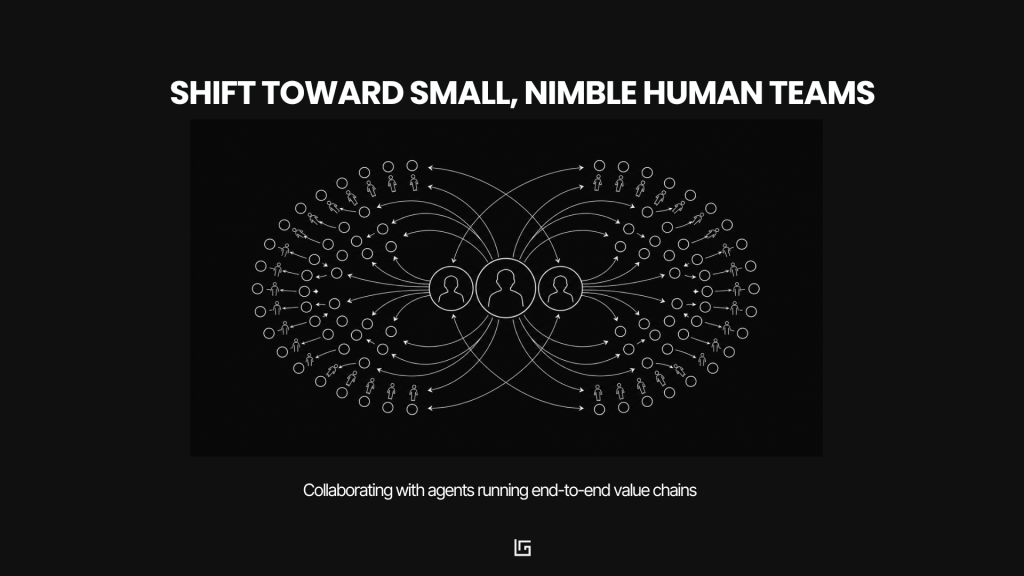
Teams that automate repetitive work and spend less time producing and more time connecting.
If machines take over a lot more of the production, humans can focus more on meaning, relationships, creativity, and helping other people succeed.
Leading in the Age of AI
The irony of the AI revolution is that it may ultimately remind us what it means to be human.
Technology is becoming cheaper every day.
Humanity is becoming more valuable.
The future will belong to those who can combine both.
Those who learn to work alongside AI while investing deeply in the capabilities that make us uniquely human.
Because in the end, the real opportunity is not replacing people with AI.
By automating more of the repetitive work, it gives us the opportunity to spend more time on the things that matter most: people, relationships, creativity, leadership, and purpose.
But the road to get there will not be easy.
Every major technological revolution creates a period of uncertainty, and this one will likely be faster and bigger than anything we have experienced before.
Many of us will question where we fit, whether our skills still matter, and what the future holds.
That is why helping each other matters.
Because beneath the technology, this is really a human transition.
And perhaps that is the opportunity hidden inside all this change:
to make being human our greatest competitive advantage.
Related reading: The Future of Work with AI: Why Human Connection Matters More Than Ever
Keep reading: Jobs AI Can’t Replace: The Human Skills that Still Matter · What Jobs Are Safe from AI in 2026? A Realistic List
Join the newsletter
Practical insights on AI, leadership and innovation — every week.