
November 30, 2025
Why Forward Deployed Engineers Are the Future of Enterprise Tech

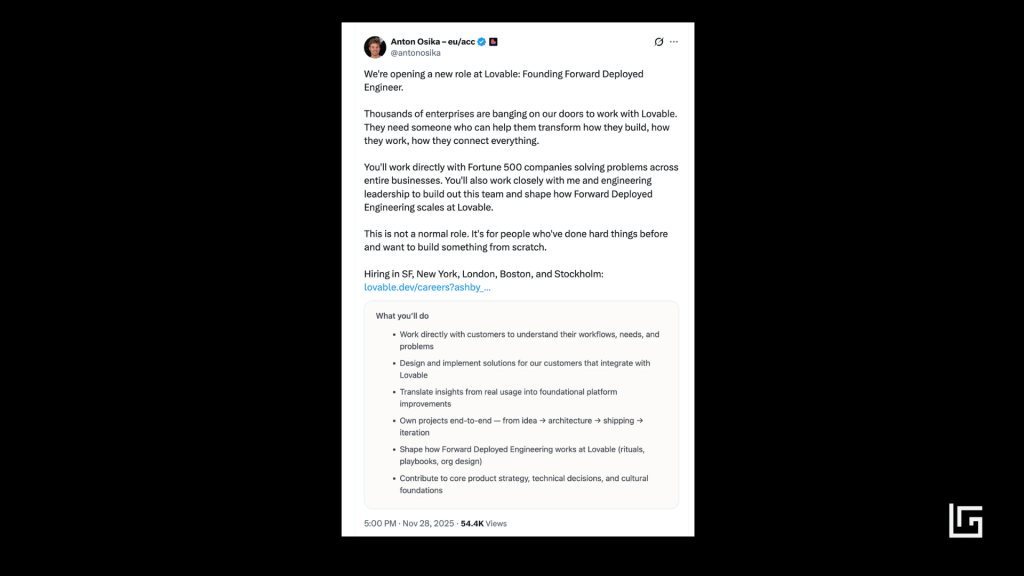
Last week, Anton Osika announced that Lovable is building a Forward Deployed Engineers organization.
Lovable is a “vibe coding” platform. It started last year as a tool for consumer developers, but just like other vibe-coding tools, it has made its way into B2B teams.
Today, many product and innovation teams rely on it for rapid prototyping.
Enterprise teams often need hands-on help to get value from technology.
And now that Lovable is showing up more in enterprise projects, they’re building a Forward Deployment Engineering team.
Other companies have already proven how powerful this model is.
OpenAI announced its own Forward Deployed Engineering function in July 2025. Enterprise teams needed help turning AI models into working, day-to-day workflows, and OpenAI responded.
Palantir has been doing this for more than a decade.
They embedded engineers, called “Deltas” work inside governments, energy companies, defense teams, and global enterprises. This hands-on support became a core part of how they win and retain their biggest accounts.
Across the industry, FDE postings grew 1,165% in 2025.
It’s now one of the fastest-growing roles in tech.
Forward Deployed Engineer DefiniWhat Exactly Is a Forward Deployed Engineer?
A Forward Deployed Engineer (FDE) is a full-stack engineer who lives inside customer projects and works in the real environment, not just within the product team.
They sit with users in the real environment.
And they deal with real constraints and issues: legacy systems, messy data and workflows that don’t look like the perfect diagrams in theproduct decks.
Think of FDEs as a blend of:
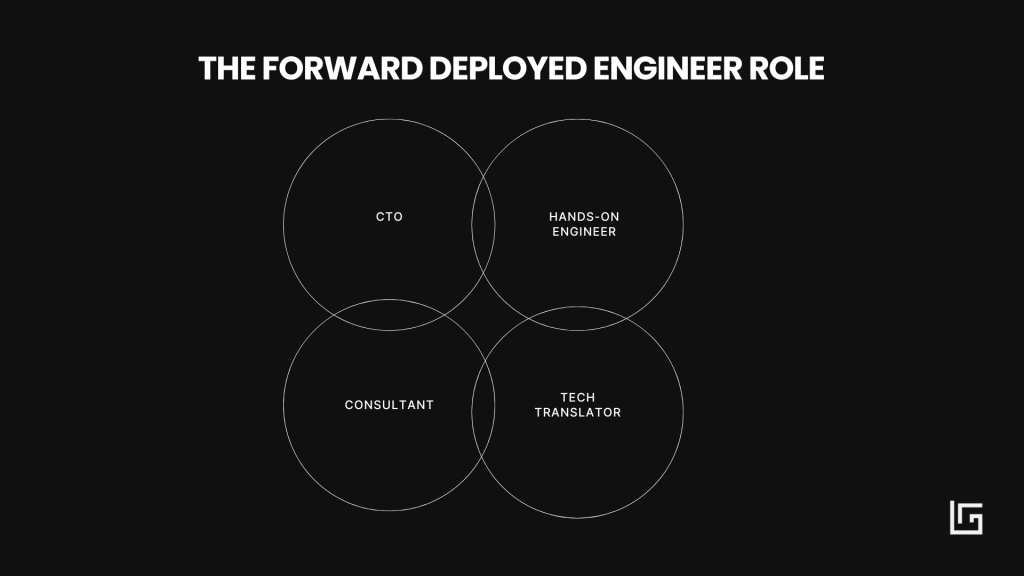
- a CTO
- a hands-on engineer
- a consultant
- and a “tech translator”
Their job is to turn a product into a working solution for a complex organization.
Palantir describes the role like this:
“Similar to a startup CTO: small teams, high-stakes projects, full responsibility.”
Why do enterprises need Forward Deployed Software Engineers?
Inside large organizations, the biggest challenges are rarely technical.
They show up in the form of old systems, slow decision cycles, scattered ownership, and unclear workflows.
New tools don’t just “plug in.”
They need translation.
They need shaping.
They need someone who understands both the tech and the real world it’s entering.
That’s why Forward Deployment Engineering is growing so fast.
It fills the gap between what software can do and what organizations can actually absorb.
I’ve spent over a decade in the middle of enterprise programs and digital transformations. And often what customers need isn’t just a technology solution.
They need someone who can help them make it work for their people, inside messy processes, under real constraints.
And this is why more tech companies are embracing the model Palantir has used for years. Not because it’s fashionable, but because it consistently helps customers get value out of their products.
Why Every Enterprise Software Company Needs Forward Deployed Engineers
Here are some reasons why I believe this role is essential:
1. Adoption
Anyone who has lived through an enterprise software rollout knows that adoption doesn’t just happen. People need support, clarity, and someone who can translate the tool into their daily reality.
Forward Deployed Engineers do exactly that.
They guide the process and make sure the technology lands inside the organization.
2. Product Insights
There’s nothing more valuable than seeing a customer use your product in the wild.
You catch the friction points, the workarounds, the little moments where someone hesitates or gets confused.
These learnings often become features that impact thousands of users.
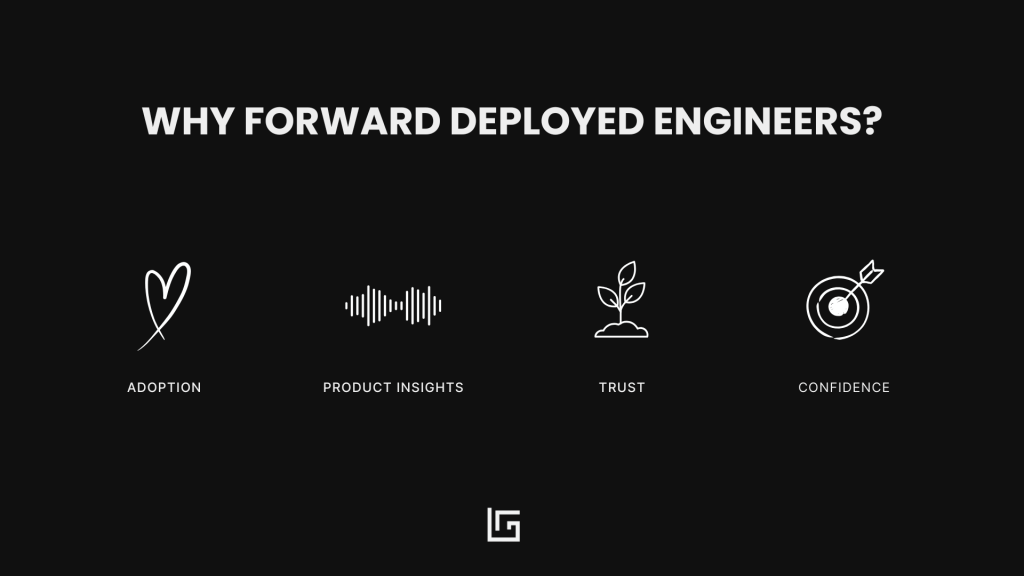
3. Trust
When OpenAI sends an engineer to support a customer, it sends a clear message:
we’re committed to your success.
Companies that rely only on documentation or self-serve support can’t compete with that level of partnership.
This hands-on model becomes a moat, one that’s hard for others to copy.
4. Confidence
Enterprise customers want to feel safe when choosing a platform.
They want to know someone will be there when things get complicated.
And they want their software partners to account for the outcomes
FDEs provide support and confidence.
The Forward Deployed Engineers Role: Their Job and Responsibilities
Forward Deployed Engineers help turn technology into something people can use every day. Their role sits right at the intersection of building, listening, and guiding.
They join customer teams to understand how work really happens.
They watch workflows, ask questions, and look for the moments where technology can make life easier.
They prototype quickly and test ideas with real users, so the solution grows from actual needs, not assumptions.And then, they turn those early ideas into stable, production-ready systems.
Forward deployed engineers work across security, data, IT, and business teams to keep the rollout moving smoothly. They also bring what they learn back to the product team.
Those insights often become features that help many more customers.
In simple terms: Forward Deployed Engineers make sure the technology doesn’t stay in the “cool demo” phase. They help it become part of the real world.
Forward Deployed Engineers vs. Consultants: What’s the Difference?
I know what you might be thinking:
“Isn’t this what consultants do?”
And honestly, yes, there’s overlap.
My consulting company, Share PLM helps teams adopt technology, guide change, and make new tools part of everyday work. That part is very similar.
But Forward Deployed Engineers bring something slightly different to the table, and these nuances matter.
Consultants usually focus on people, process, and strategy.
They help teams map their workflows, align stakeholders, and plan how a tool should be used. They’re great at translating complex ideas into something everyone can understand.
Forward Deployed Engineers do all of that and they have deep, hands-on technical expertise.
They’re not only guiding the “how.”
They’re building the “what.”
They know the product at code level.
They discuss directly with the engineering and product teams.
They can debug, integrate, architect, and ship changes quickly, right inside the customer environment.
Consultants help shape the path.
FDEs build while they walk it.
Another big difference is proximity.
FDEs aren’t external partners.
They’re part of the product team.
They bring customer insights straight back to engineering, which influences future features and improvements.
Both roles are valuable.
But FDEs combine the empathy and change support side of consulting with deep technical ownership. It’s this blend that makes them so effective in enterprise environments where technology alone is never enough.
The Rise of Forward Deployed Engineers: My take
I believe this shift will spread across every corner of enterprise tech, anywhere technology meets complexity. Because the question for enterprise software is changing from:
“Does it work?”
to
“Does it work here?”
As technology becomes easier to create, the real differentiator will be the ability to deliver outcomes, not just software.
Guaranteed results are powerful.
This is a profound shift for the industry: moving from selling licenses to selling outcomes, trust, and hands-on support.
And the software companies that invest in this path: embedding engineers, guiding adoption, and owning the final result will be the winners of the future in enterprise software.
Join the newsletter
Practical insights on AI, leadership and innovation — every week.