
October 13, 2025
Is AI a Bubble? Or the Start of Something Bigger?

Last week I was traveling, meeting clients, old friends, and a few brilliant thinkers.
Everywhere I went, the same question came up: Is AI a bubble, or the start of something bigger?
Some people said it with excitement. Others with worry.
A few smiled, convinced they had seen this story before.
So today, I decided to sit down, pour a big cup of coffee, and explore it with curiosity.
Because these days, if you work in or around tech, it follows you everywhere. Every meeting, every coffee break, every dinner somehow circles back to it.
What is a bubble, really?
A bubble begins when belief grows faster than value.
When the story becomes stronger than the numbers.
When optimism turns into overconfidence.
But not every boom is a bubble.
In a boom, prices rise because something new is actually working, even if the world hasn’t caught up yet.
In a bubble, prices rise because we’ve stopped asking if it’s working.
So when people ask, “Is there an AI bubble?” what they’re really asking is: is this just another cycle of hype, or stepping into a future we’ve never seen before?
1. The Dot-Com Bubble vs. the AI Stock Boom
If we think of bubbles, we probably first think of the dot-com bubble.
I was still a kid when it burst, but I remember the conversations at my dad’s office: the excitement, the confusion, and that strange silence when the market suddenly stopped believing.
The dot-com bubble was built on promise.
New websites. New companies. New dreams.
But most had no customers, no business model, and no cash flow.
When the story cracked, so did the market.
Now, we see AI stocks soaring. Nvidia. Microsoft. OpenAI.
At first glance, it feels familiar: big valuations, bold promises, and a whole lot of FOMO.
But here’s the difference: this time, the revenues are real.
Enterprises are paying for AI. Developers are building with it.
Entire industries are rethinking how they work because of it.
That doesn’t mean we’re immune to excess.
When Sam Altman mentioned a $7 trillion investment need for AI, it sounded like science fiction. But a year later, no one’s laughing, just quietly asking whether this level of ambition is sustainable.
And somewhere between excitement and fear, a new question is taking shape: what happens if the market runs too hot?
Some valuations are stretched. Some startups feel inflated.
But unlike 1999, this time people are actually using and paying for the products.
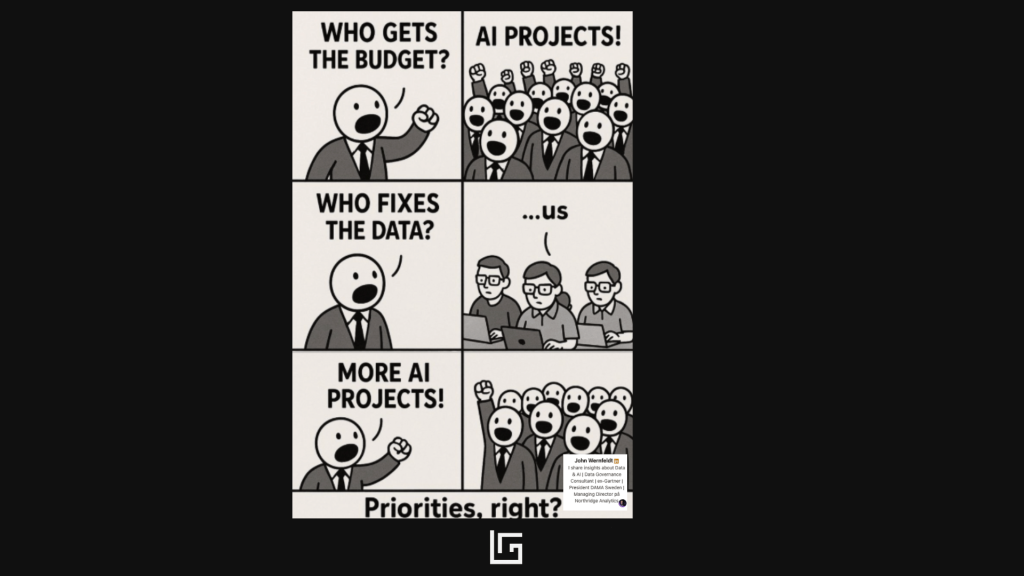
2. Spain’s Housing Bubble and “Bubble AI”
My father was a civil engineer, and he worked in real estate.
In those days, everyone around us seemed to be building something.
Cranes filled the skyline.
Empty fields turned into new neighborhoods.
There was an energy in the air a quiet belief that the good times would last forever.
Then the crash hit.
And it hit hard.
Many of my friends’ parents worked in construction or property too, and almost overnight everything stopped.
Projects were frozen.
Companies collapsed.
People who had spent years building their dreams suddenly lost them.
For us, it was a big hit: not just financially, but emotionally.
It changed how we thought about risk, work, and what “growth” really means.
The housing bubble wasn’t just about real estate.
It was about belief.
Belief in endless expansion, in easy credit, in the idea that prices would never fall.
When they did, people lost more than money.
They lost trust.
In some ways, today’s talk of a “Bubble AI” reminds me of that time.
There’s the same rush of optimism.
The same sense that missing out would be a mistake.
Data centers are rising as fast as buildings once did.
But there’s an important difference.
AI isn’t financed by fragile credit.
It’s mostly powered by cash-rich tech companies like Microsoft, Google, and Amazon.
If some projects fail, they don’t take the entire system down with them.
3. The Fiber-Optic Boom and AI Infrastructure
Another story worth remembering is the fiber-optic boom of the late 1990s.
Back then, companies invested billions to lay fiber around the world.
Most of it went unused for years, known as “dark fiber.”
The infrastructure was real, but demand wasn’t ready.
Now, we are seeing something similar.
Trillions are being spent on GPUs, chips, and data centers.
Companies race to build computing power faster than they can fill it.
It sounds familiar, but there is one big difference.
AI is already being used at scale.
From creative tools to scientific breakthroughs, the appetite for computing power keeps accelerating.
If demand keeps up, we’ll look back and call this an infrastructure boom.
If it doesn’t, we might face a correction before things stabilize.
Is AI a Bubble or Boom? Five Signals to Watch
Azeem Azhar explores the Bubble AI question in his essay The Great Value Inversion.
He describes how we’ve entered an era where financial markets increasingly reward capital, computation, and scale, often at the expense of human labor and long-term balance.
In simple terms, value is shifting from people to machines, from productivity to speculation. And that shift creates distortions that can look a lot like the early stages of a bubble.
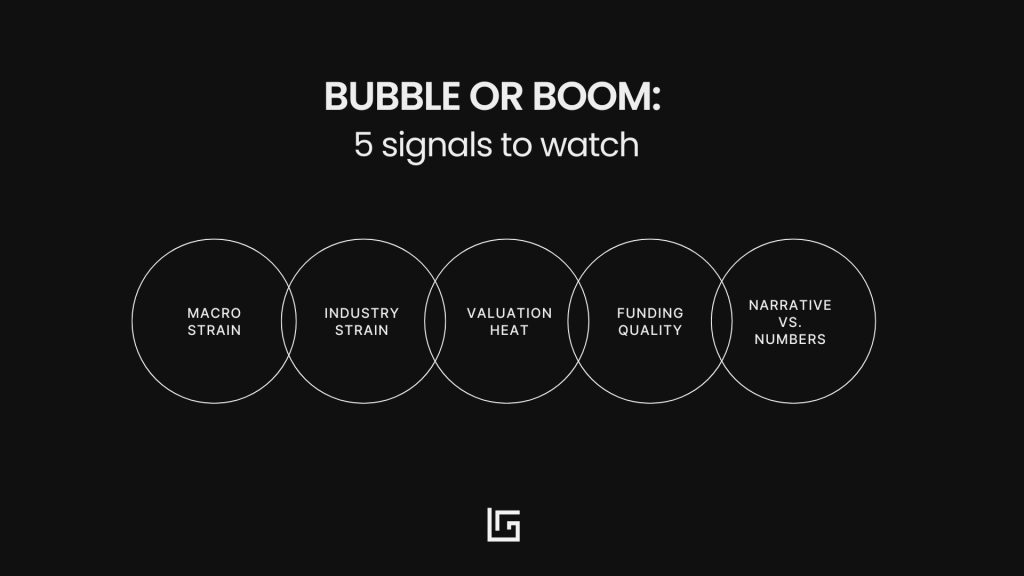
But as Azeem points out, there are patterns worth noticing: small signals that tell us when enthusiasm starts to bend into excess.
Here are five of them:
- Macro strain: When AI investment grows so large that it starts shaping GDP figures and national priorities.
- Industry strain: When capital spending races ahead of measurable productivity or real results.
- Valuation heat: When markets price in “perfection,” leaving no room for normal risk or failure.
- Funding quality: When patient capital gives way to hype money chasing the next big thing.
- Narrative vs. numbers: When stories of transformation sound stronger than the underlying data.
Each of these signals showed up in past bubbles, from the internet to housing.
And they’re starting to flicker again in AI.
If they stay in balance, we’re witnessing a boom, a huge transformation that will change how we work and live.
But if they all turn red at once, then the AI bubble talk won’t just be theory.
It will be history repeating itself.
So… is AI a bubble?
I personally don’t think so.
At least not yet.
We’re living through a massive boom with small bubbles inside it.
Some startups will rise and fall. Some valuations will reset.
But the core technology is too transformative to disappear when the hype fades.
Just like the internet, AI will reshape industries quietly after the noise.
The excitement may be loud now, but the real impact will be louder in time.
So yes, some parts of AI look frothy.
But underneath, something real is growing.
Join the newsletter
Practical insights on AI, leadership and innovation — every week.