
February 23, 2025
Me, Myself, and Isolation

The Unintended Consequences of a Self-Focused World
Last week, I met up with a friend I hadn’t seen in a while
She’s everything we’re told to strive for—young, clever, beautiful, successful.
She’s got an important position at an international company, travels the world, and is super intelligent and funny.
The kind of person you look at and think, She’s made it.
But here’s the thing: she’s deeply unhappy.
A few years ago, she was married.
But she decided to leave.
She wanted independence, freedom, the ability to live life completely on her own terms.
She believed that agency—her ability to make her own decisions—was the key to happiness.
For a while it felt exhilarating. She could travel wherever she wanted, work late without checking in with anyone, and design a life that fit her vision.
But now?
She’s feeling lonely and hunting for connection.
The Loneliness Paradox: Why Having It All Still Feels Empty
This conversation stuck with me because it reflects a broader issue that society faces today.
We have built a world that prioritizes individual success, self-sufficiency, and personal gratification.
We are told to follow our own path, to chase our own goals, and to never compromise.
But in doing so, we often sacrifice something essential: meaningful human connection.
In a world that worships independence, we chase success, carve out our own paths, and optimize our lives for me, me, me.
And yet… we’re lonelier than ever.
Autonomy isn’t Happiness
For most of human history, people lived in close-knit communities.
Your survival depended on strong relationships.
You relied on family, neighbors, and tribes.
You didn’t choose connection—it was built into your life.
Today we’ve completely flipped that dynamic.
Now, autonomy often wins over connection.
We make decisions based on personal desires.
And this shift is especially strong in certain groups:
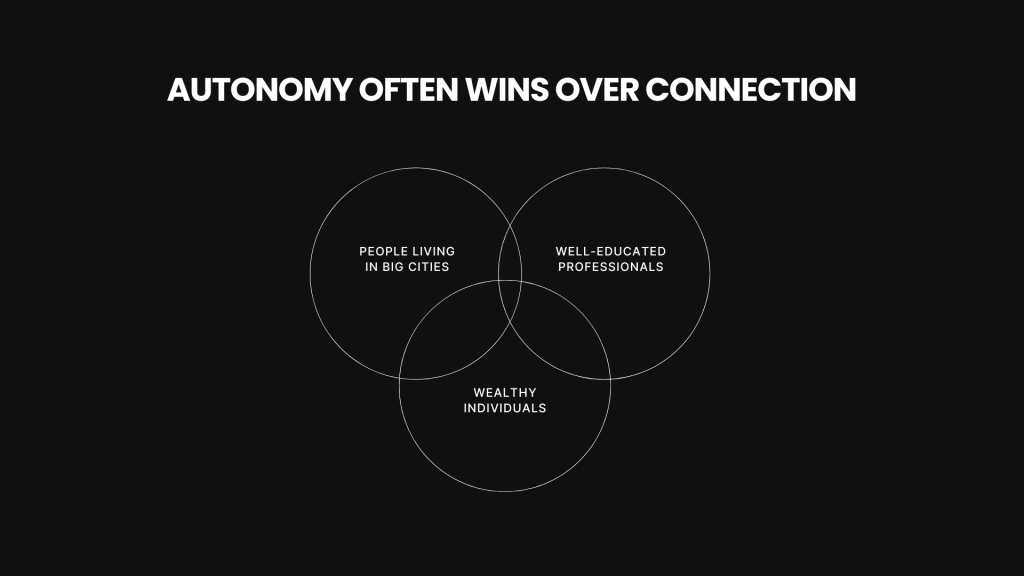
- People living in big cities: city life encourages independence but discourages deep relationships.
- Well-educated professionals: career often comes before connection.
- Wealthy individuals: financial success doesn’t require strong social ties.
Just look at the stats:
- In 1850, only 1% of Americans lived alone. Today? 1 in 7.
- Marriage rates in Europe have dropped significantly over the years. Between 1972 and 2001, the number of marriages per 1,000 people fell by almost 40%.
- In Sweden, one of the world’s most developed countries, many older adults live alone. More than 50% of households are single-person, one of the highest rates in Europe. This is especially common among the elderly, leading to higher loneliness levels.
Despite all this freedom, we’re losing the very thing that actually makes us happy: human connection.
The Digital Connection Trap
Now, you might be thinking…
“Aren’t we more connected than ever? We have tons of social apps—connection is at our fingertips!”
And you’d be right. Technically.
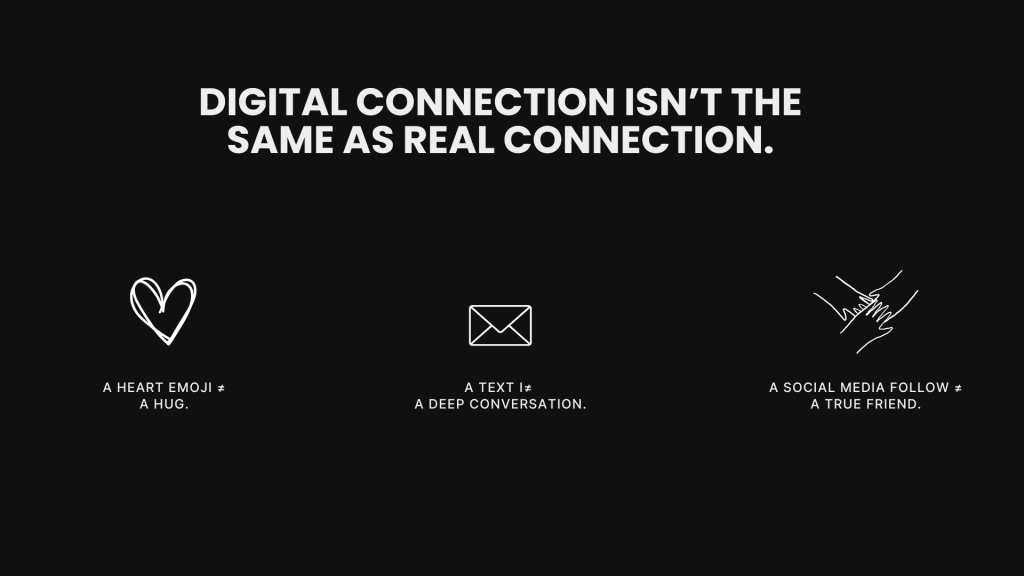
But here’s the problem: Digital connection isn’t the same as real connection.
- A heart emoji isn’t the same as a hug.
- A text isn’t the same as a deep conversation.
- A social media follow doesn’t mean you have a true friend.
In fact, studies show that heavy social media use is linked to higher anxiety and depression.
Why?
Because it gives us the illusion of connection—but without any of the emotional fulfillment. It’s like eating junk food when your body needs real nutrients. Sure, it feels like something… but it’s not satisfying in the way you actually need.
The Fine Line Between Autonomy and Connection
Ever feel like you’re caught between two opposing forces?
On one hand, you want the freedom to do your own thing, make your own choices, and follow your own path.
But on the other, you crave deep relationships, meaningful connection, and the feeling of truly belonging.
There’s a quiet tension in all relationships—the pull toward others and the need to stand on our own. It’s not a problem to solve, but a balance to navigate.
The key is learning to move between the two—sometimes standing on our own, sometimes leaning on others.
Independence helps us make choices, grow, and feel confident. But connection gives us love, support, and a sense of belonging.
Think of life as a road trip: independence is driving the car, choosing where to go.
Connection is the people in the car with you—the ones who share the journey, make it fun, and help when you’re lost.
Sometimes, you’ll need to adapt the route to keep your companion, but it is still worth it.
The Mistaken Pursuit of Autonomy
We live in a world that tells us personal happiness comes first. “Put yourself first.” “Do what makes you happy.” “Don’t compromise.” The message is clear: autonomy is the path to fulfillment.
But is it?
Last month, I met up with long-time friends in a small German city.
We were excited to reconnect, but when it came time to explore, everyone had different ideas. Some wanted to visit historical sites, others preferred a cozy café, and a few just wanted to wander.
Instead of compromising, we split up.
Ironically, we had come together to connect, yet we were spending our time apart.
Luckily, after lunch, we gathered again and realized what was happening.
The experience wasn’t about checking off our personal lists—it was about being together. So, we course-corrected, picked a place we could all enjoy, and the rest of the day felt completely different. More laughter, more spontaneous conversations, more of what we had actually come for.
We believe these choices bring us happiness—after all, we’re getting exactly what we want. But what we often fail to see is the cost: less connection, fewer shared moments, and a gradual erosion of togetherness.
The Key to a Meaningful Life: Less “Me,” More “We”
Closeness isn’t built on getting your own way all the time.
It’s built in the spaces where we adapt, compromise, and make room for one another.
Yet, in our pursuit of happiness, we often do the opposite—we isolate ourselves in the name of personal freedom.
And why wouldn’t we?
We live in the economy of impatience
Everything is instant, personalized, and convenient. No waiting, no negotiating, no need to consider anyone else. At first, it feels like freedom. But over time, something is missing.
Here’s the paradox: the more we prioritize self-interest over shared experiences, the lonelier we become.
Think about what truly makes life meaningful—laughing over a meal, watching a show together, showing up for someone even when it’s not your first choice.
These are the small, everyday moments that build connection.
Maybe the secret to fulfillment isn’t in perfect autonomy.
Maybe it’s in choosing connection, even when it means adjusting our plans.
Because in the end, happiness isn’t just about what we do—it’s about who we share it with.
Join the newsletter
Practical insights on AI, leadership and innovation — every week.