
March 22, 2026
Preparing for AI Adoption Across 3 Levels

Last weeks I’ve been having conversations with friends and peers about how AI is transforming our work.
And what keeps coming up is this:
We are all trying to make sense of it, but the shift is already happening.
So instead of asking if, we need to start asking something else:
How do we actually prepare for it?
And the more I think about it, the clearer it becomes.
We need to look at this across three levels:
- as individuals
- as companies
- as a society
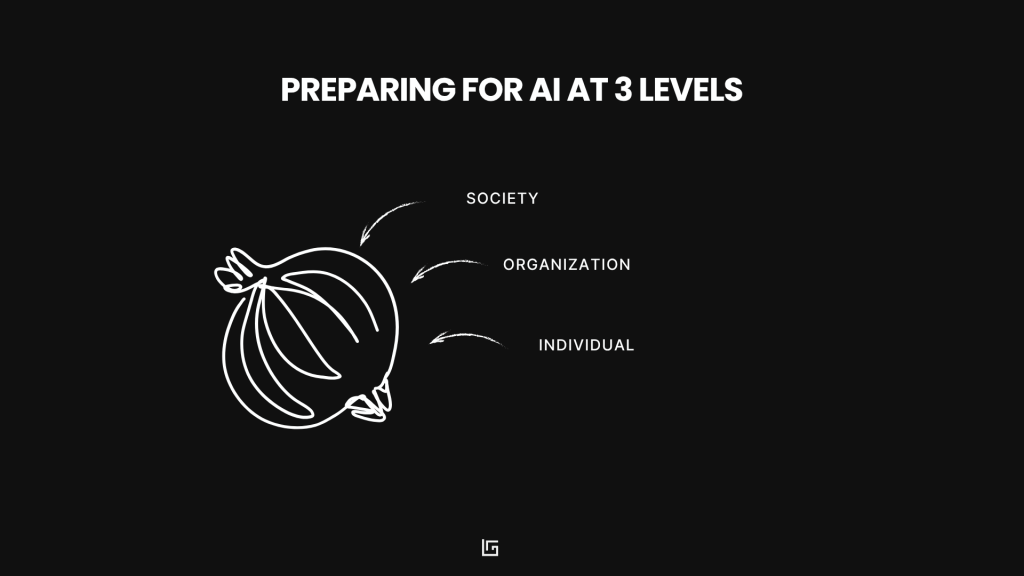
Because focusing on only one of them is not enough.
Preparing for AI Adoption: Why this moment is different
This is not just another technology wave.
AI is changing how value is created.
Tasks are being automated.
Roles are being reshaped.
And the speed is something we haven’t seen before.
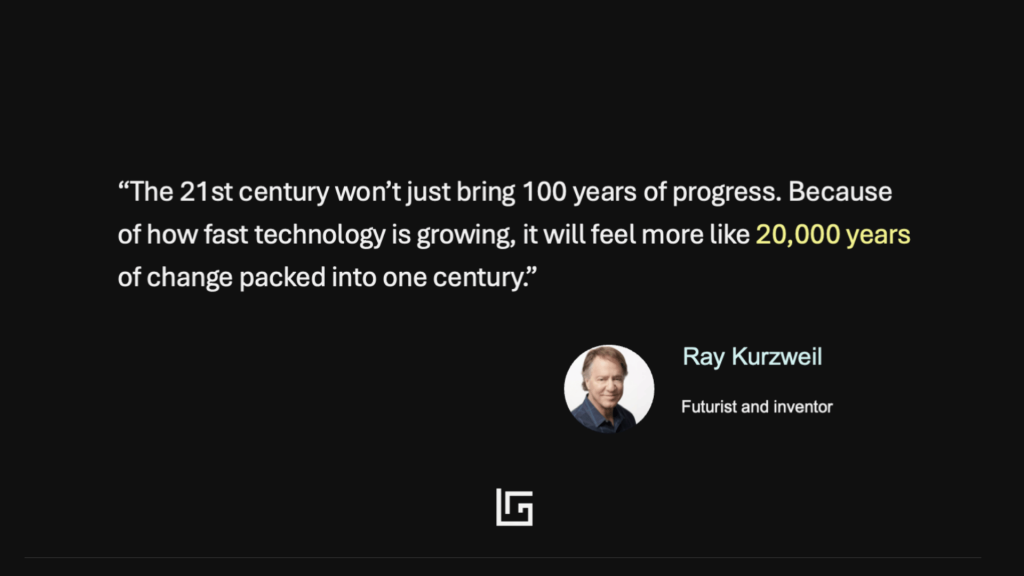
As Ray Kurzweil describes it, “this century won’t just bring 100 years of progress, but thousands packed into one.”
This is not about losing jobs or gaining jobs.
It’s about transition.
And how we navigate that transition will define a lot of what comes next.
Preparing for AI as individuals
Recently, I came across a piece from Andrej Karpathy that made this even more tangible.
He mapped hundreds of jobs based on how exposed they are to AI.
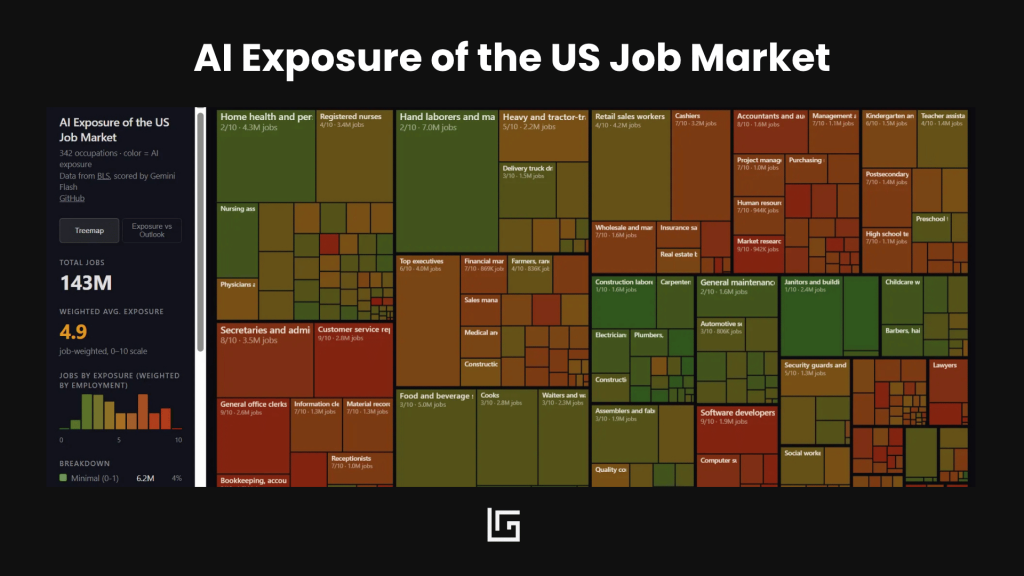
And the pattern is clear.
A lot of knowledge work is highly exposed.
That’s a shift we haven’t really seen before.
In previous waves of automation, machines replaced manual work first.
Now it’s happening the other way around.
And this is where it gets interesting.
It’s not about jobs disappearing.
It’s about jobs changing, fast.
Which makes the question even more relevant:
How do we actually prepare as individuals for this?
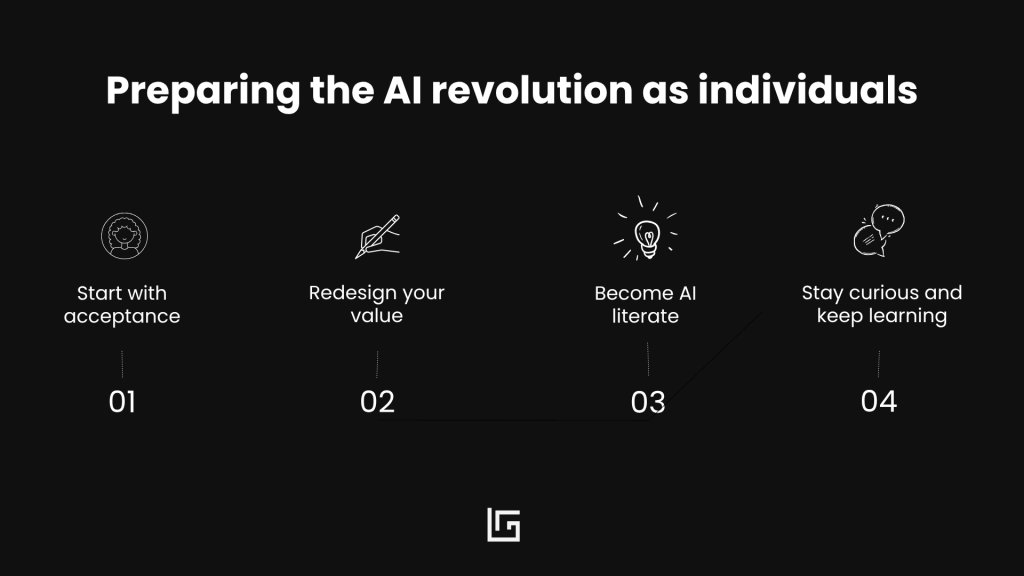
1. Start with acceptance
AI is here and it is going to change how we work.
Trying to resist it slows you down.
Accepting it gives you options.
That shift in mindset is the first step.
2. Redesign your value
Not everything you do today will still be valuable tomorrow.
So it’s worth taking a step back and asking:
- What parts of my work are repetitive?
- What parts require judgment, creativity, or human interaction?
Focus on the second.
Because that is where your value increases.
AI will take over tasks.
But it will amplify people who know how to work with AI and double down on what makes them human.
3. Become AI literate
You don’t need to become an expert.
But you do need to become comfortable.
That means:
- Understanding what AI can and cannot do
- Using it in your daily work
- Questioning the outputs instead of blindly trusting them
AI is becoming a basic skill, like using a computer was years ago.
4. Stay curious and keep learning AI
This is the fastest-changing technology we’ve seen.
New tools are coming out every day.
So this is not a one-time upgrade.
You need to keep updating yourself.
The advantage will go to people who experiment, stay open, and learn fast.
Not the ones who wait until things are clear.
Preparing as companies
The tools are there.
Many companies are already experimenting.
And still, AI adoption is slow.
63% of companies say the main barrier is skills.
And those investing in people are 1.8x more likely to see better results.
This is not a tech problem.
It’s a capability problem.
So what can we do as a company to prepare for AI?
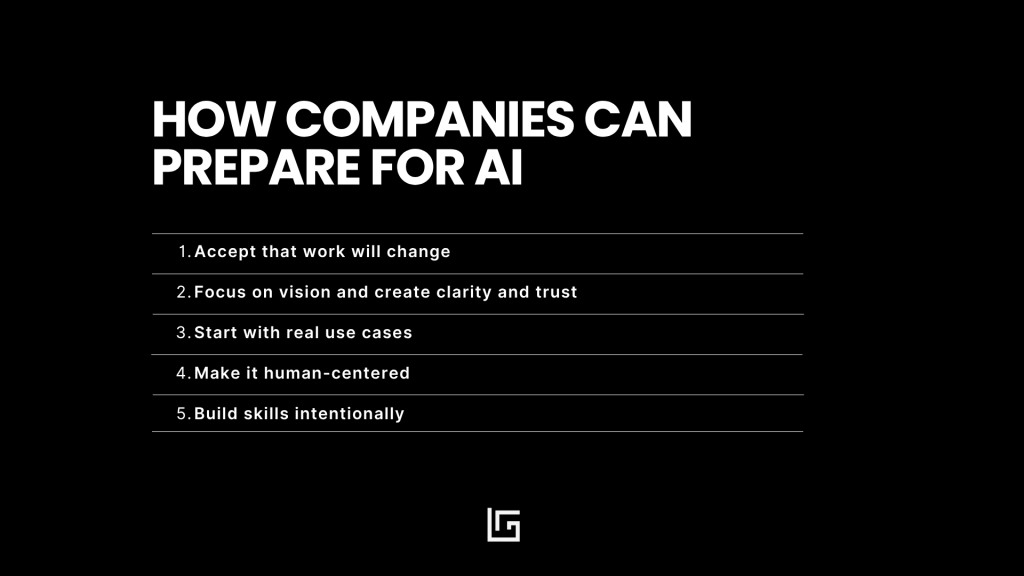
1. Accept that work will change
AI is reshaping how work happens.
Processes, roles, and decisions will evolve.
So it needs to be treated as a core topic and be made a priority.
2. Focus on vision and create clarity and trust
This transition brings a lot of uncertainty.
And in this context, having a clear vision is key.
People need to understand how the company wants to evolve.
And where they fit into that picture.
Otherwise, it’s very hard to get them behind the change.
So your role as a leader is to explain what is happening, why it is happening, and what it means for people.
This is not a one-time effort.
It requires focus and repetition.
3. Start with real use cases
Many companies get stuck trying to define the perfect AI strategy.
In reality, it works better the other way around.
Start with the challenges your company is facing today.
- Where are we losing time?
- Where is quality inconsistent?
- Where are teams overloaded?
Then start small, build momentum, move fast … and learn.
4. Make it human-centered
One of the biggest mistakes I see is treating AI as a purely technical topic.
It’s not.
It’s a people topic.
AI should not feel like something that is happening to people.
It should feel like something that is happening with people.
That means involving teams early, even when things are not fully clear.
Run workshops and test ideas together.
Co-create solutions.
You don’t design the future for people.
You design it with them.
5. Build AI skills intentionally
The biggest barrier is not the technology.
It’s capability.
That means understanding where people are today, creating the right learning paths, and combining training with real use cases so it actually sticks.
Learning alone is not enough.
People need to apply it in their day-to-day work.
Preparing for AI as a society
Society moves slower than companies or individuals.
And that’s the challenge.
The scale is different.
We are talking about millions of people needing to adapt.
In fact, around 60% of the workforce will need reskilling in the coming years.
That doesn’t happen overnight.
Systems, education, policies — they take time to change.
Which means this won’t move on its own.
It requires intention.
Here are some of my thoughts to start moving things at a society level:
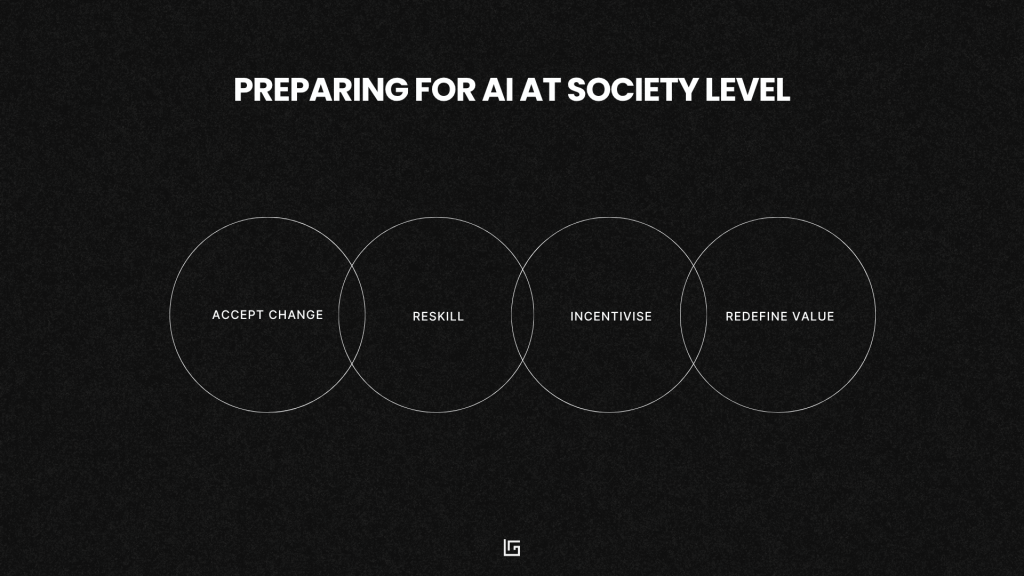
1. Accept the scale of change
Jobs will change.
Some will disappear.
Many will evolve.
This has always happened with technology, but the speed now is different.
Which means the response also needs to be faster.
2. Invest in reskilling at scale
We need systems that support continuous learning.
Not once at the beginning of a career.
But throughout it.
Because a large part of the workforce will need to adapt in the coming years.
And not everyone has the same access to learning today.
3. Create the right incentives
Companies play a key role in this transition.
But reskilling takes time, effort, and investment.
So we need to make it easier for companies to do it.
I believe this can be through:
- Tax incentives
- Public funding
- Partnerships between companies and education systems
If we want real change, we need to support it structurally.
4. Redefine what we value
AI will make us more efficient.
But efficiency should not be the only metric.
We also need to value:
- Human connection
- Creativity
- Contribution to society
Because these are the areas where humans bring something unique.
And where we should continue to invest.
Preparing for AI Adoption: My key takeaway
AI transformation is not about technology.
It’s about how we respond to it.
Individuals who evolve will increase their value.
Companies who include people will move faster.
Societies who invest in learning will stay resilient.
AI will keep moving fast.
But we do control how we show up.
Get the AI side right.
Use it.
Understand it.
Work with it.
And then double down on what makes us human.
Because in the end, that’s what will stand out.
Free tool
Build your AI enablement plan in 3 minutes
Answer 10 questions and get an ACES roadmap — Awareness, Capability, Experimentation, Scale — in six-week sprints.
Open the plan builder →Join the newsletter
Practical insights on AI, leadership and innovation — every week.