
February 9, 2025
Nail Your Next Talk: The simple presentation structure that works every time

My first job as an intern at Start Alliance was a crash course in presentation-making. In just six months, I must have created over 1,000 slides. If you’ve ever pulled an all-nighter tweaking fonts and obsessing over slide transitions, you know the drill.
But here’s the thing: great presentations aren’t about pretty slides. They’re about presentation structure, clarity, and knowing exactly what you want your audience to feel.
That’s the real magic.
Why Presentation Structure Matters
Let’s be real—boring presentations are everywhere.
We’ve all sat through slides that feel like a never-ending data dump, or worse, a robotic speaker reading straight from the screen.
But here’s the good news: creating a presentation that shines isn’t as hard as it seems.
The secret?
Planning.
Before you get lost in slide design and font choices, take a step back.
Get crystal clear on your message—what do you want people to remember? How do you want them to feel? When you start with strategy—mapping out your key points and structuring them in a way that flows—your presentation practically builds itself.
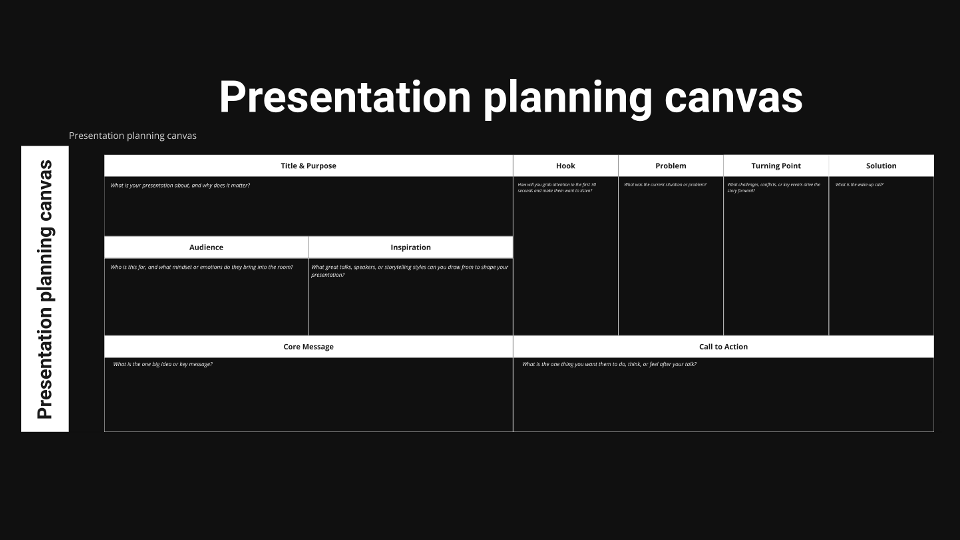
The presentation planning canvas
After years of refining my approach, I’ve realized that a great presentation starts long before you open PowerPoint.
To structure presentations, I’ve put together a Presentation Planning Canvas—a simple framework to clarify your key message, structure your ideas, and set the tone before getting lost in the details.
Whether you’re presenting alone or with a team, taking the time to think things through upfront makes the entire process smoother and ensures your presentation truly connects with your audience.
Step 1: Define Your Presentation’s Title and Purpose
Question: What is your presentation about, and why does it matter?
Before you even open PowerPoint, you need to get crystal clear on the core message of your talk. If someone asked, “What’s this presentation about?” you should be able to answer in one sentence.
To make it more tangible, I will share an example. I’m currently preparing for a keynote presentation at the 3D EXPERIENCE User Conference (March 13-14, 2024, High Tech Campus Eindhoven, Netherlands). The stakes are high, and the audience will be full of industry leaders :)
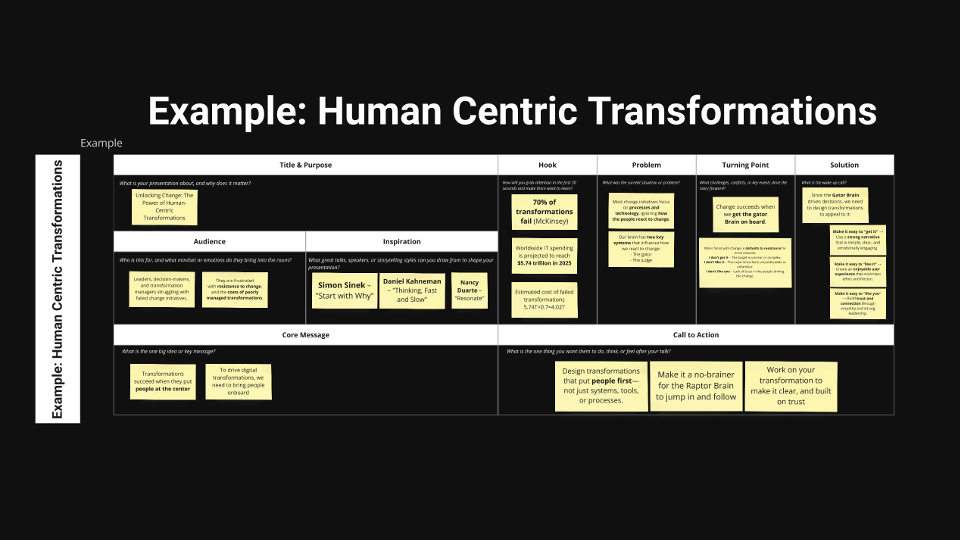
Title: Unlocking Change: The Power of Human-Centric Transformations
Purpose: “To show why 70% of transformations fail and how we can drive successful change by understanding how the brain reacts to change.”
Tip: If you can’t summarize your presentation in one sentence, your message is too scattered.
Step 2: Know Your Audience
Question: Who is this for, and what mindset or emotions do they bring into the room?
A great presentation isn’t about you—it’s about your audience. Who will be in the room? What do they care about? What challenges do they face?
For Unlocking Change, my audience consists of leaders, decision-makers, and transformation managers who struggle with resistance to change. Many of them have experienced failed digital transformations, and they’re frustrated by the cost and complexity.
Tip: Ask yourself: What is my audience worried about? What do they want? Address these directly.
Step 3: Inspiration
Question: What great talks, speakers, or storytelling styles can you draw from to shape your presentation?
Inspiration for Unlocking Change:
- Simon Sinek – Start with Why (clarity in messaging)
- Daniel Kahneman – Thinking, Fast and Slow (understanding cognitive shortcuts)
- Nancy Duarte – Resonate (storytelling for impactful change)
Step 4: Create a Hook
Question: How will you grab attention in the first 30 seconds?
Your opening sets the tone. A strong hook can be a startling statistic, a personal story, or a thought-provoking question.
Unlocking Change – Hook:
- Did you know 70% of transformations fail? That’s billions of dollars wasted every year.
- In 2025, global IT spending is projected to reach $5.74 trillion—but most of it won’t deliver results.
- Why do people resist change? The answer lies in the Gator Brain.
Tip: If you don’t hook your audience in the first 30 seconds, you’ve lost them.
Step 5: Define the Problem & Turning Point
Question: What is the challenge, and what shift in thinking will change how they see it?
People need to see why change is necessary before they care about solutions. This is where you present the core problem—then introduce a new way of thinking.
Example:
- Problem: Most digital transformations focus on technology, but ignore people.
- Turning Point: Change succeeds when we focus on people, and get the gator brain on board—the part of our brain that makes instant decisions and resists change.
Tip: Frame the problem in a way that feels urgent and relatable.
Step 6: Provide a Clear Solution
Question: What practical insight, strategy, or action will help them move forward?
This is where you share your solution, framework, or approach.
Solution Unlocking change: To unlock change, we must design transformations that appeal to the Raptor Brain:
- Make it easy to get it → Use a strong narrative that is simple and engaging.
- Make it easy to like it → Create an enjoyable user experience that minimizes effort.
- Make it easy to like you → Build trust and connection through empathy and leadership.
Tip: Keep your solutions simple, actionable, and memorable.
Step 7: Define the Core Message
Question: What is the one big idea or key message?
Core Message for my presentation: Transformations succeed when they put people at the center. To drive digital transformations, we need to bring people onboard.
Step 6: End with a Strong Call to Action
Question: What is the one thing you want them to do, think, or feel after your talk?
Your final words should inspire action. What’s the next step for your audience?
Call to Action for Unlocking Change :
- “Design transformations that put people first—not just systems, tools, or processes.”
- “Make it a no-brainer for the Gator Brain to jump in and follow.”
- “Work on your transformation to make it clear, enjoyable, and built on trust.”
Tip: People remember the last thing you say—so make it count.
Final Thoughts: Why Starting with Your Presentation Structure Works
By following this framework, you ensure your presentation:
- Has a clear purpose
- Speaks to your audience’s needs
- Hooks attention from the start
- Presents a compelling problem & solution
- Ends with a memorable takeaway
Whether you’re speaking at a high-stakes keynote or an internal team meeting, this method helps you craft a powerful and persuasive presentation.
Ready to create your own impactful presentation?
Use this framework and start planning today!
If you want to take your presentation to the next level—whether it’s a big keynote or a team meeting—I’m here to help. Let’s work together to craft a talk that’s clear, engaging, and impossible to ignore.
Reach out, and let’s make your next presentation your best one yet.
Join the newsletter
Practical insights on AI, leadership and innovation — every week.