
May 24, 2026
The Rise of the Relational Economy

I am back from a week in Jerez at the Share PLM Summit 2026 and I still feel emotionally overwhelmed in the best possible way.
The summit is an event we organize to bring together leaders around technology, AI, enterprise technology and human transformation. After days full of connections, workshops, conversations, flamenco, and very honest discussions about the future, I came home with a full heart and a head full of questions.
One thing became impossible to ignore.
AI was present in every single conversation.
Not only as a tool.
But as something much deeper.
A force that is changing how we work, how we lead, how we create value, and even how we define our own professional identity.
And the more I reflect on it, the more I believe we are entering one of the biggest shifts in the history of knowledge work.
When AI Makes Human Skills More Valuable, Not Less
For years, many of us built our professional value around tasks that are now becoming increasingly automated.
Writing reports.
Creating presentations.
Analyzing information.
Summarizing meetings.
Coding.
Researching.
Documentation.
Planning.
The difficult part is that these things were not only work.
For many people, they became identity.
Being the smart one.
The expert.
The person who knew how to solve the problem.
The person who could produce faster and better than others.
Now AI can do many of those tasks in seconds…
According to Anthropic’s Economic Index, AI could theoretically perform 60–90% of tasks in some knowledge professions today.
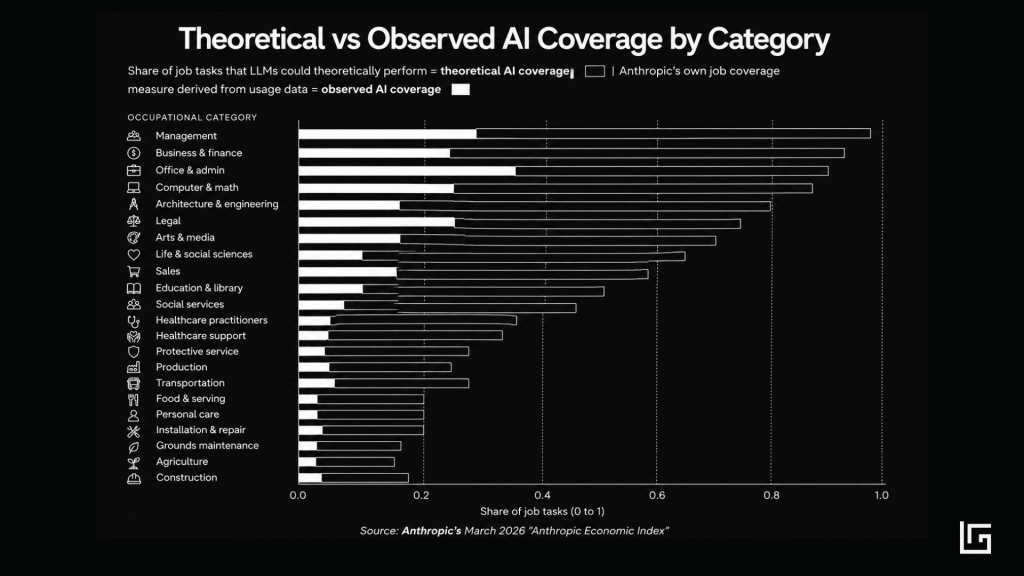
That number is honestly hard to process emotionally.
Because this is not only technological disruption.
It touches identity.
But here is the interesting paradox.
As AI makes many cognitive tasks cheaper and faster, the value of deeply human skills increases: empathy, facilitation, taste, communication, leadership, trust, and community.
The things we used to call “soft skills” are quickly becoming some of the hardest and most strategic skills in business.
From Transactional Businesses to Relational Businesses
For decades, companies competed around productivity and efficiency.
Faster execution.
Lower costs.
More scale.
More output.
This is what I call the Productivity Economy.
But AI is changing the economics of production itself.
When intelligence becomes abundant, the value does not disappear.
It relocates.
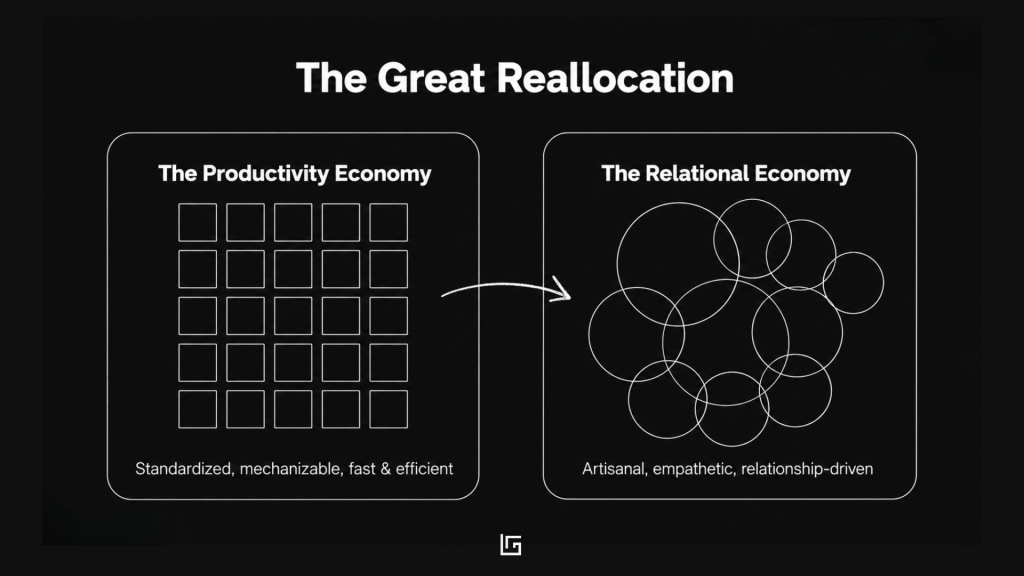
Value is moving toward the things that are harder to automate: human experiences, relationships, trust, and emotional connection.
I think we are slowly moving from transactional businesses toward relational businesses.
The companies that win in the future will not only compete on what they produce.
They will compete on how people experience them.
How customers feel working with them.
How leaders communicate.
How teams collaborate.
How communities form around them.
As technology makes production cheaper, human experience becomes more valuable.
The Rise of the Relational Economy
This is why I believe we are entering what I call The Relational Economy.
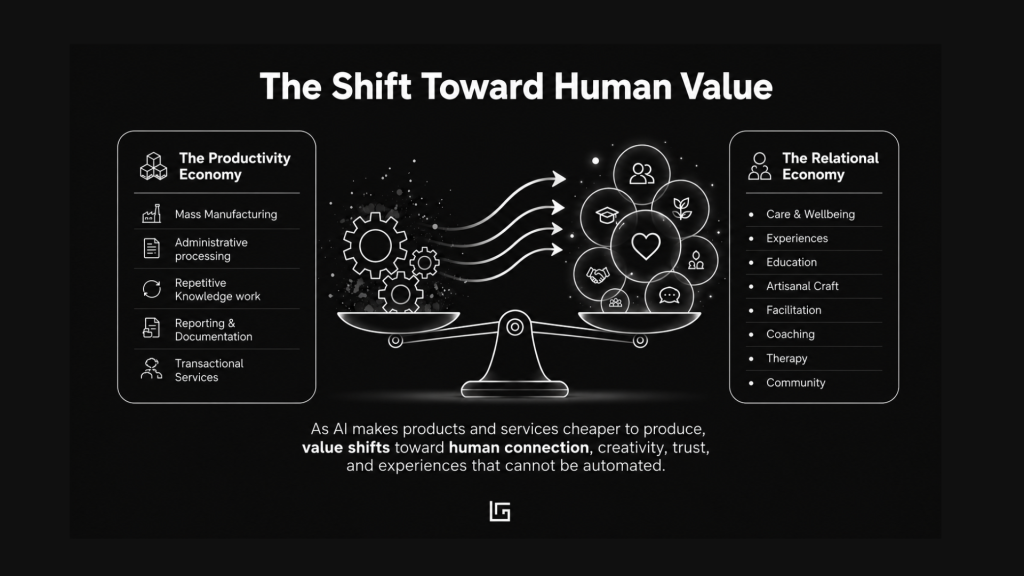
An economy where relationships themselves become part of the product.
Where community becomes strategy, and trust becomes infrastructure.
Where the premium is no longer only the deliverable itself, but the emotional experience surrounding it.
And you can already feel this shift happening.
People are tired.
Tired of noise, of content overload of transactional interactions.
Tired of hyper-optimized digital experiences that feel empty.
At the same time, we crave authenticity more than ever.
Smaller communities feel more meaningful.
In-person conversations feel more valuable.
We crave communal experiences and connection.
Because scarcity creates value.
And ironically, AI abundance may make humanity itself more premium.
The Relational Economy: Why Trust Is Becoming a Business Model
Some of the smartest AI companies in the world already understand this deeply.
Look at OpenAI, Anthropic, or Lovable.
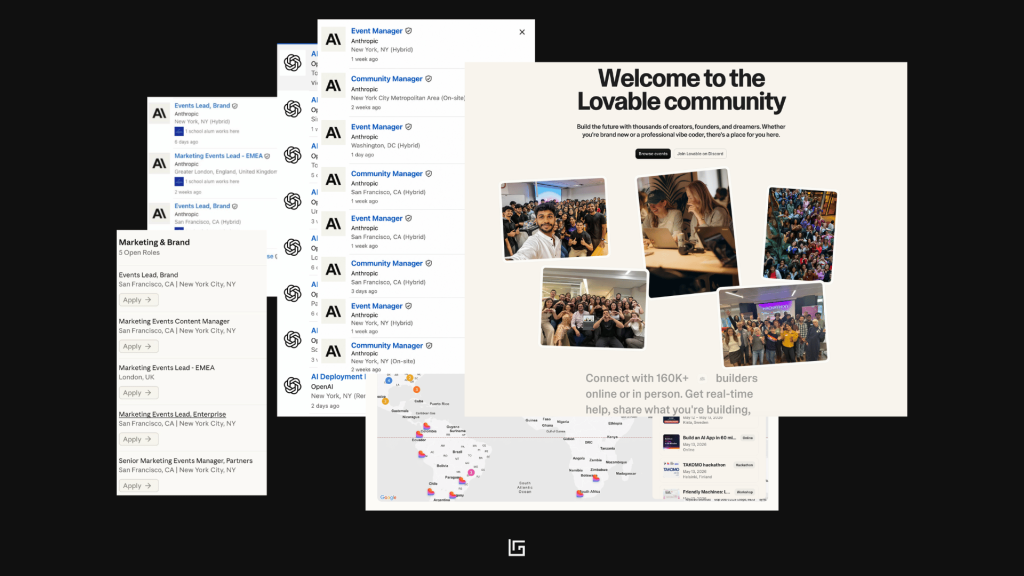
Yes, they are building extraordinary technology.
But they are also investing heavily in community, tribe, belonging, events, creators, and identity.
Because we humans are tribal by nature.
We want to belong to something bigger than ourselves.
And in a world where AI models increasingly start looking similar, trust becomes one of the few real differentiators.
Not only trust in the technology itself.
Trust in the people behind it, in the community around it.
Trust in the experience.
I think this is one of the biggest lessons many companies still underestimate.
The future winners will not only build the smartest systems.
They will build the strongest emotional connections.
The New Premium: Feeling Seen, Heard, and Understood
At the summit, some of the most meaningful moments had nothing to do with presentations or technology.
They happened during coffee breaks.
At dinner tables.
Walking through the streets of Jerez late at night.
Talking honestly about fear, leadership, pressure, uncertainty, and the future.
Because we remember experiences and emotions.
We remember how people made us feel.
And I think many of us today are not searching for more information.
We already have infinite information.
We are searching for something else entirely: to feel seen, heard, and understood.
That may become one of the most valuable experiences businesses can create in the next decade.
The Age of Meaning, Belonging, and Connection
I also think something deeper is happening culturally.
The more digital and automated the world becomes, the more humans crave human experiences.
Community.
Facilitation.
Coaching.
Learning together.
Being physically present with other people.
This is also why I believe leadership is changing.
In the future, leadership will not only be about strategy and execution.
It will increasingly be about emotional clarity.
Helping people navigate uncertainty.
Creating psychological safety.
Building alignment in moments of rapid change.
Technology may be accelerating work.
But humans still need meaning.
The Future of Work Is More Human Than We Think
I believe the companies that win in the future will not simply be the ones with the best technology.
Because technology will increasingly become accessible to everyone.
The real differentiator will be how people experience working with your company.
How customers feel working with you.
How your teams collaborate.
How leaders communicate.
The leaders who truly understand where the world is heading will invest heavily in this.
Not only in AI infrastructure and productivity, but in experiences, culture, humanity, and connection.
Because at the end of the day, businesses win through people.
And maybe that is the real paradox of this AI revolution: the more technology advances, the more valuable being human becomes.
Keep reading: The Meaning Economy: Why Attention Is No Longer Enough · What Makes a Team Work?
Join the newsletter
Practical insights on AI, leadership and innovation — every week.