
April 6, 2025
Supervised Learning: Teaching Machines to Think Like Us
Do you remember learning about animals as a kid?
Your teacher would show you a picture of a dog and say, “This is a dog!” Then a cow, “This is a cow!”
Over time, you just knew.
You didn’t need the teacher anymore to identify a dog from a cow.
That’s supervised learning for humans. We learn by being shown examples repeatedly until we recognize patterns on our own.
Now, imagine doing the same thing with machines.We teach them to recognize things by giving them labeled examples.
Lots of examples.
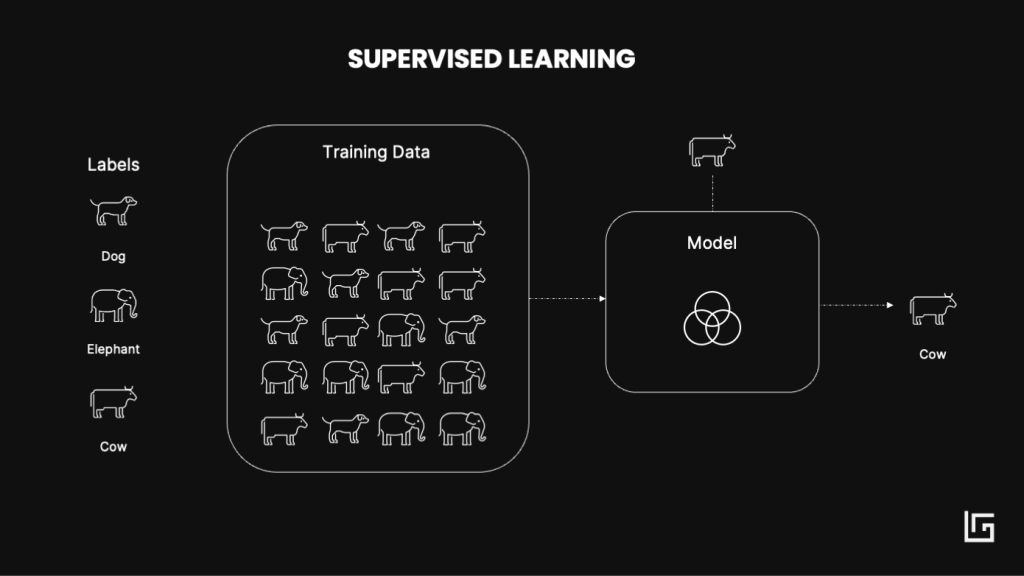
It’s like showing a computer a thousand pictures of dogs, cows, and elephants until it “gets it.
What Is Supervised Learning?
Supervised learning is one of the most fundamental methods in machine learning. You feed the machine labeled data, meaning examples where we already know the correct answers.
It learns from these examples, developing an understanding of patterns and associations.
Think of it as teaching a child to recognise different types of animals by showing them picture cards, each clearly labeled.
Over time, they internalize the features that make a dog a dog, a cow a cow, and an elephant an elephant.
Why Is Supervised Learning Important?
Supervised learning is the engine behind many of the smart tools we use daily. From spam filters that separate junk from real emails to recommendation systems that know what show you’ll want to watch next. The power of supervised learning lies in its ability to make accurate predictions after being trained on high-quality, labeled data.
How Does Supervised Learning Work?
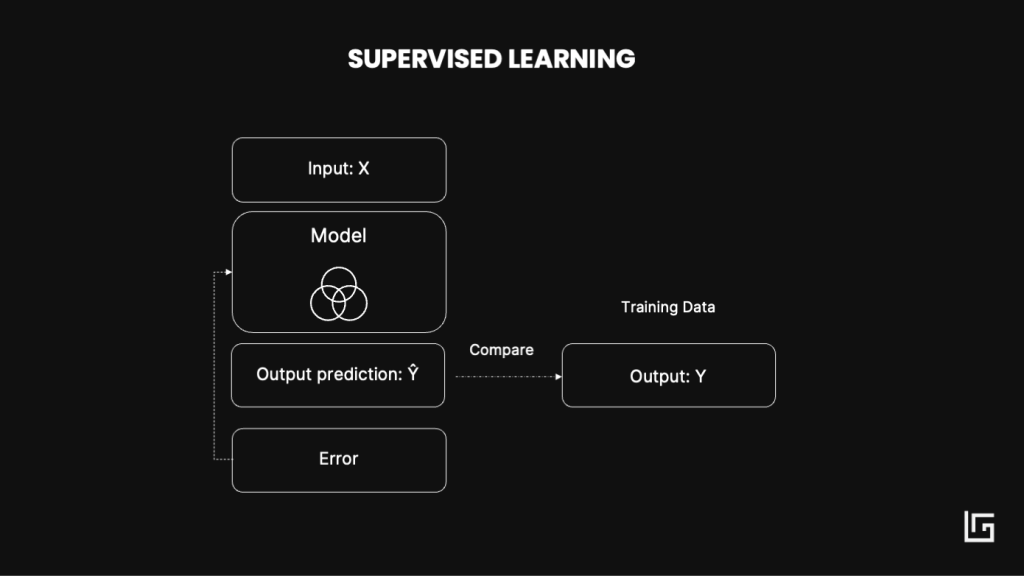
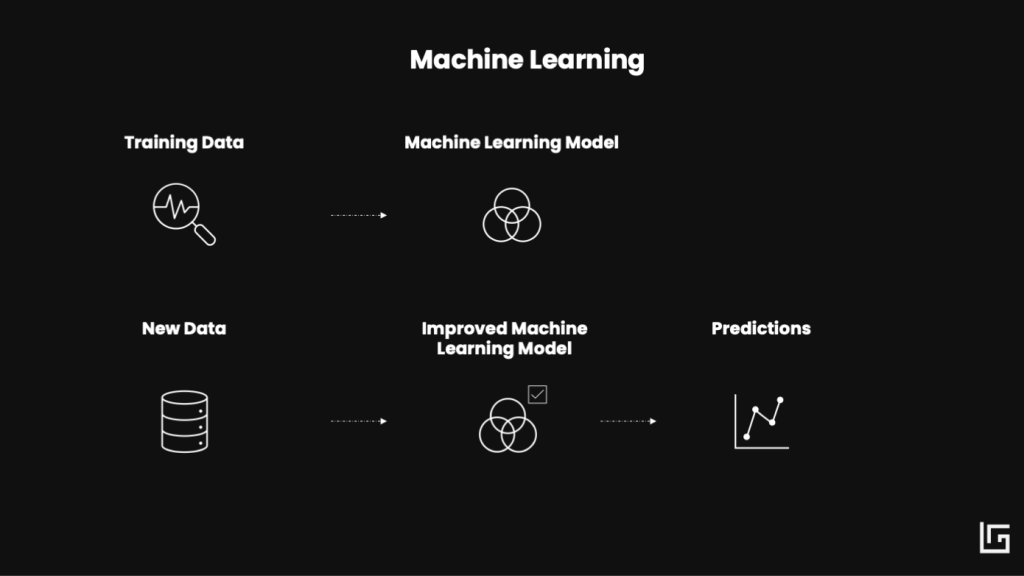
It’s an iterative process: train, predict, compare, adjust.
1. Training Phase:
First we feed the model labeled data, like showing a kid flashcards of animals.
At first, the machine doesn’t really understand what it’s seeing. It processes each image, noticing the characteristics: the size, shape, texture, and other visual cues. It’s like showing a child flashcards over and over. The machine slowly starts associating the features of each image with the correct label.
2. Prediction and comparison:
Once the model has practiced with enough images, it’s time to test it. You show it a new image of a cow. The model takes what it learned and tries to make a guess. “Cow!” it declares. Sometimes it’s right. Sometimes it’s wrong.
In essence, the model makes a guess when given new data and we check the guess against the correct answer.
3. Adjustment:
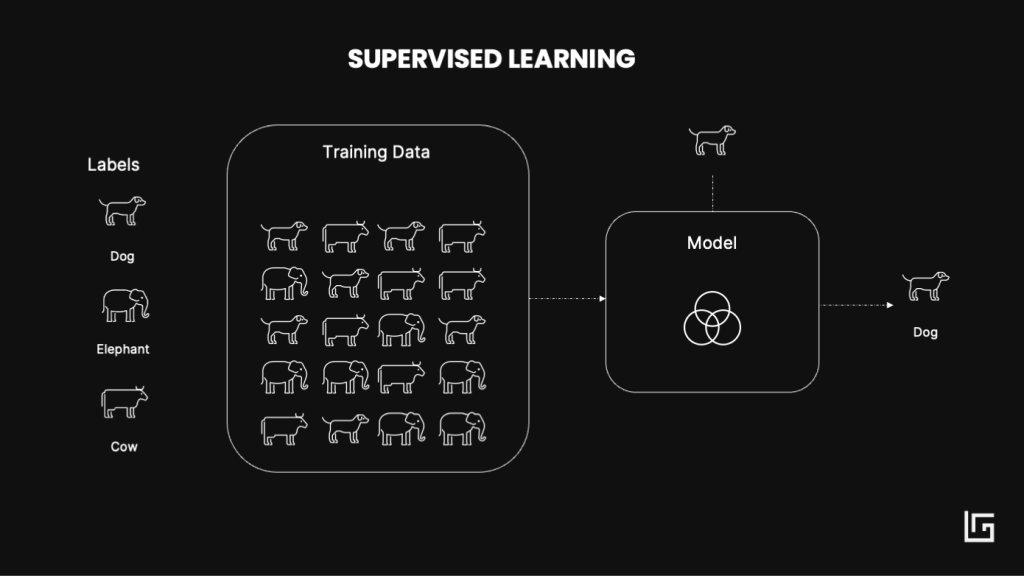
If the model correctly identifies the cow, great! It’s on the right track. But if it mistakes the cow for a dog, it needs feedback. Just as you’d gently correct a child, you show the model the correct answer and let it adjust its understanding.
So in this phase, we correct the model if it’s wrong and fine-tune it.
This loop repeats until the model gets really good at making predictions.
Why Supervised Learning Works
The more labeled data we have, the better the model becomes at making accurate predictions.
Diversity in the data also helps the model generalize, so it can recognize a new breed of dog it has never seen before.
Different Types of Supervised Learning Algorithms
Supervised learning encompasses a variety of algorithms, each tailored to specific tasks. Below are some of the most prevalent supervised learning algorithms, along with resources to deepen your understanding:
1. Linear Regression:
Linear regression is employed for predicting a continuous output based on input features. It models the relationship between a dependent variable and one or more independent variables by fitting a linear equation to observed data.
-> Continue learning: Linear Regression in Machine Learning | GeeksforGeeks
2. Decision Trees:
Decision trees are versatile algorithms used for both classification and regression tasks. They function by splitting the data into branches based on feature values, forming a tree-like structure where each internal node represents a decision rule, and each leaf node represents an outcome.
-> Learning Resource: 1.10. Decision Trees — scikit-learn 1.6.1 documentation
3. Support Vector Machines (SVM):
SVMs are powerful algorithms primarily used for classification tasks. They work by finding the hyperplane that best separates data points of different classes in a high-dimensional space, aiming to maximize the margin between different classes.
-> Explore SVMs: Support Vector Machines for Machine Learning | Machine Learning Mastery
4. K-Nearest Neighbors (KNN):
KNN is a simple, non-parametric algorithm used for classification and regression. It classifies a data point based on the majority class among its ‘k’ nearest neighbors in the feature space.
-> Learn more : K-Nearest Neighbors (KNN) Classification with scikit-learn | DataCamp
5. Neural Networks:
Inspired by the human brain, neural networks consist of layers of interconnected nodes (neurons) that process data. They are particularly powerful for capturing complex patterns in data and are widely used in deep learning applications.
- Continue Learning: Deep Learning Specialization | DeepLearning.AI
Real-World Examples of Supervised Learning
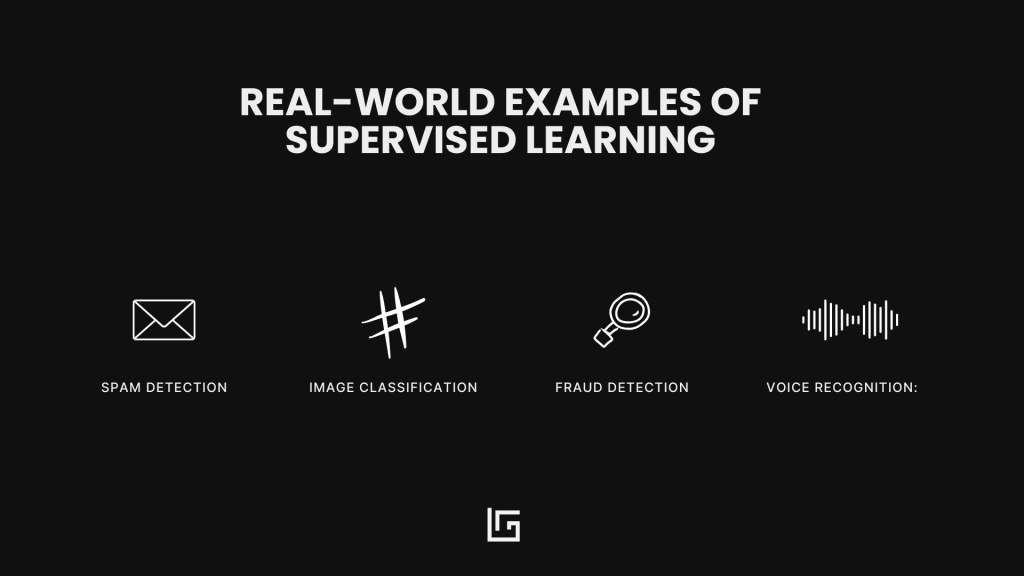
- Spam Detection: Automatically identifying junk emails.
- Image Classification: Recognizing cats, dogs, and even identifying faces.
- Fraud Detection: Spotting unusual patterns in financial transactions.
- Voice Recognition: Converting speech to text accurately.
Challenges and Limitations of Supervised Learning
While supervised learning is powerful, it’s not without its challenges. Understanding the limitations helps in building more robust models and managing expectations.
1. Data Quality and Quantity:
Supervised learning models are only as good as the data they’re trained on. If your dataset is small, noisy, or poorly labeled, the model’s performance will suffer. Imagine training a dog recognition model using only images of golden retrievers. When shown a dachshund, the model might fail because it didn’t see enough variety.
Solution: Collect large, diverse datasets and carefully label them to ensure accuracy. Data augmentation techniques, such as rotating images or adding noise, can also increase variety without requiring more data.
2. Overfitting:
Overfitting occurs when the model learns the training data too well, memorizing instead of generalizing. This can lead to poor performance on new data. It’s like a student who memorizes the answers to practice tests but struggles with similar questions on the actual exam.
Solution: Techniques like cross-validation and regularization help reduce overfitting by ensuring the model does not become overly complex. Pruning decision trees or using dropout in neural networks can also help.
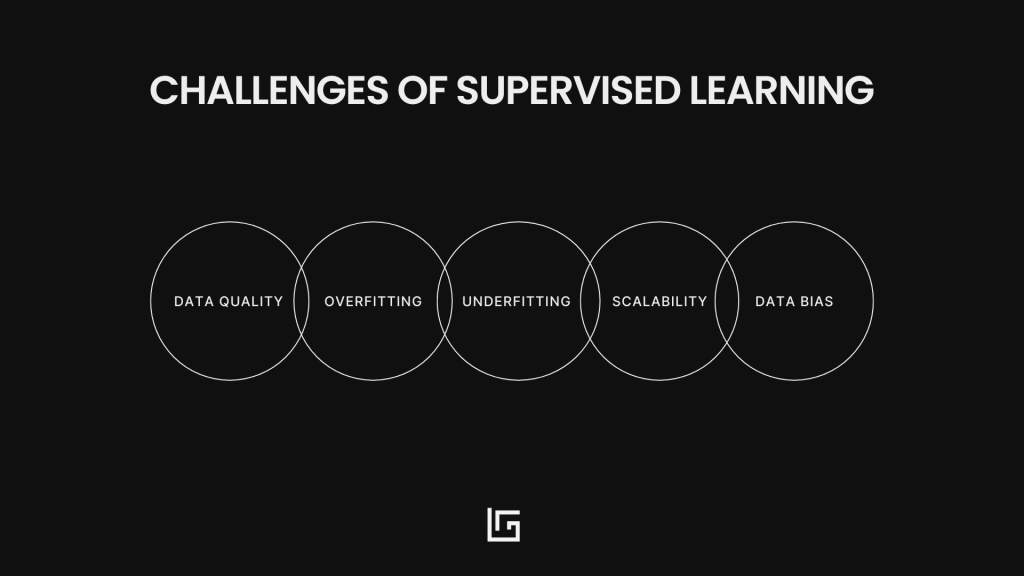
3. Underfitting:
The opposite of overfitting, underfitting happens when the model is too simple to capture the underlying patterns. This is common when the model or algorithm used is not sophisticated enough for the data complexity.
Solution: Increase the model complexity, use more advanced algorithms, or provide additional features to help the model capture relevant patterns.
4. Scalability:
Supervised learning can struggle with extremely large datasets, especially with algorithms like KNN, which require calculating distances for every new prediction. Training neural networks can also be computationally intensive.
Solution: Use dimensionality reduction techniques like PCA (Principal Component Analysis) or optimize algorithms to handle large data volumes efficiently. Leveraging cloud-based platforms for model training can also help.
5. Data Bias:
If the training data contains biases, the model will likely inherit them. For example, a hiring algorithm trained on data that favors a particular demographic will continue to produce biased hiring recommendations.
Solution: Carefully examine and preprocess data to remove biases. Implementing fairness metrics during model evaluation can also help detect potential bias.
Supervised Learning: Machines Learning Like We Do
Supervised learning is a way to teach machines by example, much like how we learn as children.
The more practice they get, the better they become.
Next time you unlock your phone with facial recognition or receive a recommended video, you’ll know that it’s supervised learning in action.
Learning from Mistakes: A Human Approach to Machine Intelligence
Supervised learning is a reflection of our human way of gaining knowledge. We learn through feedback, through the willingness to make mistakes and learn from them. When we see a model improve, it’s not so different from seeing a child light up with recognition after getting a tricky word right.
Got thoughts on this? I’d love to hear from you.
Share your ideas in the comments below!
Join the newsletter
Practical insights on AI, leadership and innovation — every week.