
June 24, 2025
What Makes a Team Work?
Reflections on Teams that Work, TEAL, Energy, and the Human Side of Organisations
Last week, I had a long, reflective conversation with my business partner, Bea.
She’s leading a TEAL transformation at Share PLM, our consulting company, and while the work is focused on the present, our conversation took us back in time.
A few years ago, we’d come out of a challenging period.
On the surface, everything looked fine.
Projects were delivered.
Clients were happy.
The engine kept running.
But underneath, something didn’t feel right.
People were leaving.
Good people.
People we cared about.
And they were leaving quietly.
Not with drama or dissatisfaction, but with detachment.
And we couldn’t ignore it.
Looking back now, I can see that the structure we were working in: one that looked fine from the outside, but wasn’t designed to hold people emotionally.
It was traditional: roles, reporting lines, layers of control. It worked for managing tasks.
But not for belonging.
That moment forced us to stop and ask deeper questions.
Not about revenue.
About relationships.
What Is a TEAL organization?
That’s when we first came across the idea of self managing and TEAL organisations.
If you haven’t heard of TEAL before, here’s a quick explanation.
It’s a way of structuring companies based on three principles:
- Self-management (no rigid hierarchy, people make decisions close to where the work happens)
- Wholeness (people bring their full selves to work, not just a polished professional version)
- Evolutionary purpose (the company adapts and grows based on what it learns, not just a fixed strategy)
In other words, TEAL is about creating organisations that feel alive.
I remember having lunch at a business conference, sitting across from Xavi, one of the founders of Full Circle, a consulting company that helps businesses transition toward self-managing and human-centered models.
We were drinking wine, and talking about work, honestly, not in that surface-level networking way, but really talking. I shared some of what we’d been going through. And then he started describing what he sees in companies who come to them for help.
It was uncanny.
The things he named: disconnection, hidden exhaustion, structure that no longer fits the way people actually work.
They mirrored what we were experiencing.
It felt like someone had taken our mess and translated it into a story.
That moment stayed with me.
TEAL organization model
Later, when we read Reinventing Organizations by Frederic Laloux, everything clicked into place.
The concept of TEAL hit home.
It described what we were missing.
Especially in consulting, where our team members are often “loaned out” to clients, a sense of core identity is essential.
If there’s no emotional connection to the home company, detachment is inevitable.
We didn’t want to control people.
But we did want them to feel held.
That’s the line we’ve been walking ever since.
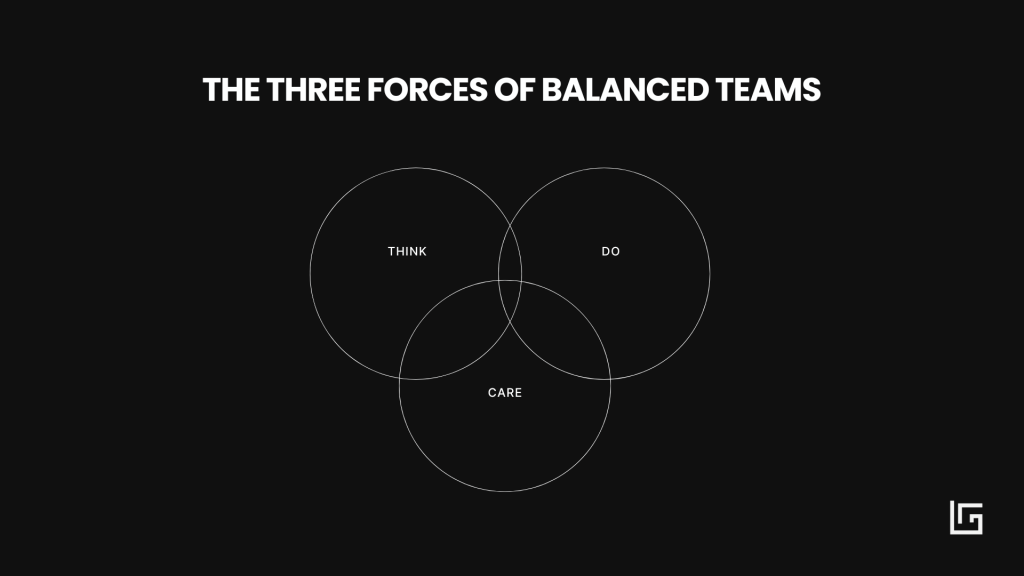
Teams that work need to Think, Do and Care
Every effective team needs a balance of these three forces:
- Think – Strategic thinking, planning, seeing the bigger picture
- Do – Execution, delivery, getting things done
- Care – Emotional awareness, presence, caring about the team
Back when we were struggling, we were over-indexed on Do. We were busy. Efficient. Reliable.
Think was there too, but mostly in the leadership layer.
What we were missing was Care.
No one was really holding the emotional space.
People’s needs weren’t ignored, but they weren’t designed into the system either.
Care happened informally, if at all.
And that’s the problem.
When you don’t design for Care, it becomes optional.
And often, it disappears under the pressure of deadlines.
Without Care, people feel detached.
Without Think, people feel directionless.
Without Do, nothing moves forward.
So we started asking:
Who’s doing the thinking?
Who’s doing the doing?
And who’s making sure everyone is okay?
When these three are balanced, teams don’t just function. Teams that work feel good to be in.
The Energies Behind Global Teams that Work
As we kept reflecting, on what makes a team work, we noticed another pattern.
It’s the dynamic between feminine and masculine energy.
Not in the gendered sense.
But in the archetypal, psychological sense.
- The feminine is receptive, intuitive, nurturing, relational.
- The masculine is structured, directional, forward-focused, protective.
When we mapped this onto Think–Do–Care, a new insight emerged.
- Care is often a feminine energy: soft, connective, attuned.
- Think often leans masculine: visionary, analytical, strategic.
- Do can be either, depending on how it’s driven.
Most companies, especially traditional ones are flooded with masculine energy. Planning.
Performance.
Protection through control.
There’s less space for feminine energy.
Less listening.
Less presence.
And yet, it’s the feminine energy that creates safety.
That makes a team feel like a team.
We also saw this pattern in ourselves.
I’ve spent most of my career leading with masculine energy: strategy, action, structure.
I love to think.
I find comfort in clarity.
But over time, I realised I needed to soften.
To listen more.
To feel the team, not just steer it.
Our third business partner at Share PLM,Cristina, who we’ve incorporated in the project later on, has a natural talent for the Care space.
She senses mood shifts, holds people through change, and remembers the small things.
Bea and I are both learning to lead from wholeness.
To integrate both energies.
Because we all carry both.
And the more we learn to balance them within ourselves, the more balanced our teams become.
Teams that work: What Makes a Team Feel Alive?
Looking back, I don’t regret that tough season.
It woke us up.
It taught us that a team is not just a group of people doing things. It’s a web of relationships, of energy, of meaning.
That culture isn’t what you say, it’s what you feel.
And that belonging doesn’t happen by accident.
It’s created.
Intentionally.
Repeatedly.
That’s why we’re doing the work now.
Building a TEAL organization.
Designing for Care.
Because when teams are in balance, people don’t just stay.
They grow.
They show up whole.
They contribute with their mind, their hands, and their heart.
And Now, A Question
If you’ve made it this far, thank you.
I’d love to hear from you.
When you think of the best team you’ve ever been part of, what made it work?
Was it the work itself?
Or the way people showed up for each other?
I’m genuinely curious.
Let’s keep the conversation going.
Join the newsletter
Practical insights on AI, leadership and innovation — every week.