
January 11, 2026
Technostress in the Age of AI

Have you heard about technostress?
Scroll through social media today and one feeling dominates: exhaustion.
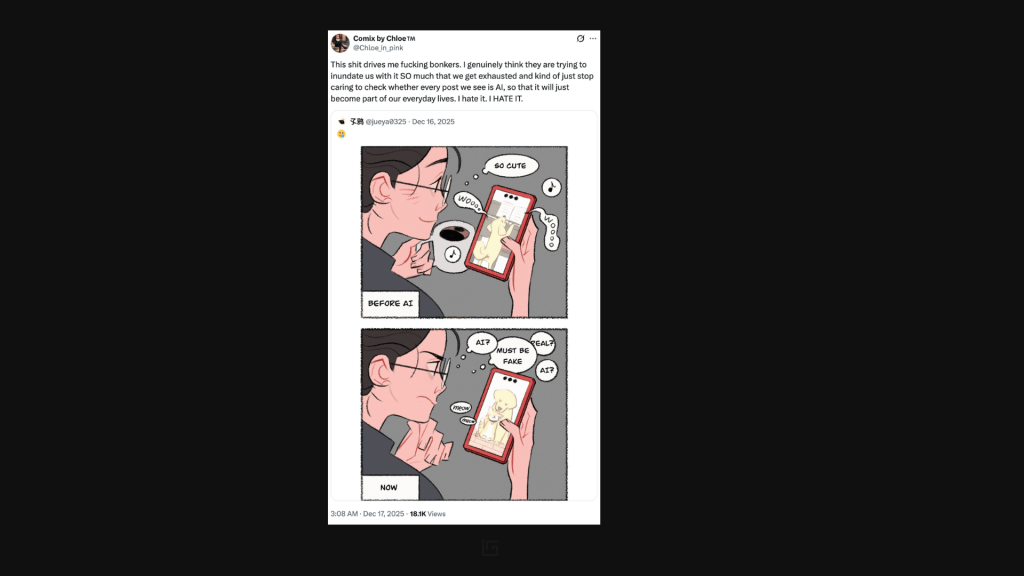
Posts go viral where people openly admit they no longer enjoy content because they are constantly asking themselves whether what they see is real or AI‑generated.
This tweet on X from Paito captures the feeling.
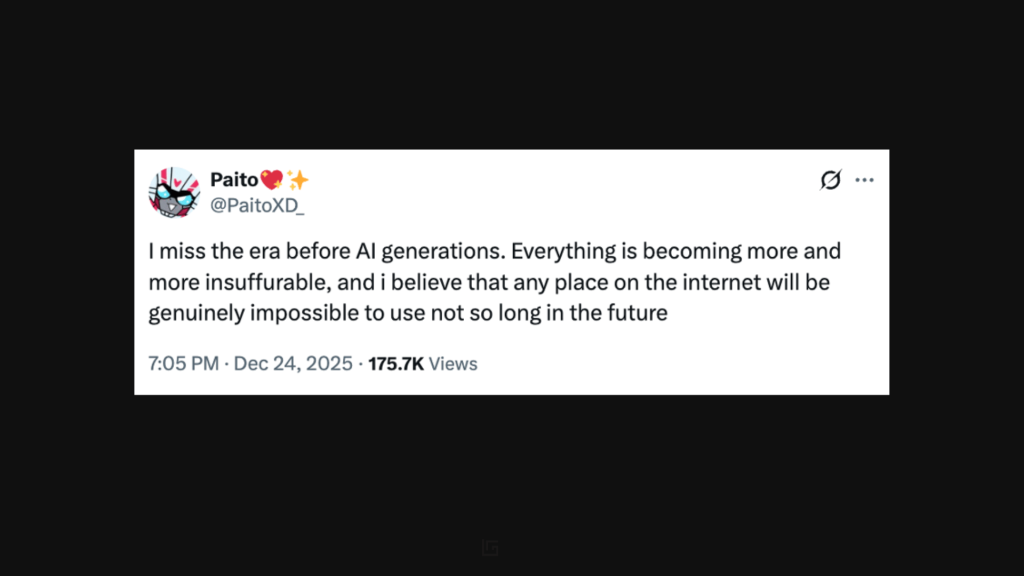
What once sparked curiosity now triggers suspicion, doubt, and mental overload. Many describe the same reaction: at some point, you simply stop checking. Not because you trust it, but because you are too tired to care.
This sentiment is not limited to social media. It mirrors what I observe in organizations that are actively introducing AI
As part of my research on AI adoption, I explore AI adoption with leaders, engineers, and change managers.
Again and again, I hear the same story.
The tools are powerful.
The potential is obvious.
And yet, people feel overwhelmed, uneasy, and mentally drained.
Technostress: The Dark Side of Technology
This experience has a name.
Technostress.
Technostress describes the stress people experience due to the use of information and communication technologies. The concept was systematically defined by Ragu-Nathan and colleagues in their research on the “dark side” of technology in the workplace.
They identified several technology-related stressors, called technostress creators, that trigger negative psychological reactions.
The most relevant creators are:
- Techno-overload
Technology forces people to work faster and handle more information than before. - Techno-invasion
Technology blurs boundaries between work and private life through constant connectivity. - Techno-complexity
Users feel pressured to continuously learn new systems to remain competent. - Techno-uncertainty
Ongoing technological change creates instability and a sense of never being “done.” - Techno-insecurity
Fear that technology will replace one’s job or reduce one’s value.
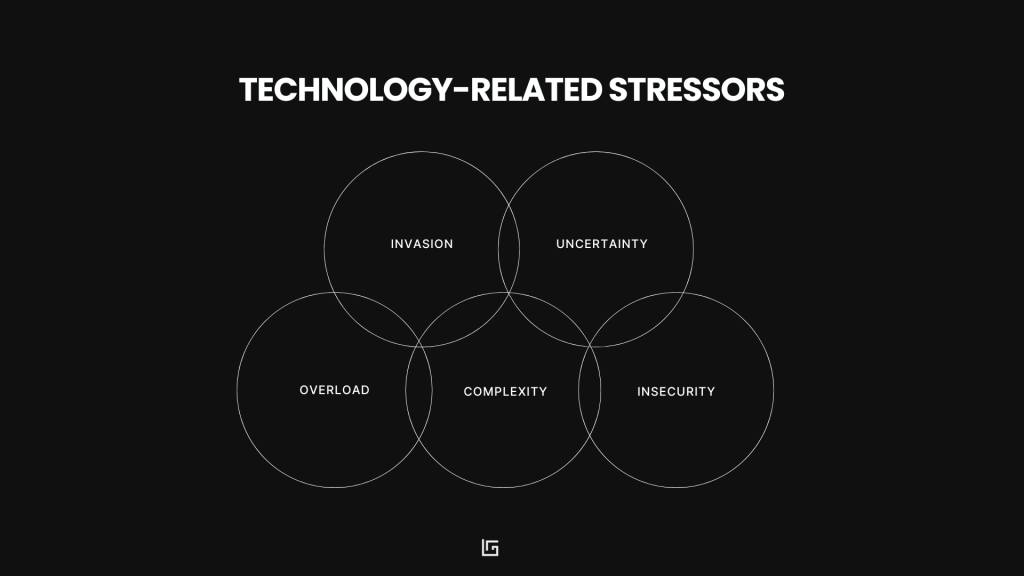
These stressors lead to technostrain manifests as anxiety, fatigue, inefficacy, and emotional exhaustion.
Empirical studies consistently link technostrain to lower job satisfaction, reduced performance, and higher burnout and turnover intentions.
Technostress meaning: What changes with AI
What is particularly interesting for me is that AI alters which stressors dominate.
Until now techno-complexity was one of the biggest issues in large enterprises.
I’ve worked for many years with big enterprises, helping people adopt technology.
Systems were hard to use.
Interfaces were unintuitive.
AI changes that dramatically.
Modern AI tools are conversational, intuitive, and easy to access.
From a pure usability perspective, complexity has decreased.
Even children can interact with these systems.
And yet, stress is increasing.
Why AI Feels Different
With AI the dominant stressors have shifted from usage to meaning and future impact.
With AI, the primary driver of stress is no longer “Can I use this?”
It is “What does this mean for me?”
This maps directly to techno-uncertainty and techno-insecurity, which are now amplified:
- Uncertainty about how fast roles will change
- Fear of becoming obsolete
- Anxiety about performance expectations rising without clear boundaries
Even people who actively work with AI report feeling uneasy.
They understand the technology, but they do not understand the long-term rules of the game.
This is why AI fatigue is spreading.
It is not caused by bad UX.
It is caused by existential ambiguity.
AI Fatigue Is Not About UX
This is why we see what many now call AI fatigue.
AI fatigue is not about bad user experience.
It is about constant anticipation.
Constant adaptation.
Constant pressure to stay relevant.
The result is the same: mental overload.
When people are forced to continuously evaluate, verify, and adapt without structure, mental energy is consumed by vigilance rather than meaningful work.
People are not resisting AI.
They are protecting their limited cognitive and emotional resources.
Why This Matters for AI Adoption
From an adoption perspective, technostress is not a soft issue. It is a core risk factor.
When stress levels rise:
- People avoid tools
- Usage becomes shallow
- Trust erodes
- ROI declines
Many organizations interpret this as a technology problem. In reality, it is an adoption design problem.
The technology works.
The human system is overloaded.
Leading Without Burning People Out
If we take technostress seriously, the implications for leadership are actually very clear.
There are no silver bullets here.
What helps is often surprisingly basic and even a bit boring:
· Address fear openly, not defensively
· Create narratives that explain why AI is introduced
· Design learning experiences that reduce extraneous cognitive load
· Set explicit boundaries around availability and performance
Most importantly, people need to feel that AI adoption is intentional, paced, and human-centered.
AI Technostress: A Final Thought
AI is accelerating productivity faster than any technology before.
But the stress is accelerating too.
Technostress is not resistance.
It is feedback.
And learning to listen to that feedback may be one of the most important leadership skills in the age of AI.
Related reading: AI Workslop: What happens when creation is easy and thinking is optional · The Rise of the Relational Economy · What Jobs Are Safe from AI in 2026? A Realistic List
Join the newsletter
Practical insights on AI, leadership and innovation — every week.