
November 17, 2025
The 9 Most Common Signs of AI Writing
Many people are feeling overwhelmed by the growing signs of AI writing.
Last week I wrote about AI fatigue.
This week I felt it in real time.
I opened LinkedIn.
Scrolled.
Closed the app.
Not because the topics were bad.
Because everything sounded the same.
Clean. Polished. Standard.
AI writing has a tone.
And once you see the marks, you cannot unsee them.
Here are the nine signals I look for.
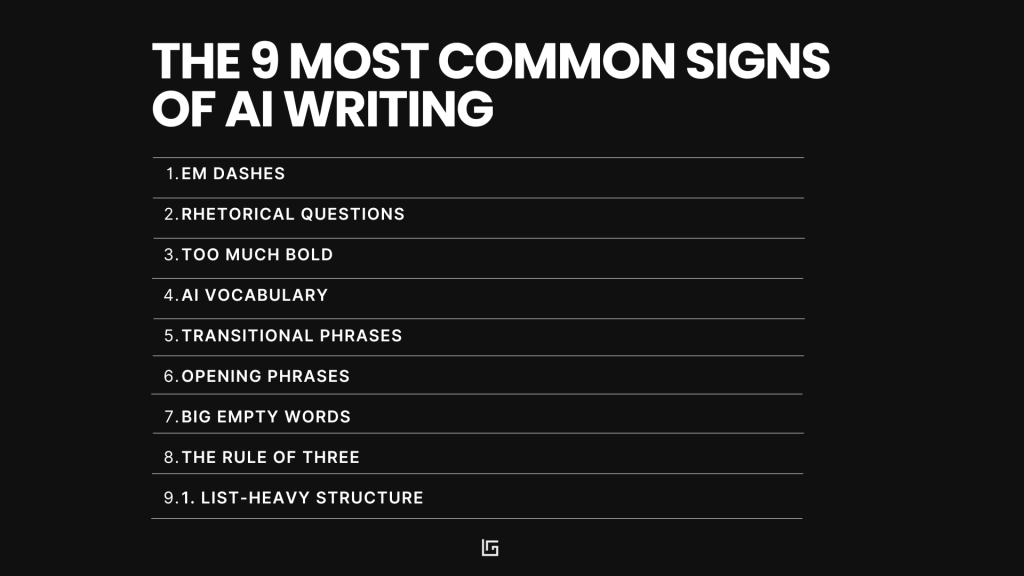
9 Most Common Signs of AI Writing
1. Em dashes
One of the easiest signs of AI writing is the em-dash.
AI loves it. It uses it to glue ideas, add drama, and solve every punctuation problem in one move.
In early models AI used punctuation as a crutch.
Em dashes link ideas in a simple way that works for the model, even when it sounds forced.
The good news is that this is changing.
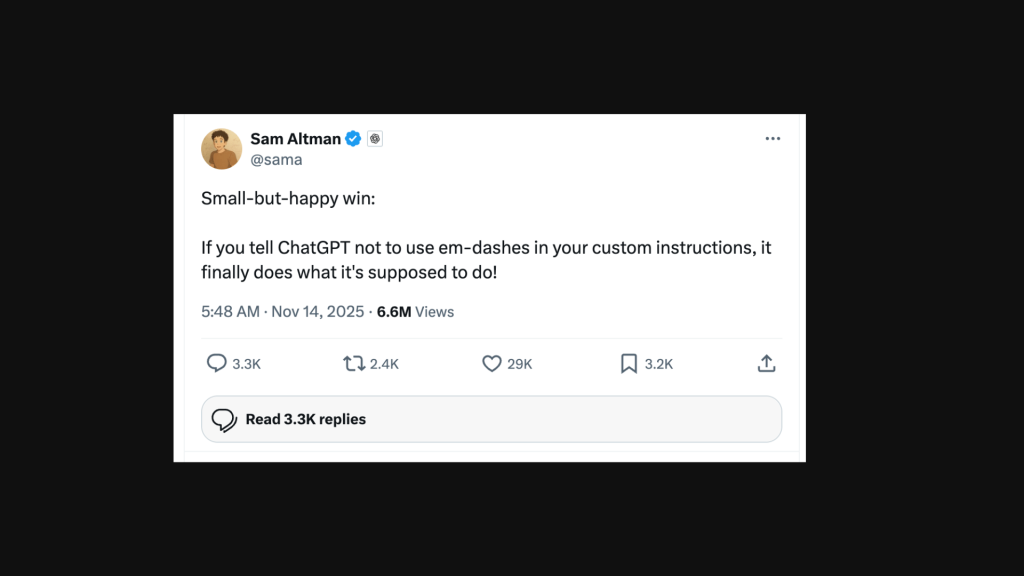
OpenAI finally made it possible to remove them through custom instructions last week.
Sam Altman even called it a “small but happy win.”
2. Rhetorical questions
AI models love rhetorical questions.
They place them at the start of every section.
They use them to transition between ideas, even when nothing deep or curious follows.
It feels like someone is talking to themselves in a room.
Human writers use questions with intention.
AI uses them because the structure is easy to copy.
3. Too much bold
AI loves formatting.
It bolds every second word.
It breaks sentences into neat mini-headers followed by highlighted definitions and explanations.
Humans only use formatting to highlight something important.
Because when everything is highlighted, nothing is.
4. The classic AI vocabulary
There is a group of words AI cannot resist.
Delve. Harness. Leverage. Unlock. Robust. Realm. Intricate. Showcase. Foster. Enhance.
You have probably seen them.
This is not how most people speak or write in daily life.
When several of these appear together, it’s usually an AI sign.
5. Transitional phrases
AI text often follows a predictable flow and it overuses transitions.
“Generally speaking.”
“It’s important to note that.”
“In addition.”
“Furthermore.”
“As a result.”
“From X to Y.”
“Designed to help you do Z.”
“By doing this, it achieves that.”
The structure is smooth but mechanical.
Paragraphs follow the same pattern and sentences mirror each other.
6. Predictable opening phrases
You can spot AI writing from the first sentence. It often starts with a phrase like:
“In today’s fast-paced world…”
“It is important to note that…”
“When it comes to…”
It looks clean, but it feels like a template.
7. Big empty words:
AI writing often sounds correct but empty.
It explains something in a broad, safe, general way.
Everything is “transformative” or “revolutionary” or “highly efficient.”
What’s missing is the feeling.
The example.
The personal moment.
The lived experience.
8. The rule of three
AI loves lists of three.
Three words.
Three examples.
Three ideas in a row.
It does this because triads are common in writing, so the model repeats them to sound polished and balanced.
9. List-heavy structure
One of the biggest signs of AI writing is the formatting.
Perfect lists.
Even line lengths.
Balanced bullets.
Same sentence shapes.
AI always likes to stick to a structure.
Signs of AI writing – Why they matter
We are not tired of AI.
We are tired of the AI content that feels like it was made on autopilot.
We do not need more content.
We need more perspective.
More stories.
More human context.
This is especially important if you work in tech.
People do not want more content.
They want your interpretation.
Your experience.
Your voice.
How to avoid AI marks in your own writing
If you use AI to support your writing, you can still keep your voice.
You just need to guide it.
In my 31-day AI challenge, I shared some tips to build a brand content guideline system for this. You can load it into your model and it will adapt to your style. It cleans the AI marks. It brings your tone. It protects your rhythm.
Here is a simple prompt that can help:
“Write this in my own voice. Use short paragraphs. Simple English. No rhetorical questions. No em dashes. No generic openings. No buzzwords. Keep sentences irregular and human. Focus on clarity and personality.”
This one prompt removes 80% of the AI feeling.
Spotting AI writing: Final thoughts
It helps us think faster.
It helps us create at scale.
And I use it every day.
But writing still needs a soul.
It needs warmth.
It needs perspective.
If you have spotted other “AI signals,” tell me.
I would love to learn how you see it.
Join the newsletter
Practical insights on AI, leadership and innovation — every week.