
January 25, 2026
Value Only Makes Sense in Context

Last week, I was in a discussion with a customer preparing a massive digital transformation in engineering.
At some point, the conversation landed on a familiar word.
Value.
What value will this bring.
How do we prove value.
When will people see the value.
1. Why “Value” Is the Most Misused Word in Consulting
“Value” is one of the most used and least defined concepts in transformation work.
I work in consulting, and value comes up all the time.
Value often becomes shorthand for ROI, efficiency, speed, or cost reduction.
Important, yes.
But incomplete.
I’ve seen projects declared successful on paper while teams felt exhausted, confused, or disengaged.
And I’ve seen small, almost invisible changes unlock momentum that no KPI had predicted.
The problem is not measurement.
The problem is assumption that “value” means the same for us all.
We talk about delivering value as if value were objective.
As if it were the same for everyone involved.
It isn’t.
2. Value Only Exists in Relation to a Goal
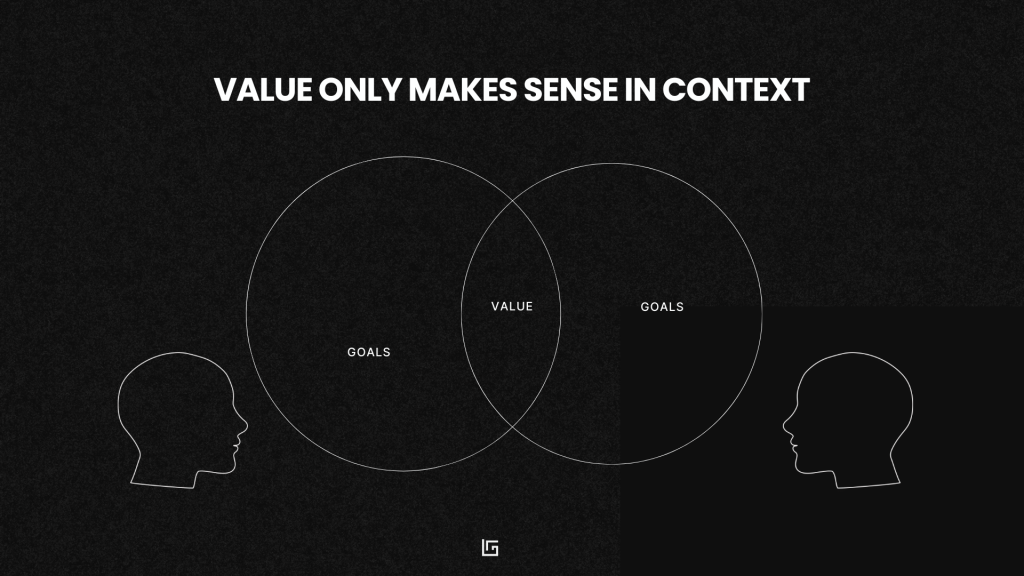
Value is not absolute. Value only exists in relation to a goal.
An agency can design and build a technically excellent system.
Architecture is solid. Features are complete. Everything works as specified.
And still, the system is barely used.
From the agency’s perspective, the work was successful.
From the customer’s executives, it wasn’t.
They were looking for ROI from real usage.
Adoption. Productivity. Business impact.
That was the value they cared about.
And because it was never clearly defined at the beginning, it never became the shared reference point.
The same thing happens with growth programs.
I’ve seen organizations invest heavily in sophisticated training and development programs, with genuine intentions to support employee growth.
The programs were well designed.
The investment was significant.
And still, the impact was limited.
Because they were aligned with what the organization thought people should want, not with how individuals actually wanted to grow.
I’ve made the same mistake in my own companies myself.
The effort was real.
The outcome wasn’t.
Because value only exists in relation to what someone is trying to achieve.
Value Has Layers (Like an Onion)
Value is rarely one-dimensional.
It has layers.
What creates value at an organizational level is not always what creates value for a team or for an individual. Yet all three layers need to be present for change to work.
Think of value like an onion.
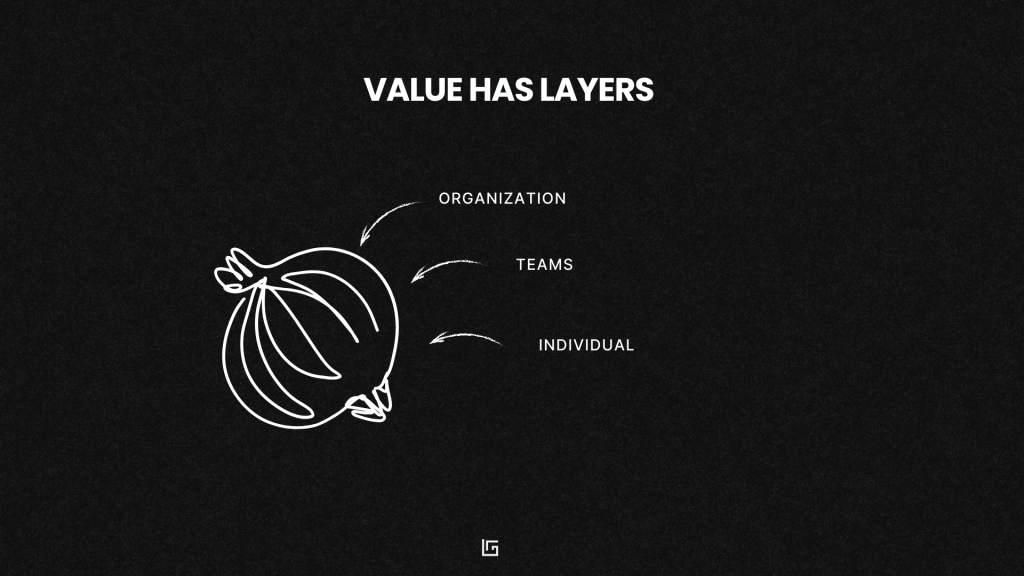
At the outer layer sits the organization.
An organization introducing AI might define value very clearly: improve productivity, reduce costs, and speed up product introduction. For example, using AI agents to translate requirements across markets.
From that perspective, value is measurable:
- Faster time-to-market.
- Lower translation costs.
- More consistent outputs.
Move one layer inward, and you reach the team.
For the team, value looks different.
It’s not primarily about cost savings. It’s about relief:
- Less pressure to find scarce translators.
- Fewer coordination issues.
- Less time spent fixing inconsistencies between languages and formats.
The same AI solution, but a different experience of value.
At the core sits the individual.
For an individual contributor, value can be something else entirely:
- The opportunity to work with new technology.
- To develop new skills.
- To take on more responsibility.
- To grow into a new role or earn a promotion.
If this layer is ignored, motivation fades.
If it’s acknowledged, momentum aligns.
The mistake many organizations make is optimizing only for the outer layer.
They define value at the top, assume it will cascade downward, and are surprised when adoption stalls.
But value does not automatically translate across layers.
It has to be intentionally aligned.
When organizational, team, and individual value point in the same direction, change feels meaningful.
When they don’t, even good solutions struggle to land.
4. Defining Value Before You Start Anything
One of the most important things I’ve learned is this:
value has to be shared and clarified at more than one level.
At the organizational level:
What outcome makes this investment worthwhile?
At the team level:
What would make this initiative feel valuable for us as a team?
At the individual level:
What does success mean for me personally?
Because value is not just one thing.
It lives between our priorities and individual motivations.
That’s why the most valuable work starts with alignment.
Join the newsletter
Practical insights on AI, leadership and innovation — every week.