
May 1, 2025
What Is an LLM? Large Language Models Explained Simply

Imagine stepping into an infinite library, filled with every book, article, and conversation ever written. Every corner holds stories, answers, and deep knowledge ready to be explored.
Now imagine you could chat with this library. Ask it anything. Get insights. Receive advice based on everything it has absorbed.
That’s exactly how a Large Language Model (LLM) works.
In this article, we’ll dive into what LLMs are, how they function, and why they’re transforming the future of artificial intelligence.
LLM: What is an LLM in AI?
Definition of LLM
An LLM (Large Language Model) is a type of artificial intelligence trained to read, understand, and generate text, just like a human.
Sounds complicated? Let’s simplify it.
Imagine a robot that has read every book, article, and conversation in history. Not only does it remember everything, it knows how to connect words into clear, meaningful sentences.
It can debate philosophy like a professor or crack jokes like a comedian.
Remember that time you tried to write a heartfelt message but ended up sounding like a technical manual? An LLM could have saved you, and probably impressed your crush too.
Here’s the key. Data. Massive amounts of data.
The more data an LLM consumes, the more human its output sounds.
How LLMs Are Different from Other AI Models
LLMs specialize in one thing: language.
They write, translate, summarize, brainstorm, and even create art with words. While other AI models might focus on recognizing images or driving cars, LLMs are built to master communication.
But how do they actually understand us and reply in ways that make sense?
Let’s break it down.
What Does an LLM Actually Do?
LLMs are already woven into your everyday life
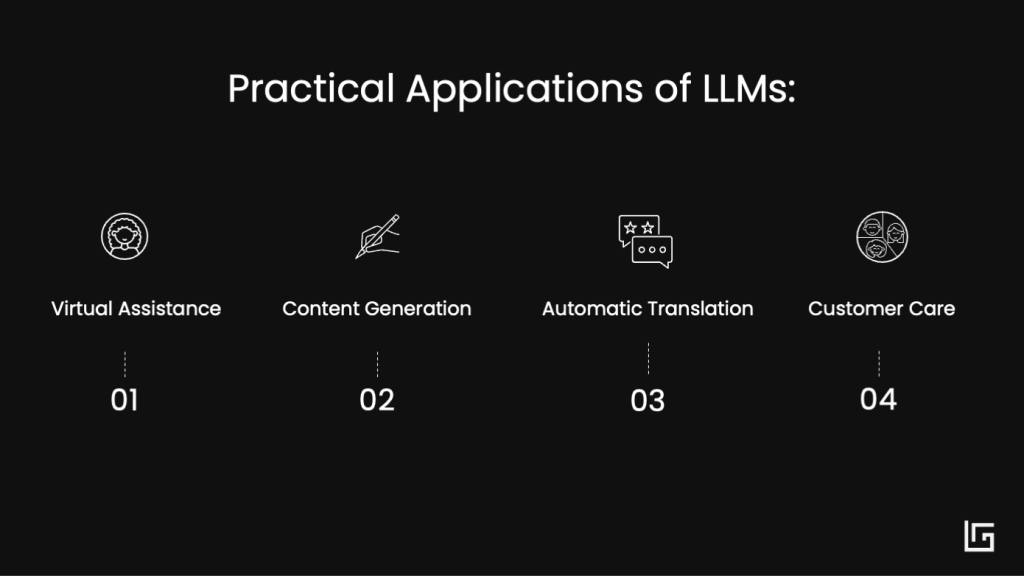
- Virtual Assistants: Alexa, Siri, and Google Assistant rely on LLMs to understand your questions and deliver smart answers
- Content Generation: News articles, blog posts, marketing copy, social media captions
- Automatic Translation: Google Translate and DeepL use LLMs to bridge languages smoothly
- Customer Support: AI chatbots that solve problems, answer questions, and never take a coffee break
LLMs don’t just understand language. They use it to enhance almost every aspect of our digital lives.
How Does an LLM Work?
Let’s keep it simple.
Most modern LLMs are built on a system called a Transformer, introduced by Google in 2017.
Instead of reading word-by-word like humans, Transformers process entire chunks of text at once, using “attention mechanisms” to spot the relationships between words.
Imagine trying to follow a conversation at a noisy party. You pick up bits and pieces here and there, but you still grasp the big picture.
That’s what Transformers do: they zoom in on the important parts and deliver contextually smart responses.
How an LLM Works: Practical Examples
You’ve seen this before. LLMs predict the next word based on context, like filling in famous phrases.
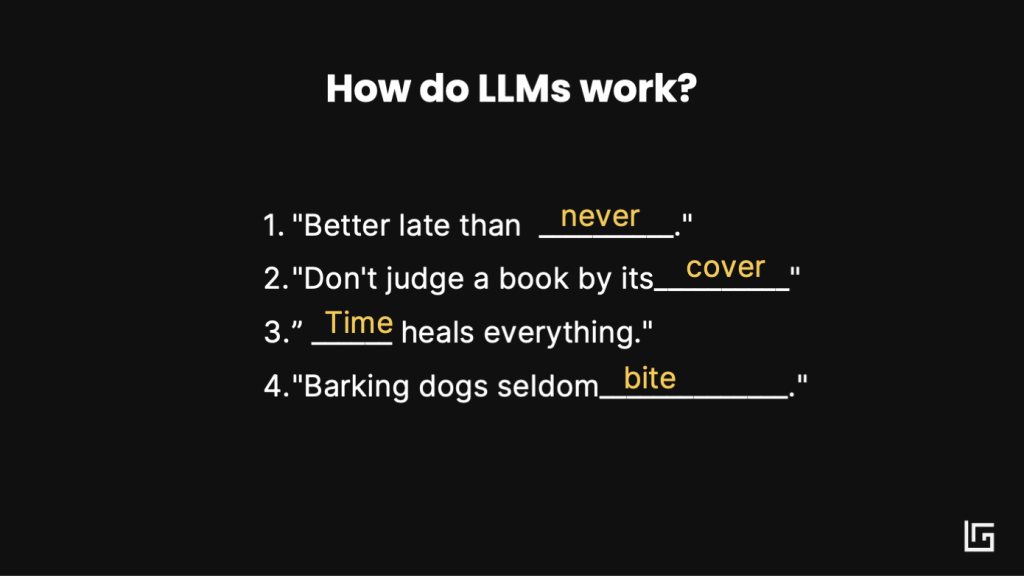
- “Better late than _____.”
- “Don’t judge a book by its _____.”
- “______ heals all.”
- “Barking dogs seldom ______.”
By training on millions of examples like these, LLMs learn to guess accurately what comes next.
Training an LLM
Training an LLM is an enormous job.
It requires billions of words from articles, websites, novels, tweets, and more.
Training can take weeks or even months, using massive computing power. Definitely not something you can do on your laptop at a café.
LLM Training: Adjusting Weights
During training, LLMs tweak their “weights,” or internal settings, to make smarter predictions.
Imagine the sentence: “I can’t wait to go to the ____.”
Early guesses might look like this:
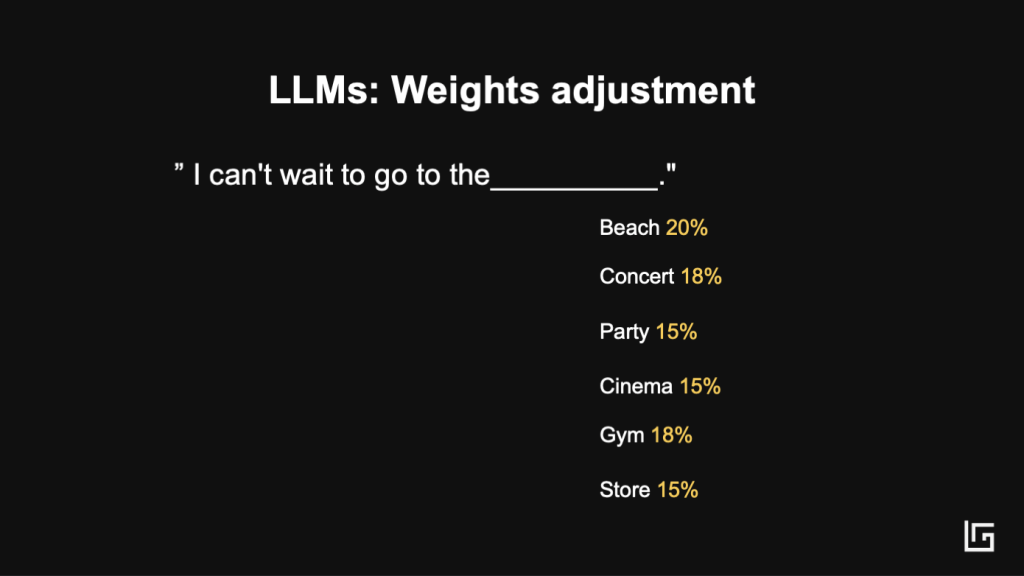
- Beach 20%
- Concert 18%
- Party 16%
- Cinema 15%
- Gym 11%
- Store 8%
Each percentage represents the model’s best guess based on its training.
With more examples and feedback, these guesses become sharper over time.
Fine-Tuning and Feedback
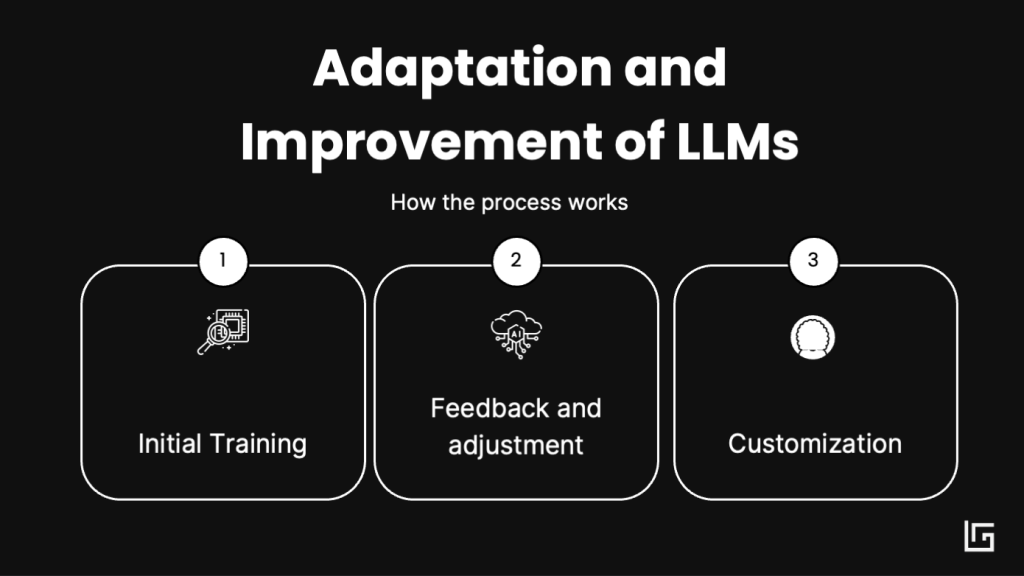
After initial training, LLMs often go through fine-tuning.
This means specializing the model for a specific goal, like helping with legal research or planning events.
For example, after fine-tuning for event planning, the guesses might shift to:
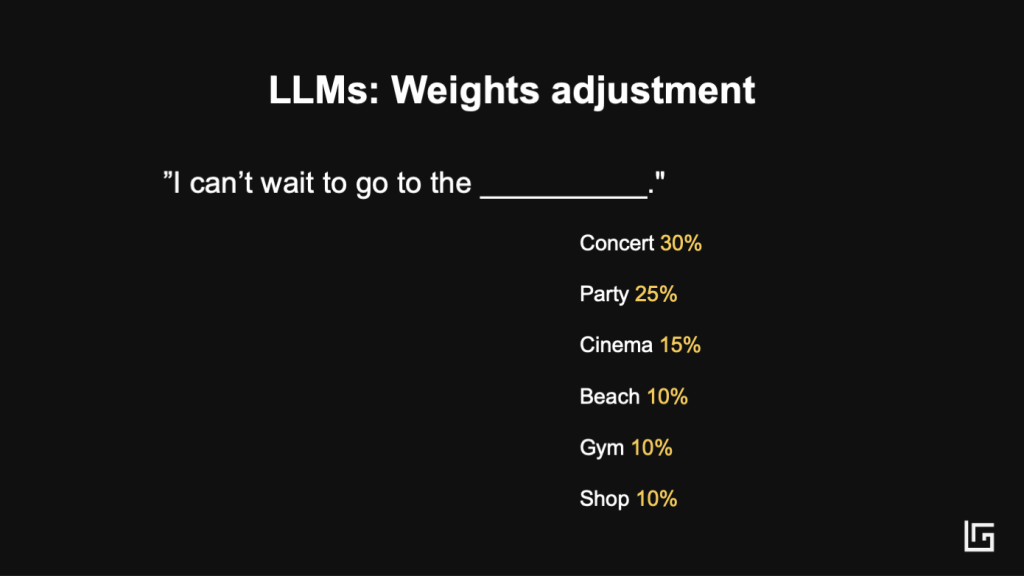
- Concert 30%
- Party 25%
- Cinema 15%
- Beach 10%
- Gym 10%
- Store 10%
Fine-tuning helps the LLM become more relevant, accurate, and helpful in specific fields.
Challenges LLMs Face
Even the smartest LLMs aren’t perfect. Here’s what you need to know:
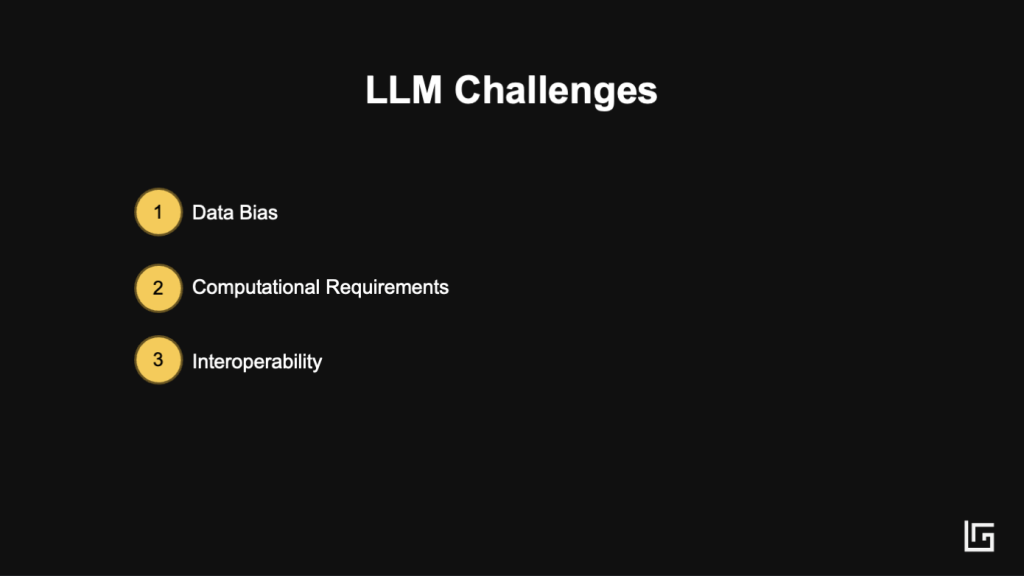
1. Bias in Data
If an LLM learns from biased or skewed content, it can repeat those biases. The controversy around Google’s Gemini showed how tricky it is to balance accuracy and fairness.
2. Computational Requirements
Training and fine-tuning LLMs demand enormous processing power and energy.
3. Interpretability
LLMs often behave like “black boxes.” Sometimes it’s hard to understand exactly why they choose one answer over another.
Real-World Examples of LLMs
Here are some standout LLMs you should know:
- ChatGPT by OpenAI: Famous for its natural, coherent conversations and powerful writing abilities
- Claude by Anthropic: Focused on creating safe, reliable AI systems that align with human values
- LLaMA by Meta: Lightweight and efficient, ideal for researchers and developers
- Grok by X: Designed to boost user experiences on social media platforms
- Gemini by Google: A multimodal model combining text and visual generation
- DeepSeek: A powerful research-driven LLM built to handle complex searches, detailed reports, and advanced knowledge tasks
Each of these models brings something unique to the table, pushing the boundaries of what AI can do.
How LLMs Can Transform Your Life
Here’s how you can actually use them
- Content Creation
Writer’s block? Gone. LLMs can generate articles, captions, video scripts, and newsletters effortlessly.
- Market Research
Stay ahead of competitors by gathering trend insights and data in minutes.
- Product Development
Need new product ideas or catchy brand names? LLMs can spark creativity fast.
- Data Analysis
They can process tons of information and find patterns that are easy to miss.
- Sales and Marketing
Craft irresistible, high-converting messages tailored for your audience.
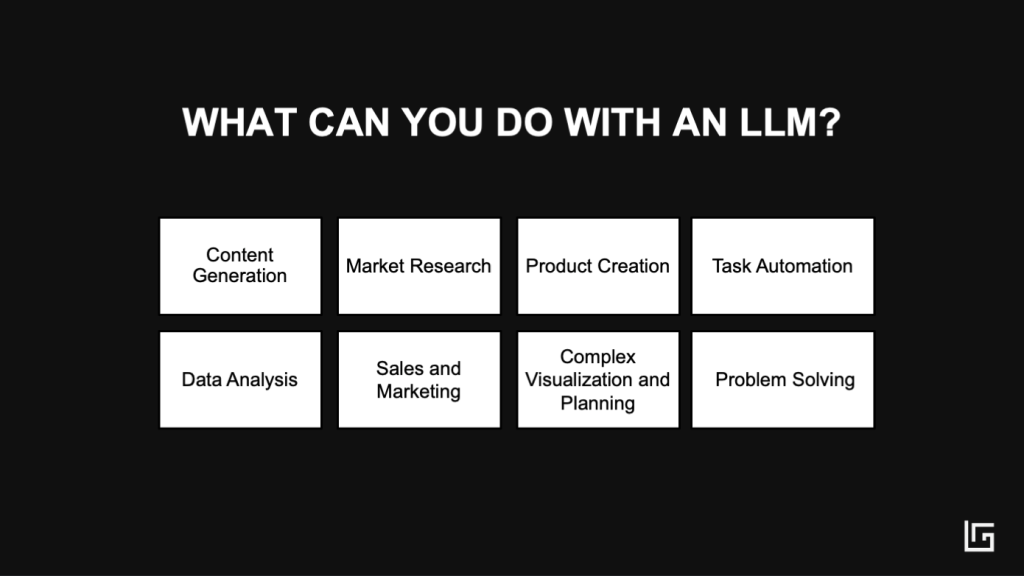
- Visualization and Planning
From mind maps to event plans, LLMs can help you organize complex projects in seconds.
- Problem Solving and Automation
Automate repetitive tasks and free up your time for bigger challenges.
- Personal Growth
Whether you want to build better habits, learn new skills, or optimize your routines, LLMs can act like a personal coach always ready to help.
Final Thoughts
Large Language Models are not just a trend. They are reshaping how we work, learn, and communicate.
In the near future, LLMs could even understand our emotions and intentions more deeply. Imagine an AI that lifts you up when you’re feeling stuck or celebrates your wins with you.
That world is closer than we think.
LLMs are here to stay.
LLMs build on decades of research. See the key milestones in this AI timeline infographic.
Join the newsletter
Practical insights on AI, leadership and innovation — every week.