
October 20, 2025
Physical Artificial Intelligence Explained: How AI Is Moving Into the Real World
Physical Artificial Intelligence is no longer science fiction, it’s rapidly becoming one of the most transformative technologies of our time.
At the beginning of this month, Figure AI unveiled something that felt deeply human.
Their new creation, Figure 03, did not just walk.
It understood.
It reached.
It felt.
Figure 03 is designed for homes and everyday environments.
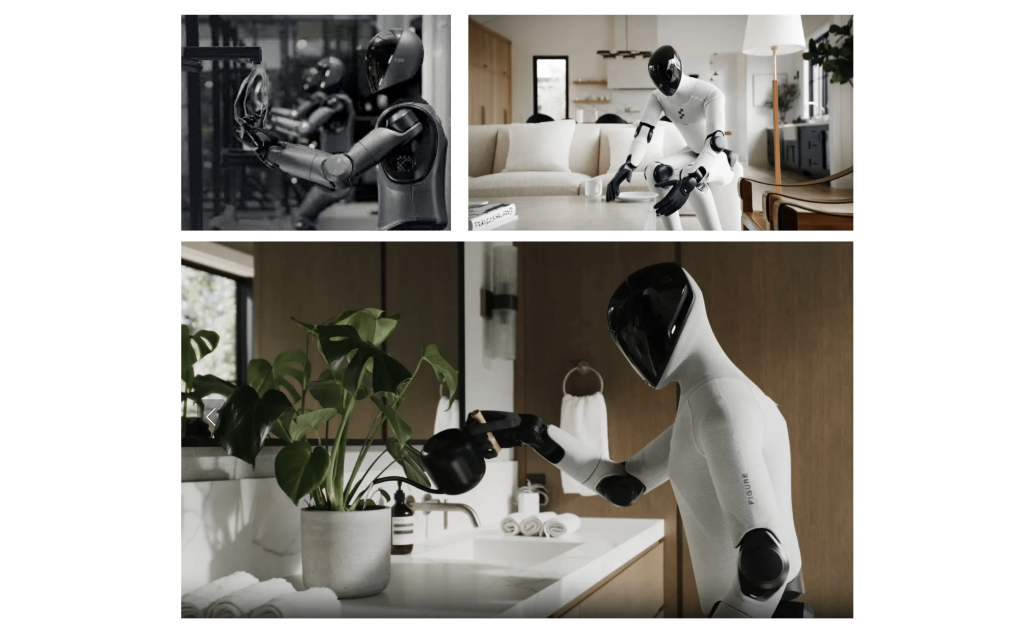
It can fold laundry, stack dishes, or handle a fragile glass of water without breaking it. Its hands are equipped with tactile sensors and palm cameras that give it true dexterity.
The robot runs on Helix, Figure’s vision–language–action system. This helps it see, reason, and act in the real world, similar to the way people do.
With Figure 03, physical artificial intelligence took its next step.
What Is Physical Artificial Intelligence
Physical AI gives machines the ability to see, reason, and act in the real world.
Robots have been part of AI’s story since Unimate in 1961. See the full AI timeline for how we got here.
It powers robots, drones, self-driving cars, and smart cameras.
These systems can move, touch, and react to change in real time.
Traditional AI lives in digital space, processing text, numbers, and images.
Physical AI lives in our world. A world that is complex, messy, and full of movement.
To make this possible, three key elements work together:
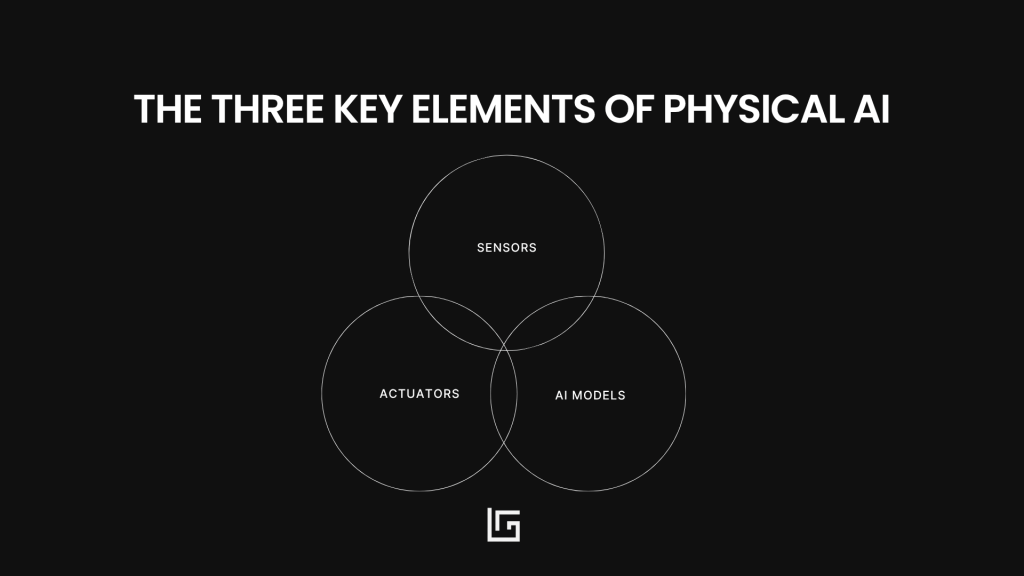
- Sensors that perceive the world, such as cameras, LiDAR, microphones, and touch sensors.
- Actuators that create motion, like robotic arms, wheels, or grippers.
- AI models that interpret information and decide what to do next.
Together, they give machines a new kind of presence and purpose in the physical world we share.
The Rise of Physical AI: Intelligence in Motion
Intelligence is no longer confined to screens.
It is beginning to move, to sense, and to shape the world around us.
This is a big shift from machines that think to machines that act.
Physical Intelligence is expanding what technology can do.
It connects the digital and the physical, linking information with action.
This change will reshape how we work, produce, and live.
Why Physical Artificial Intelligence Matters
Today, manual labor costs shape the price of nearly everything we buy or use.
Human labor represents around 50 percent of global GDP, or roughly 42 trillion dollars each year.
When physically intelligent robots join the workforce, from factories to farms, that cost will begin to fall toward the price of operating or renting a robot.
Lower labor costs will mean lower production costs across industries.
Lower labor costs will mean lower production costs across industries.
Over time, robots will even build other robots, multiplying efficiency and reducing prices further.
This could facilitate manual labor and lead to a world where goods and services become far more accessible.
Physical intelligence has the potential to increase productivity, reduce scarcity, and open space for humans to focus on what only we can do: imagine, create, and care.
The Four Pillars of Physical AI
Every physically intelligent system relies on four core abilities:
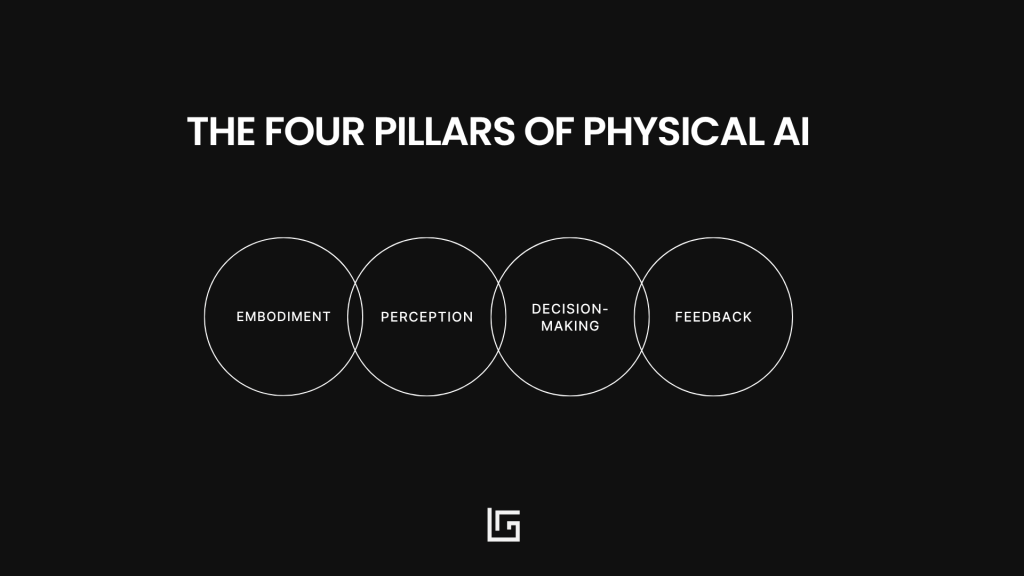
- Embodiment
Intelligence takes a physical form: a robot, a drone, or a vehicle.
- Perception
Sensors create a real-time map of the surroundings.
- Decision-Making
Algorithms evaluate information and choose actions.
- Action and Learning
The system performs, adapts, and improves over time.
This continuous loop of sensing, deciding, acting, and learning brings machines closer to understanding the real world.
Physical Artificial Intelligence in Action
Physical intelligence combines reasoning with motion.
It enables machines to act with purpose, precision, and safety.
Examples of this new wave include:
1. Autonomous mobile robots
Navigating warehouses and factory floors, delivering goods, mapping spaces.
Examples:
2. Manipulator arms
Sorting thousands of products per hour, assembling complex components, packing items.
Examples:
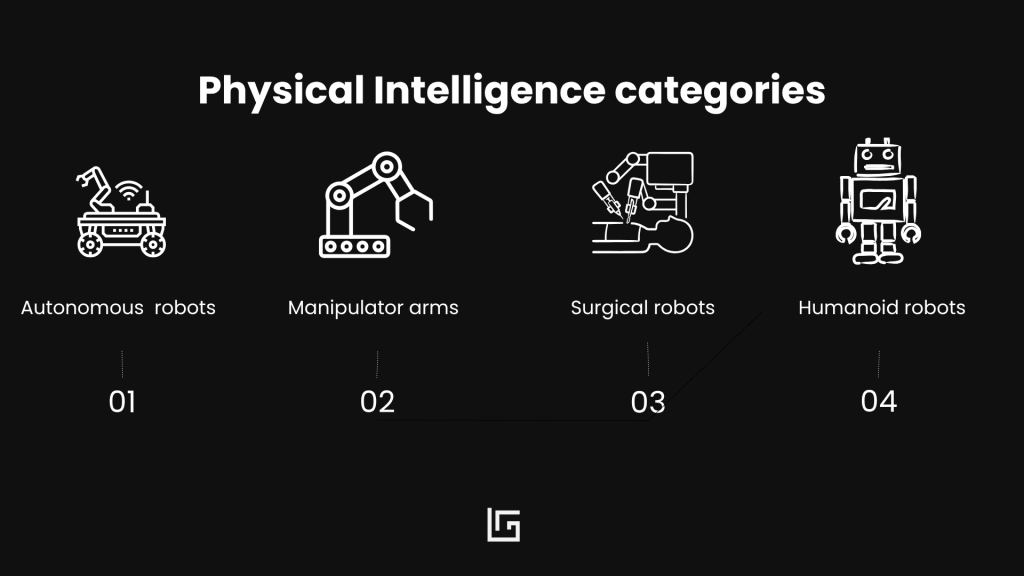
3. Surgical robots
Performing intricate surgical procedures with sub-millimeter accuracy.
Examples:
4. Humanoid robots
Adapting to and working within human spaces, providing personal assistance, learning new tasks.
Examples:
These are not isolated experiments.
They are signs of a broader shift where machines start to understand and collaborate within our environments.
How Physical Artificial Intelligence Works
To bring intelligence into the physical world, machines need more than software.
They need a body, senses, a way to communicate, and a space to learn safely.
At the heart of this new generation of robots are Vision–Language–Action (VLA) models.
These systems combine three key skills:
- Vision to see and interpret the environment through cameras and sensors.
- Language to understand instructions and context in human terms.
- Action to translate perception and understanding into precise movement.
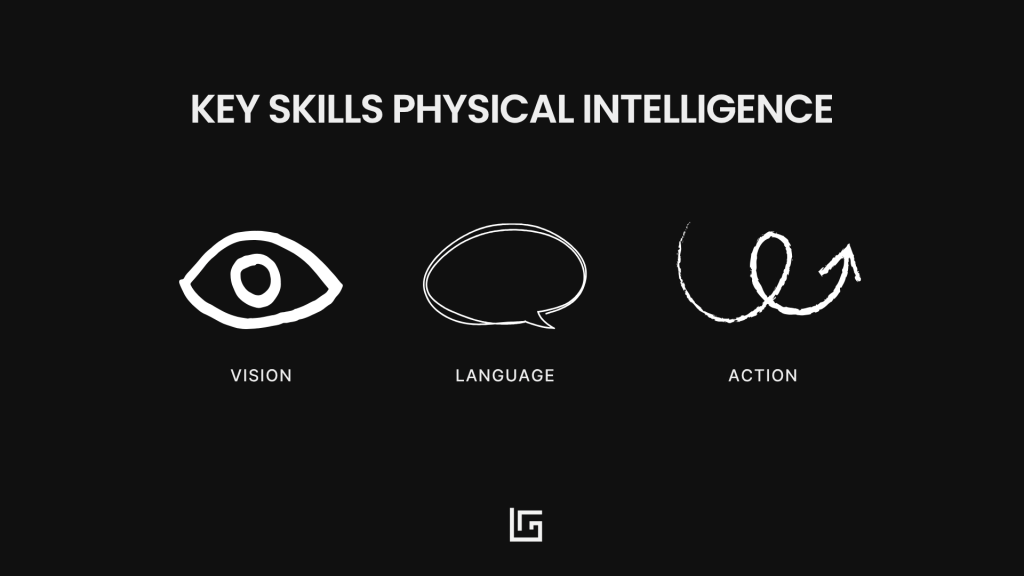
In practice, this means a robot can watch a human demonstration, understand a verbal request, and then perform the same task on its own.
Models like Helix, developed by Figure AI, or RT-X by Google DeepMind, teach machines to connect what they see with what they know and what they need to do next. It’s the bridge between cognition and movement.
Physical Intellingence and Digital Twins: Howe Robots Learn to Move
These systems can’t learn safely in the real world right away.
They need virtual spaces to practice: digital replicas of real environments known as digital twins. With digital twins physical AI can be trained millions of times faster than in reality.
Inside these digital environments, robots learn to recognize objects, avoid obstacles, and improve their coordination.
They make mistakes without risk.
Once their behavior is refined, that learning can be transferred to the physical world: a process known as sim-to-real transfer.
The Challenges of Physical Intelligence
Creating phisical artificial intelligence that can act safely and meaningfully in physical space is complex work.
Here are five key challenges shaping the field today:
1. The Sim to Real Gap
Robots learn many skills inside simulations before they ever move in real life.
But the real world is full of variables such as lighting, textures, noise, and unpredictable people that no model can perfectly capture.
Bridging this gap between virtual training and physical performance is one of the hardest problems in robotics today.
2. Data and Synthetic Environments
Training robots requires massive amounts of data.
Collecting it from the real world is expensive and slow.
Synthetic data and digital twins help fill this gap, but if the simulations are not realistic enough, the results may fail to transfer to reality.
Finding the right balance between speed, accuracy, and realism remains a major challenge.
3. Safety and Human Interaction
Physical AI systems must work safely around people.
They need to predict human movement, stop instantly if something goes wrong, and understand personal boundaries.
Ensuring that robots act responsibly, especially in homes, hospitals, or public spaces, is essential for trust and adoption.
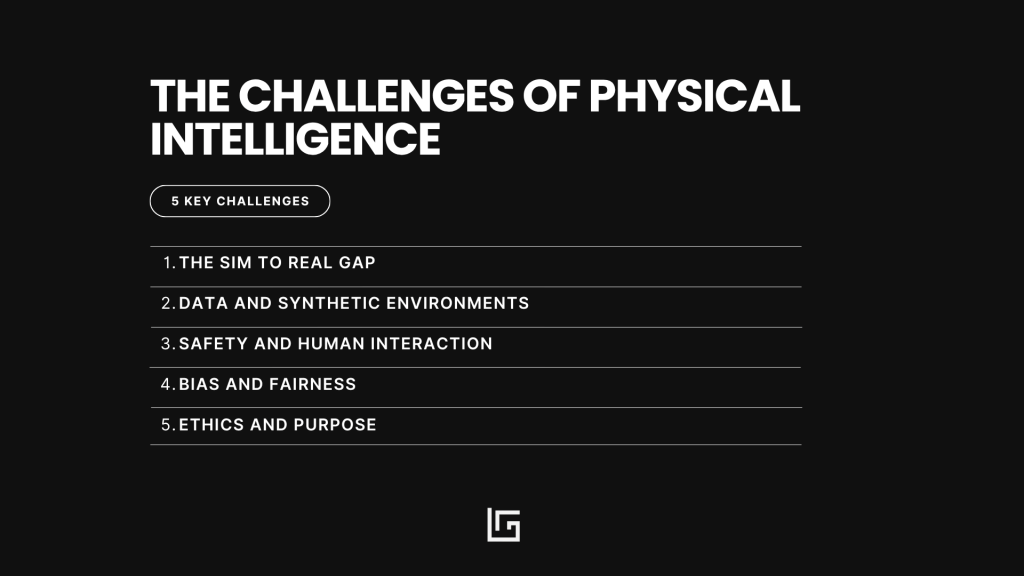
4. Bias and Fairness
Every intelligent system learns from the data it receives.
If that data contains bias, the robot’s behavior will reflect it.
To build reliable systems, developers must use diverse and representative data and test robots across many environments and conditions.
5. Ethics and Purpose
As machines become more capable, the focus is shifting from “can we build them” to “should we build them.”
Physical intelligence must have a clear purpose that supports people instead of replacing them.
Defining ethical principles early ensures technology enhances life and remains aligned with human values.
Two Paths Toward a Physically Intelligent World
There are two main strategies for bringing robots into real environments.
1. Building spaces designed for robots
This approach focuses on creating controlled, structured environments where automation can thrive.
Companies like Amazon Robotics, Ocado Group, and Boston Dynamics follow this model, optimizing layouts and workflows to help robots move efficiently and safely.
2. Building robots designed for human spaces
The second approach flips the equation.
Instead of shaping the world for robots, it focuses on creating robots that can move through ours. This is the path taken by Figure AI, Tesla (Optimus), and Agility Robotics (Digit).
They are developing general-purpose humanoid robots that can walk, see, understand, and collaborate in the same environments people already use.
The choice is between developing millions of specialized machines for individual tasks or creating adaptable humanoids capable of learning many.
A Future Built on Movement
Artificial Intelligence is moving beyond the screen and into our world.
The next generation of technology will not only think.
It will move, build, and collaborate.
Join the newsletter
Practical insights on AI, leadership and innovation — every week.