
June 30, 2025
What Jobs Are Safe from AI in 2026? A Realistic List

Lately, I’ve found myself coming back to the same quiet question: What jobs are safe from AI?
Artificial intelligence is transforming the job market in ways that are subtle, sweeping, and sometimes unfair.
If you’re just entering the workforce, or supporting someone who is, you may have noticed how fast the landscape is changing.
The jobs that used to build experience, resilience, and confidence are becoming automated.
The ladder of opportunity seems to be missing a few lower rungs.
So what work is safe?
And what’s quietly being replaced?
The jobs that will be replaced by AI
Not all jobs are disappearing.
But some types of work are far more vulnerable than others.
The roles most at risk share a few traits:
- They are repetitive
- They follow clear rules or templates
- There is a defined “right” or “wrong” outcome
- They involve little emotional or ethical judgment
Put simply, if a job can be expressed as a series of if-then instructions, it’s a candidate for automation.
For example:
- Transcribing audio or inputting data into spreadsheets
- Sorting resumes based on keyword matches
- Reviewing documents for errors
- Managing calendars and booking meetings
- Creating reports based on data
These are all tasks AI can now handle at high speed and low cost.
They’re also often the jobs that employers assign to interns, assistants, or junior staff.
The jobs that are safe from AI: Friction vs. Judgment
To understand how AI is reshaping the workforce, it helps to think in terms of two qualities: friction and judgment.
- Friction: refers to how time-consuming, manual, or repetitive a task is.
- Judgment: how much human thought, emotional insight, or ethical consideration a task requires.
We can imagine these two qualities on a simple grid:
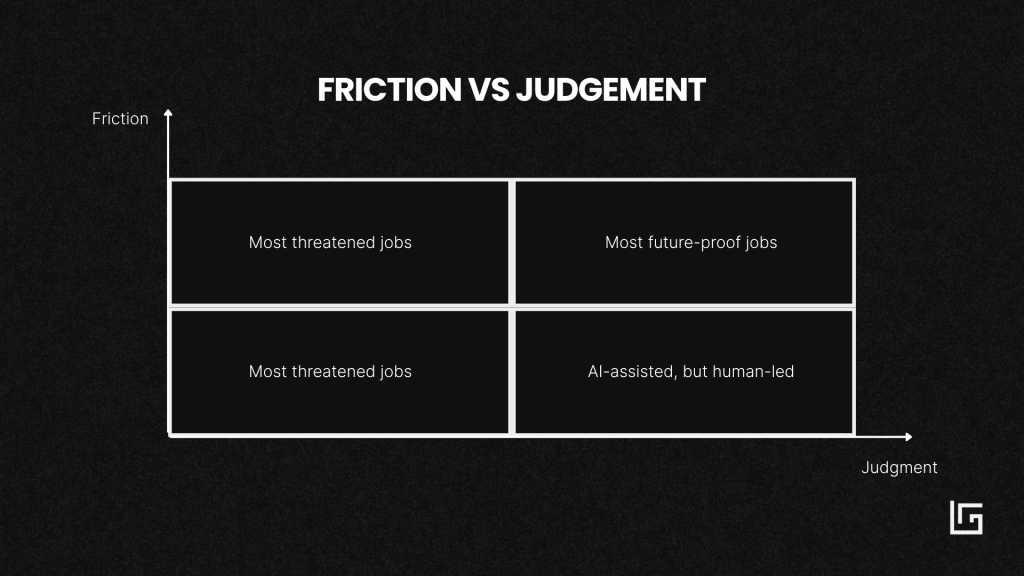
| Low Friction | High Friction | |
| Low Judgment | Easily automated | Most threatened jobs |
| High Judgment | AI-assisted, but human-led | Most future-proof jobs |
Jobs that are low in friction and low in judgment are easily automated.
These include tasks like scanning barcodes at checkout, basic data input or sorting, or tagging images. They are quick, rule-based, and don’t need much human input.
When a job is high in friction but still low in judgment, it becomes even vulnerable.
These are the kinds of roles that are repetitive and time-consuming, but still don’t require much critical thinking. Examples include PowerPoint or document formatting, travel bookings or administrative work. These are some of the first roles being replaced by AI because they are both tedious and predictable.
AI is particularly effective at tasks that are low in judgment but high in friction. These tasks tend to be time-consuming for people, yet do not require emotional or ethical nuance.
This is exactly the space where many entry-level jobs exist today.
High judgment, low friction jobs are a bit more resilient.
These are roles where human thinking still matters, but the work can often be streamlined. Editing content, reviewing reports, or synthesizing research are good examples. AI can assist in these areas, but a human is still needed to make final decisions and apply nuance.
The most future-proof jobs are those that are both high in friction and high in judgment. These roles are complex, often unpredictable, and involve working with people or situations that do not follow clear rules. Think of therapists, nurses, teachers, project coordinators or consultants solving complicated human problems.
These jobs require emotional intelligence, ethical reasoning, and the ability to navigate messy, real-life situations where there is no single correct answer.
AI Entry level jobs: Entry level jobs under threat
For decades, entry-level jobs were a vital training ground.
They were the places where people learned how to show up, manage expectations, take feedback, and develop a working identity.
These jobs taught skills you couldn’t always get in school.
Today, many of those positions are shrinking, not because there’s no work to do, but because AI can do it faster, cheaper, and without needing a coffee break.
In 2024, a report by the World Economic Forum predicted that nearly 44% of workplace tasks would be automated by 2027.
This chart shows something we’ve never seen before.
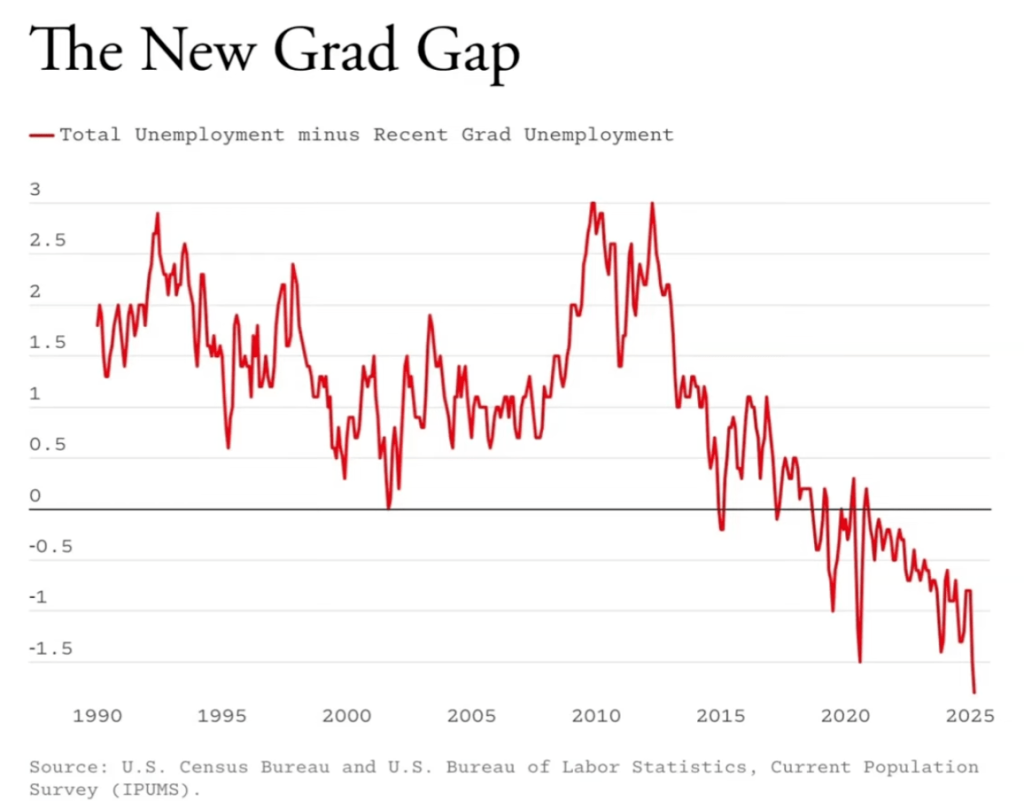
For the first time in modern history, new graduates are struggling more than experienced professionals to get hired. That bottom rung of the job ladder—the one meant to help people launch their careers—is becoming harder to reach.
What this chart shows:
- Y-axis: The gap between overall unemployment and recent graduate unemployment
- X-axis: Time period from 1990 to 2025
- Red line: How recent grads are doing compared to everyone else
How to read it:
- Above zero: New grads had better job prospects than average
- Below zero: New grads now have worse job prospects than average
For decades, being a recent graduate was an advantage. It meant being younger, more tech-savvy, easier to train. But since around 2015, that advantage has quietly slipped away. By 2025, the gap is clearly negative—marking the first time in nearly 40 years that new college grads are doing worse in the job market than the general population.
So why is this happening?
One big reason is AI. It’s replacing exactly the kinds of roles people used to start with:
- Research summaries
- Report writing
- Basic data analysis
- Scheduling and coordination
- Early-stage content creation
These were never glamorous jobs, but they were essential.
They were how people learned the ropes, made mistakes, and built real-world confidence.
Now, that foundational layer of experience is shrinking.
And without it, the path forward becomes less clear.
If we want to support the next generation of workers, we have to be honest about what’s being lost and intentional about creating new spaces where people can learn, grow, and contribute in ways machines can’t.
What Jobs are safe from AI: Characteristics of jobs that won’t be replaced by AI
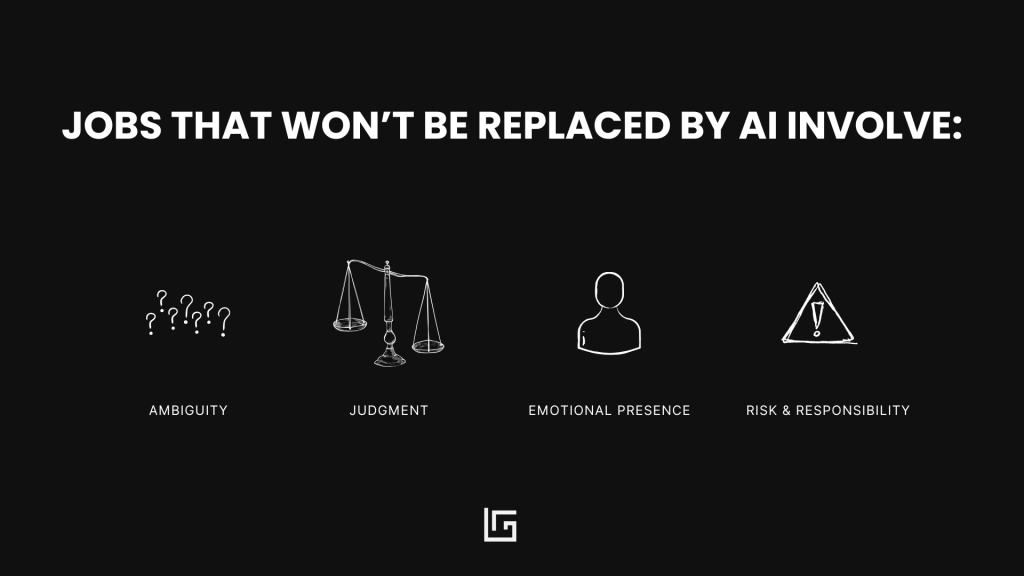
The kinds of jobs that remain deeply human tend to share a few core qualities:
- They involve ambiguity, where the “right” answer isn’t always clear
- They depend on ethical judgment or human conscience
- They require emotional presence, listening, and relational skills
- They involve risk and responsibility that humans must carry
These are the roles that exist in the messy, unpredictable parts of life.
They aren’t ruled by data alone.
They ask us to notice subtleties, hold contradictions, and act with compassion.
These roles often involve emotional nuance, ethical judgment, and the ability to navigate situations where there’s no obvious right answer.
Here are a few examples of work that lives in that space, where people, not machines, make the real difference:
- Nurse: Cares for people in vulnerable moments, balancing clinical skill with empathy.
- Teacher: Adapts to different learning styles, emotions, and needs in real time.
- Design Thinking Consultant: Helps organizations solve complex problems through empathy, collaboration, and creativity.
- Therapist: Listens deeply, holds space for complexity, and helps others make sense of their lives.
- Career Coach: Guides people through uncertainty, personal goals, and hard decisions that don’t have a clear path.
Becoming future proof: Addressing ambiguity
AI will continue to reshape the job market.
It will change the way we work, and it may feel threatening at times.
But it also offers us a chance to redefine the value of human work.
Work that is mechanical, predictable, and rigid is fading.
Work that is relational, ambiguous, and emotionally intelligent is rising.
I’ve been sitting with this idea for a while, and I keep coming back to one truth: the work that will matter most in an AI-driven world is the work that lives in ambiguity.
Ambiguity is where there isn’t a clear answer. It’s where logic and emotion collide, where values don’t neatly align, and where human nuance carries more weight than clean data.
This is the kind of space where AI struggles and where we, as humans, are uniquely capable. Not because we always know what to do, but because we can hold complexity without needing it to be simple.
The future is human
The most important thing you can do right now is not to race against AI.
It is to become more human in the way you work.
Build real relationships.
Pay attention to people.
Stay connected.
Yes, learn AI.
Understand agents and how workflows are changing.
That is part of the job now.
But focus even more on what will always matter.
People.
In a world full of automation, being human is the one skill that cannot be replaced.
Join the newsletter
Practical insights on AI, leadership and innovation — every week.