
March 15, 2025
How to Learn AI in 2026: The 80/20 Guide for Busy Professionals

A year ago, I found myself at a crossroads.
As a creative, I was deeply fascinated by the limitless possibilities AI offers in content creation, design, and problem-solving.
But AI felt like an intimidating, complex beast, something reserved for PhDs and data scientists.
Lucky for me, my brother Kike is a PhD-level data scientist who had been diving deep into AI for years.
At the Universidad Politecnica de Madrid, he teaches AI while leading research projects in the space. Seeing how he used AI in his research, I felt an irresistible pull. It wasn’t just about using the latest flashy tool—I wanted to understand the fundamentals, to truly grasp how AI worked under the hood.
So, I took the plunge. In the past year, I have completed three remote courses:
- MIT AI and Machine Learning: Building Data Science Solutions Focused on AI fundamentals and machine learning.
- Master in AI at UNIR Focused on AI applications, deep learning, and ethical considerations.
- Master in Machine Learning at University of Tübingen (Germany) – Ongoing studies in AI research and advanced models.
Now, after going from a complete newbie to feeling AI-savvy in just a year, I want to share what I’ve learned with you.
And here’s the truth: you don’t need a PhD to master AI.
If you understand 20% of the concepts, you can do 80% of what matters.
This blueprint will show you how to learn AI efficiently, focusing on the 20% of concepts that deliver 80% of the results.
The Three Main Types of AI
Before we dive deeper, let’s rewind for a moment—what exactly is AI?
Artificial Intelligence (AI) is a field of computer science that focuses on mimicking human intelligence and behaviors in machines. It enables systems to learn, reason, adapt, and perform tasks that typically require human intelligence, such as problem-solving, decision-making, language understanding, and pattern recognition.
AI has been evolving since the 1950s. For the full backstory, see my history of AI timeline.
AI comes in different flavors, but three major types dominate the landscape: Machine Learning, Deep Learning and Generative AI.
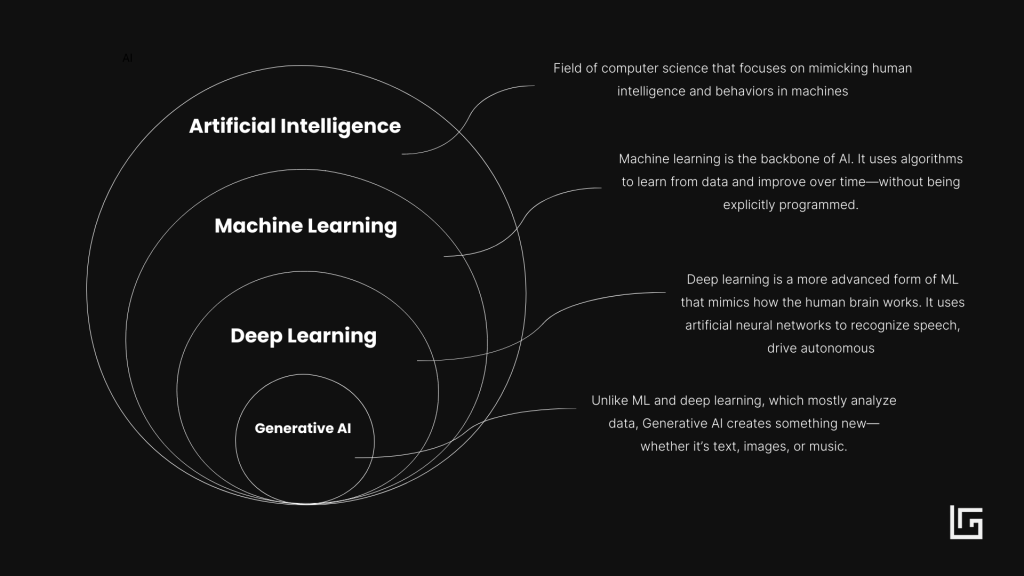
1. Machine Learning (ML): The Foundation
Machine learning is the backbone of AI. It uses algorithms to learn from data and improve over time—without being explicitly programmed.
Example: Amazon’s product recommendations. Based on what you’ve browsed and bought before, ML suggests items you might like.
2. Deep Learning: Taking It Further
Deep learning is a more advanced form of ML that mimics how the human brain works. It uses artificial neural networks to recognize speech, drive autonomous cars, and even tag faces in photos.
Example: Facebook’s automatic photo tagging. Ever noticed how Facebook knows who’s in a picture before you tag them? That’s deep learning recognizing faces.
3. Generative AI: The Creator
Unlike ML and deep learning, which mostly analyze data, Generative AI creates something new—whether it’s text, images, or music.
Example: ChatGPT or AI tools that generate images and videos.
How AI Actually Works
At its core, AI runs on data.
The more data it has, the smarter it gets.
Here’s the basic process:
- Data Collection: AI needs input—lots of it.
- Pattern Recognition: It analyses the data and finds trends.
- Decision-Making: Based on the patterns it recognises, AI makes predictions or takes action.
Want one more example?
Ever wonder how Netflix knows exactly what you want to watch?
It studies your viewing habits, compares them to others, finds patterns, and suggests content tailored to you.
That’s AI in action.
The Four Key Gen AI Categories to Master
If you want to get comfortable with AI, there are four essential areas you should familiarise yourself with.
These will give you the biggest bang for your buck in terms of practical applications.
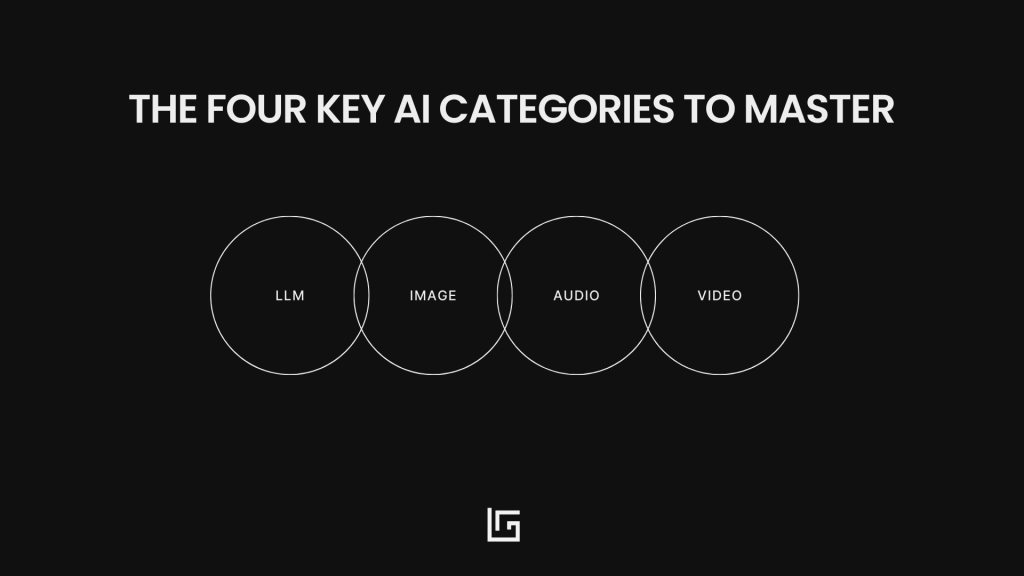
1. LLMs (Large Language Models)
Large Language Models are at the heart of AI-powered text generation. They process vast amounts of information to generate human-like responses.
Key Tools: ChatGPT, Claude, Gemini, Deepseek
Fundamentals to Learn:
- How LLMs are trained on massive datasets
- How to write better AI prompts to get useful responses
- Ethical concerns and biases in LLMs
2. Image AI
AI can create stunning visuals, enhance designs, and generate art in seconds.
Key Tools: Midjourney, DALL·E, Stable Diffusion
Fundamentals to Learn:
- How image generators work and process inputs
- The fundamentals of prompting in AI image generation
- The difference between AI-assisted editing vs. full AI-generated art
- Techniques for refining and editing AI-generated images
- Ethical and copyright implications of AI-created visuals
3. Audio AI
AI is transforming the way we generate, edit, and enhance sound.
Key Tools: ElevenLabs, Descript , Google Notebook LM
Fundamentals to Learn:
- How AI-generated voices work
- How AI learns and mimics human speech patterns
- The role of neural networks in voice synthesis
- How AI enhances audio production
- Applications of AI voice synthesis in dubbing, accessibility, and content creation
4. Video AI
From automatic video editing to deepfake creation, AI is changing the landscape of video content.
Key Tools: Runway , Kling AI, Sora, Pika Labs
Fundamentals to Learn:
- How AI-generated video is revolutionizing content creation
- How video generation models work and process inputs
- The fundamentals of prompting in AI video generation
- Techniques for refining and editing AI-generated videos
Learning AI: The 80/20 Path to Mastering AI
So, where should you start if you want to get good at AI without spending years studying it?
Here’s my 80/20 approach:
1.Understand the Fundamentals
Get a solid grasp of how AI works. This LinkedIN AI Learning path is a great place to start.
2. Choose One Area to Focus On
Are you interested in Automation, AI research, image generation, or video editing? Pick one area and go deep.
3. Use AI in Your Daily Work
The best way to learn is by using AI tools for practical projects. Have one challenge at hand? Try to solve it using the tools mentioned. I’ve used AI to strategise change, plan projects, structure presentations or to create AI illustrations and AI icons. Lately I’ve also been exploring vibe coding and have built surveys, configurators and even some tools using Cursor AI and Claude and Replit.
4. Stay Curious
AI evolves fast. Stay updated by following industry leaders, taking online courses, and testing new tools. Here are some shows and people to follow:
- The AI Daily Brief – A daily newsletter covering the latest AI advancements and tools.
- Sam Altman’s Blog – Insights from OpenAI’s CEO on AI and the future of technology.
- Dario Amodei’s Blog – Deep dives into AI safety and alignment from the CEO of Anthropic.
- Satya Nadella (Microsoft) – Thoughts on AI and enterprise transformation from Microsoft’s CEO.
Machine learning for beginners: your reading path
If machine learning is the foundation of AI, it’s also where most beginners get lost. Too much maths, too many acronyms, too little connection to real work.
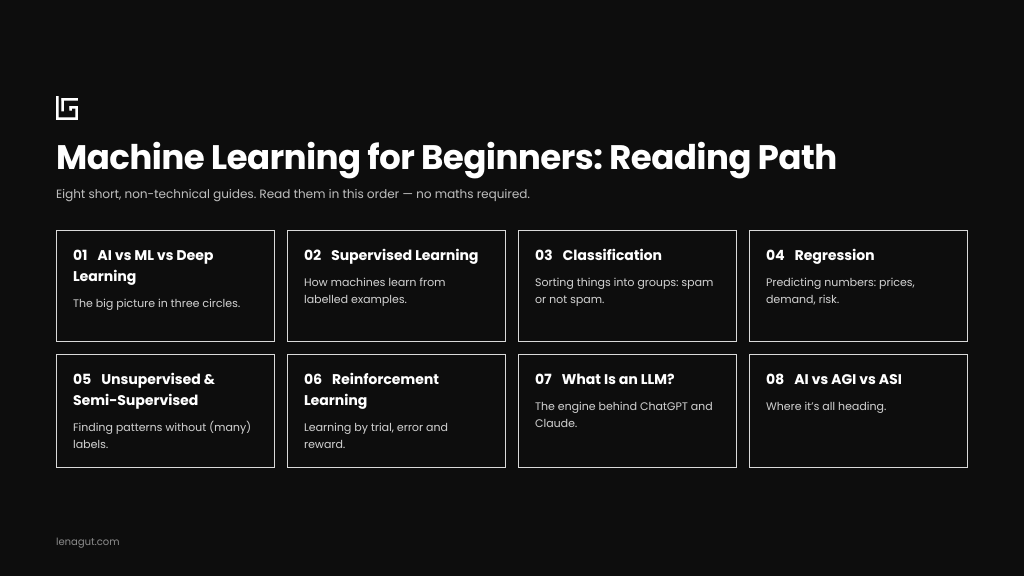
So I wrote a series of short, non-technical guides — the ones I wish I’d had when I started. Read them in this order and you’ll understand machine learning for beginners level in an afternoon, without a single equation:
- Start with the big picture: AI vs Machine Learning vs Deep Learning — three circles, one spam filter, zero maths.
- How machines learn from examples: Supervised Learning — the approach behind most business AI today.
- Sorting things into groups: Classification Models — spam or not spam, churn or stay.
- Predicting numbers: Regression, Explained Simply — prices, demand and risk.
- Finding patterns without labels: Unsupervised Learning and Semi-Supervised Learning.
- Learning by trial and error: Reinforcement Learning — from game-playing AI to how chatbots are fine-tuned.
- The engine behind ChatGPT and Claude: What Is an LLM?
- Where it’s all heading: AI vs AGI vs ASI.
Keep my AI Glossary open in another tab while you read. Every term you meet is explained there in one or two plain sentences.
My three lessons from learning AI
Looking back, three things made the biggest difference for me.
Learn the concepts once, apply them every day. The fundamentals don’t change every week, even if the tools do. Understanding how a model learns makes every new tool easier to judge.
Build something small. My understanding jumped when I stopped only reading and started building — prompts, little apps, automations. Even a tiny project teaches you more than ten videos.
Teach what you learn. Writing these guides forced me to really understand each topic. Explaining AI to a colleague, a friend or your team works the same way.
What’s next?
Are you ready to start your AI journey?
You don’t need a PhD to master AI — you just need curiosity, the right resources and a willingness to experiment.
If you want a structured start, take my free 10-Day AI Crash Course: one short lesson a day by email, built for busy professionals. Then turn it into a habit with the 30-Day AI Challenge. And if you’re choosing a course for yourself or your team, here is my shortlist of the best AI courses for business leaders.
I’d love to hear from you! If there’s a specific area of AI you’d like me to explore in more depth, reach out and let me know.
Looking for more ways to keep learning? Here is my list of the best AI blogs to follow.
Related reading: My 30-Day AI Challenge: What I Learned Recording 31 Videos
Free tool
Not sure which AI course to take?
Answer 5 quick questions and get the 3 courses that fit your role, goal, time and budget.
Open the course finder →Join the newsletter
Practical insights on AI, leadership and innovation — every week.