
April 15, 2025
The Beginner’s Guide to Unsupervised Learning
Have you ever scrolled through Instagram and wondered, How does this app know exactly what I want to see?
Or maybe you’ve shopped online and thought, Wait, how did they recommend the perfect pair of shoes I didn’t even know I wanted?
This is the work of unsupervised learning, the quiet genius to uncover hidden patterns without needing someone to label everything first.
Let’s pull back the curtain and see how this magic really works.
How Unsupervised Learning Works
Picture this: You’re a little kid flipping through a big animal picture book for the first time.
No labels. No parent saying, “This is an elephant, this is a cow.”
Just you, your curious mind, and pages filled with creatures of all shapes and sizes.
Slowly, you start noticing patterns:
- Big, gray animals with long trunks
- Large, spotted animals with hooves
- Furry, four-legged animals with wagging tails
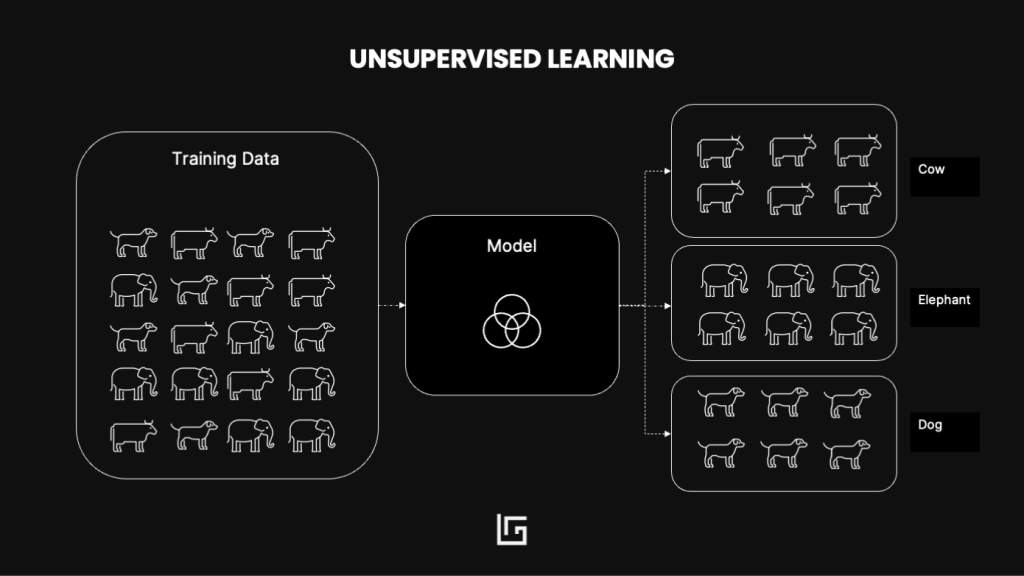
You didn’t need anyone to tell you what each animal was – you just naturally grouped them by what looked alike.
That’s exactly how unsupervised learning works in AI.
Let me walk you through the unsupervised learning process:
Data Collection and Preparation
- We start by gathering thousands of unlabeled animal photos – elephants, cows, and dogs all mixed together in one big digital pile.
- The images are cleaned and standardized (same size, orientation) but remain completely unlabeled – no “elephant” or “dog” tags.
Feature Extraction
- The algorithm scans each image and identifies distinguishing features:
- For elephants: large size, gray color, trunks, big ears
- For cows: hooves, spots or solid coloring, body shape
- For dogs: fur texture, tail shape, ear types
- These become the key characteristics the system will use to differentiate the animals.
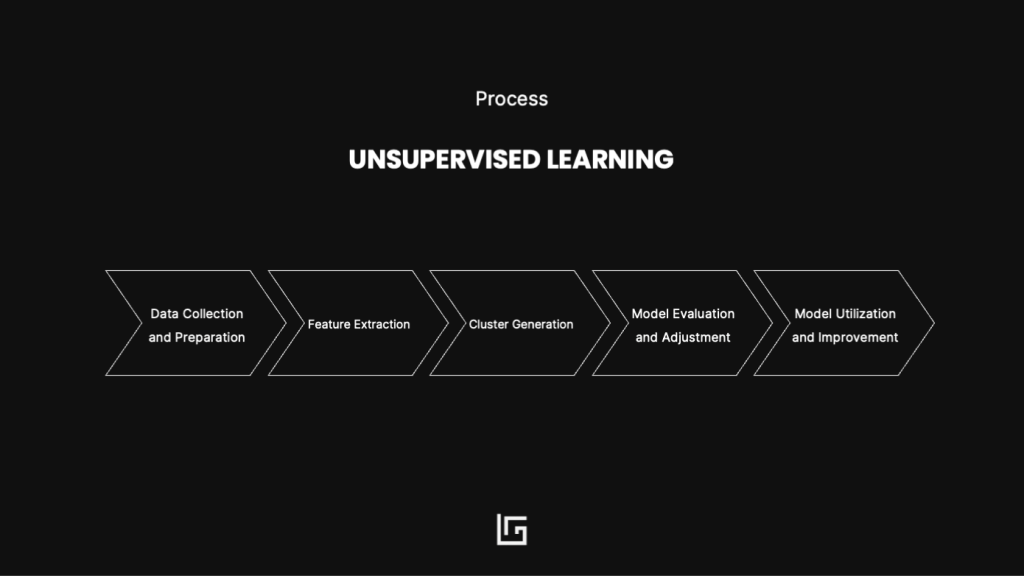
Cluster Generation
- Using clustering algorithms, the system starts grouping similar images:
- Cluster 1: Large size + trunks → Elephants
- Cluster 2: Hooves + spotted/solid → Cows
- Cluster 3: Fur + varied sizes → Dogs
- Like a child sorting animal cards, it looks for natural groupings without any predefined categories.
Model Evaluation and Adjustment
- The system checks its work:
- Did it confuse a large Mastiff dog with a small cow?
- Did it properly distinguish short-haired elephants from similar-toned dogs?
- Adjustments are made to improve the feature weighting (maybe ear shape matters more than color).
Model Utilization and Improvement
- Now functional, the system can:
- Classify new unlabeled animal photos
- Identify when an image doesn’t fit existing clusters (maybe a rhino gets flagged as unusual)
- Continuously refine its groupings as more data comes in
Unsupervised vs Supervised Learning
Remember back in school when you first learned about animals? If you pointed to a wolf and called it a “big dog,” your teacher would gently correct you. That’s supervised learning – having a guide to tell you exactly what’s right and wrong. The teacher provides labeled examples (“This is a wolf, this is a dog”), and you learn from these clear instructions.
But unsupervised learning is like being left alone in the library with nothing but animal picture books.
No teacher.
No labels.
Just you figuring things out through observation.
You might notice that while wolves and dogs share similarities, there are distinct patterns – wolves are generally larger, with different facial structures and tail positions.
You’re learning purely through pattern recognition, making your own categories based on what you observe.
Unsupervised Learning: Real-World Examples:
Take Netflix‘s recommendation system as an example. With unsupervised learning:
- It doesn’t need someone to define genres like “quirky British comedies” or “90s action movies”
- Instead, it notices that viewers who watch “The Office” (UK) often enjoy “Shaun of the Dead”
- These connections emerge naturally from viewing patterns, not predefined categories
Fraud detection systems work similarly:
- They don’t rely on rules like “flag all purchases over $500”
- Instead, they learn each user’s unique spending “fingerprint”
- A $20 gas station purchase might be flagged if it’s at 3 AM in a different state – not because of the amount, but because it breaks your established pattern
The Power of Combined Supervised and Unsupervised Learning
The most effective learning—for both humans and machines—isn’t about choosing between guidance or independence.
It’s about leveraging both.
Think of a musician who masters scales through lessons (supervised learning) then develops their unique style by experimenting (unsupervised learning).
The real magic happen when structure meets exploration.
Next week we’ll explore semi-supervised learning.
By combining a small set of labeled data with vast amounts of raw, unlabeled information, it achieves what neither method can do alone: faster learning, sharper insights, and more adaptable systems.
Imagine training an AI with just a handful of examples, then watching it grow smarter on its own.
But before I go, I’d love to turn the spotlight to you: What have you been learning about AI lately?Whether it’s hands-on experiments or just something that made you pause and think, hit comment—I’m curious.
Join the newsletter
Practical insights on AI, leadership and innovation — every week.