
April 21, 2025
Semi-Supervised Learning Explained

Supervised vs Unsupervised vs Semi-Supervised Learning:What Is Semi-Supervised Learning?
Over the past few weeks, we’ve been on a journey through the world of machine learning.
Then we explored supervised learning, where machines learn from clearly labeled data, followed by a deep dive into unsupervised learning, where models uncover hidden patterns with no labels at all.
Today, we’re going to explore what happens in between.
It’s called semisupervised learning, and it’s one of the most practical, powerful, and human-like ways machines can learn.
This method blends the clarity of supervision with the freedom of exploration and it’s exactly how many of today’s most advanced AI models are being trained.
Supervised vs Unsupervised vs Semi-Supervised Learning
Most AI systems rely on:
- Supervised learning, where every piece of data is meticulously labeled
- Unsupervised learning, where the system finds patterns with zero guidance
Semi-supervised sits in the middle.
It starts with a small set of labeled examples, just enough to point the AI in the right direction. Then, it uses that small set to teach the model how to understand the larger, unlabeled portion.
Semisupervised learning is faster to train because there’s no need to label every data point.
It’s also more adaptable and cost effective.
The Semi-Supervised Learning advantage
To teach an AI model how to recognize images, generate text, or understand language, you need data.
But not just random data — it needs to be labeled.
That means a human has to go through thousands, even millions, of files and labelled it.
It’s slow, expensive, and nearly impossible to scale.
That’s where semisupervised learning comes in.
Instead of labelling everything manually, you label a small portion and let the model learn from that to label the rest.
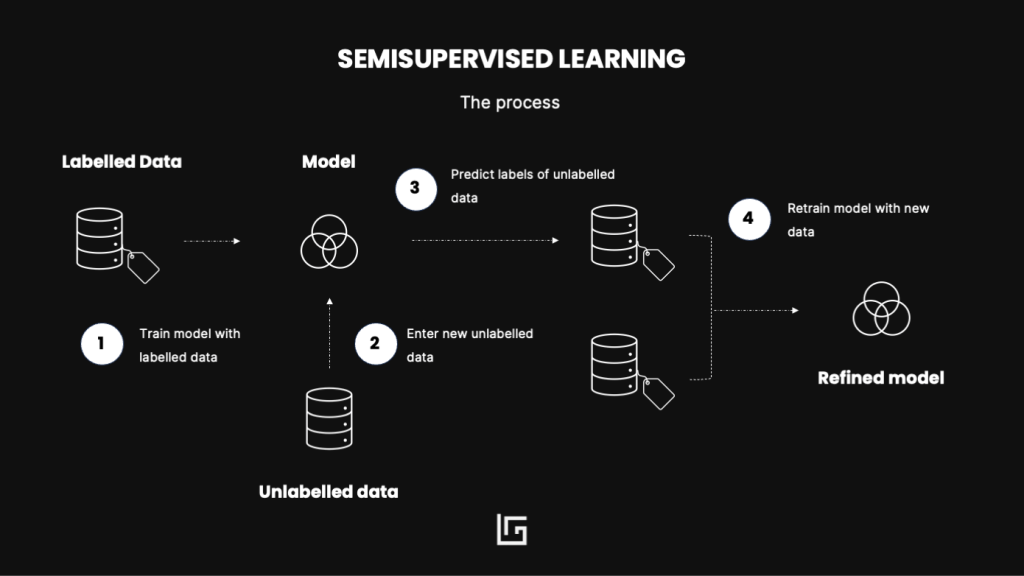
How Semi-Supervised Learning Works
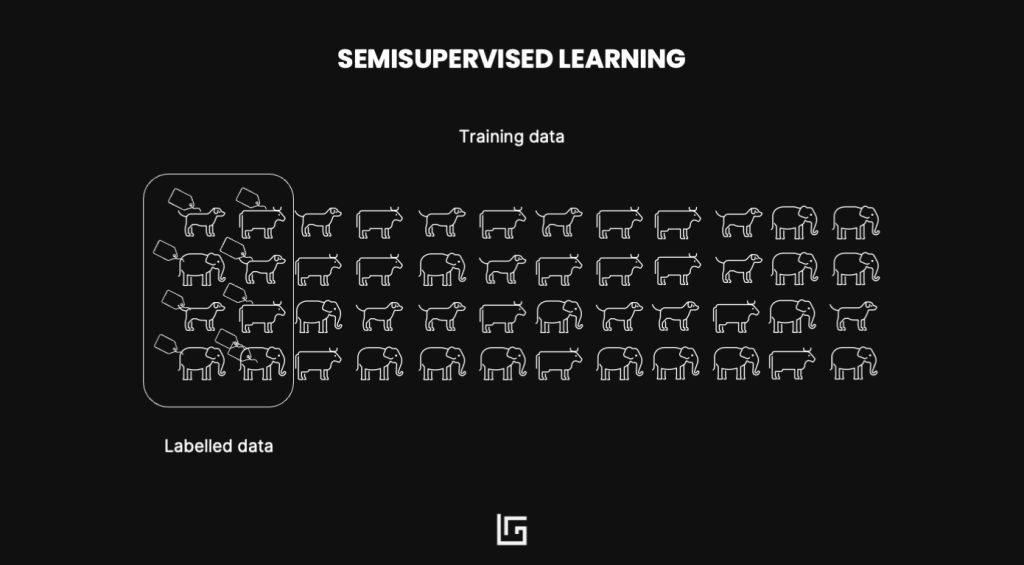
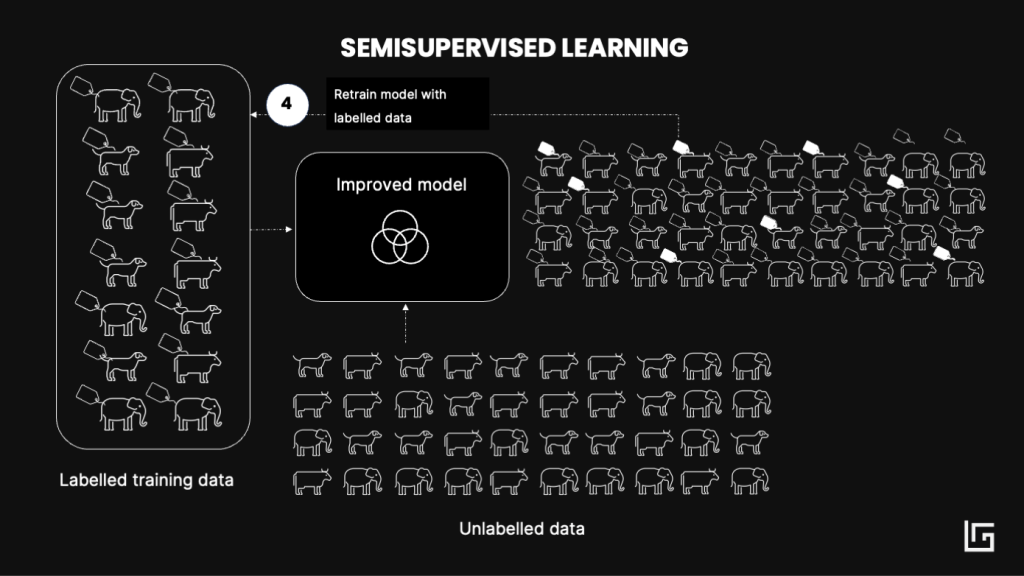
Let’s go back to our animals example and say you have a big batch of animal photos.
Some are labeled, most are not.
They’re all a mix of dogs, cows, and elephants.
Step 1: Start Small
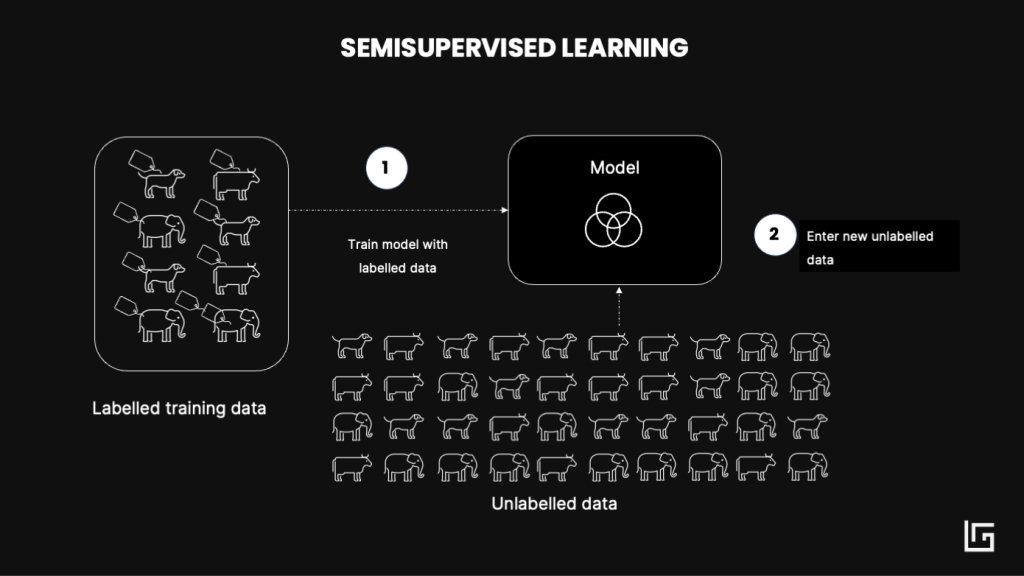
You begin with a handful of labeled images.
Three dogs. Three cows. Three elephants.
That’s enough to start. The model learns from these labeled examples what makes a dog a dog, what features define an elephant, and what separates a cow from the rest.
Step 2: Add Unlabeled Data
Now you bring in a much larger dataset — all unlabeled.
It includes more dogs, cows, and elephants, but no tags to tell the model what’s what.
Using what it learned from the labeled data, the model starts making guesses.
This looks like a dog. That probably is a cow. This one could be an elephant.
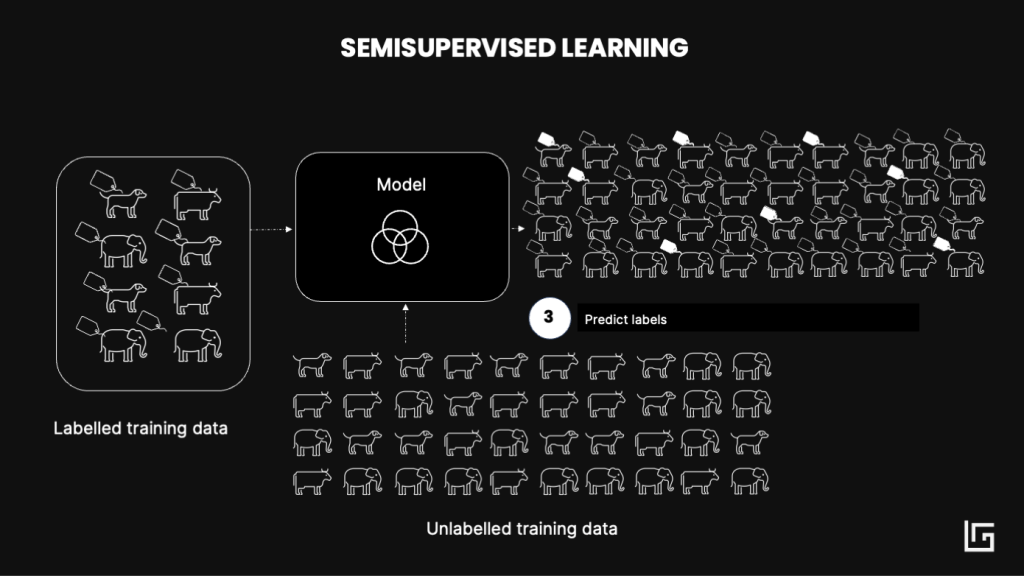
Step 3: Predict and Label
The model labels all the unlabeled data based on its current understanding.
At this point, it’s using educated guesses, not perfect answers.
That’s okay. Learning happens through trying.
Step 4: Retrain With More Data
Once everything is labeled — both by humans and by the model itself — the system gets retrained.
Now it’s working with more data and a better understanding of how to categorize what it sees.
The result is a classification model that can sort animals faster and more accurately, all while reducing the need for massive amounts of manual labelling.
Semisupervised vs. Self-Supervised: What’s the Difference?
You’ve probably hear about self-supervised learning, and wonder if it’s related to semisupervised learning.
Semisupervised learning starts with a small amount of labeled data and combines it with a large amount of unlabeled data. The model learns from the labeled examples and then tries to apply that knowledge to the unlabeled ones—improving its predictions over time. There’s still a little human input at the beginning to guide the process.
Self-supervised learning, on the other hand, doesn’t rely on labeled data at all. Instead, the model generates its own labels from the raw data itself. It might, for example, predict missing parts of a sentence, or identify which part of an image was moved or altered. This type of learning has powered breakthroughs in models like GPT and BERT, where massive amounts of data are available but labeled examples are rare or unnecessary.
So what’s the key difference?
Semisupervised learning starts with some help.
Self-supervised learning teaches itself from scratch.
In practical terms, semisupervised learning is often easier to apply when you have at least a few examples to work with, while self-supervised learning tends to require very large datasets and more advanced model architectures.
Both methods are increasingly popular as AI continues to evolve.
Semisupervised Learning explained
Semisupervised learning remembers me a bit of how most of us learn.
With a few clear lessons, a bit of trial and error, and the courage to make guesses as we go.
In a world flooded with information, it’s not about having it all figured out.
It’s about knowing enough to get started and being open to learning along the way.
That’s the real power of semisupervised learning.
And maybe, it’s a reminder that we’re all still figuring things out, one step at a time.
So now I’ll turn it over to you.
What’s something you’ve been learning lately—maybe even without having all the answers upfront?
Whether it’s a new tool, a mindset shift, or something totally outside your comfort zone, I’d love to hear about it.
Hasta la proxima,
Helena
Join the newsletter
Practical insights on AI, leadership and innovation — every week.