
August 23, 2026
Prompt Engineering Basics: 10 Patterns and Tips Every Professional Should Know

You don’t need to be technical to get great results from AI. You need to be clear. Prompt engineering is just that: the skill of asking so well that the AI can’t misunderstand you. After teaching AI to hundreds of professionals, these are the ten prompt engineering patterns I use every single day — plus the tips and mistakes I see in every workshop.

The 10 prompt engineering patterns
1. Give it a role
“You are an experienced CFO reviewing this budget.” A role sets the lens, the vocabulary and the standards. It’s the fastest quality upgrade there is.
2. State the audience
“Explain this to a new hire” produces a different answer than “explain this to the board”. Say who the output is for.
3. Show the format you want
Table? Bullet list? 3 paragraphs? One-line summary first? Describe the shape of the answer — or paste an example and say “like this”.
4. Add your context
AI can’t read your mind — but it can read your paste. Include the email thread, the data, the draft. The more relevant context, the less generic the answer.
5. Give examples
One or two examples of “good” beat a paragraph of instructions. This is called few-shot prompting, and it’s how you teach AI your taste.
6. Set constraints
Length, tone, words to avoid, things that must appear. Constraints are not limits on creativity — they’re the brief.
7. Ask for thinking first
For hard problems: “Think through this step by step before answering.” Reasoning first, conclusion second. Fewer confident mistakes.
8. Iterate — don’t restart
The first answer is a draft. Say what’s wrong: “shorter”, “less formal”, “the second point is weak — replace it”. Treat it like feedback to a fast, tireless colleague.
9. Ask it to ask you
“Before you answer, ask me any questions you need.” This flips the pattern and catches the gaps in your own brief. My favourite trick to give away.
10. Ask for a critique
“Now argue against this plan.” “What would a skeptical customer say?” AI is as good at poking holes as filling them — use both modes.
A template you can steal
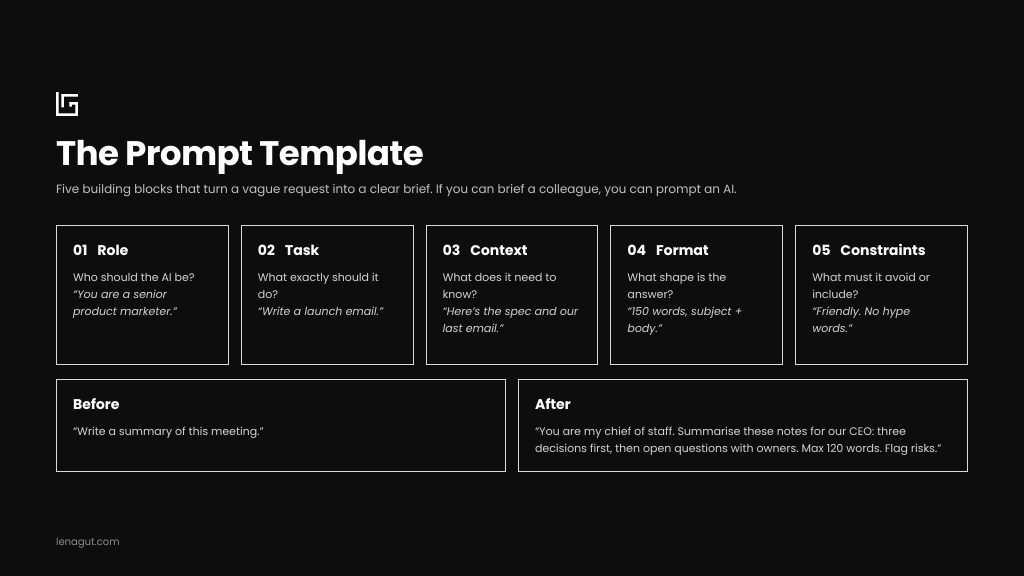
Role + Task + Context + Format + Constraints.
“You are a senior product marketer (role). Write a launch email for the feature below (task). Here’s the spec and our last launch email (context). 150 words, subject line + body (format). Friendly but no hype words like game-changing (constraints).”
Before and after: a prompt makeover
Here’s a real-life example of the difference these patterns make.
Before: “Write a summary of this meeting.”
You’ll get something. Probably long, probably generic, probably not what you needed.
After: “You are my chief of staff. Summarise the meeting notes below for our CEO, who missed the meeting. Start with the three decisions we made, then open questions with an owner each. Maximum 120 words. Flag anything that sounds like a risk.”
Same tool. Same notes. A completely different result — because the second prompt tells the AI who it is, who it’s writing for, what matters and what the output should look like.
Prompt engineering tips I share in every workshop
The patterns are the foundation. These tips are what turn them into a daily habit.
Start with the outcome, not the task
Don’t ask for “a presentation”. Ask for “a 5-slide story that convinces the board to fund a pilot”. When the AI knows what success looks like, it makes better choices along the way.
One job per prompt
Long prompts that ask for research, analysis, a draft and a translation at the same time usually do all four badly. Split big jobs into steps and review between them.
Paste, don’t describe
Instead of explaining your brand voice, paste two texts you love. Instead of describing the data, paste the table. Real material beats any description of it.
Name what to avoid
“No jargon.” “Don’t invent numbers.” “Don’t use the word ‘leverage’.” Telling the AI what you don’t want is one of the quickest ways to make the answer sound like you.
Save your best prompts
When a prompt works, keep it. A small personal library of 10 good prompts — for meeting summaries, emails, feedback, planning — will save you hours every month. Share it with your team.
Always check the facts
AI writes with confidence, even when it’s wrong. For anything with numbers, names, dates or legal consequences, verify before you send. Clear prompting reduces mistakes; it doesn’t remove your responsibility.
Common prompt engineering mistakes
Being polite but vague. “Could you maybe help me with my strategy?” is friendly — and impossible to answer well. Be warm, but be specific.
Accepting the first answer. Most people stop after one try. The magic usually happens in the second and third round of feedback.
Hiding the real problem. If you’re worried about how your team will react to a change, say so. The AI can only help with the problem you actually share.
Using it only for writing. AI is a brilliant thinking partner: ask it to find gaps, play devil’s advocate or prepare you for a difficult conversation.
The mindset behind the patterns
Notice what these have in common: none of them are technical.
They’re the same skills you use to delegate well to a person — clarity, context, examples, feedback. If you can brief a colleague, you can prompt an AI. And as AI becomes more agentic, briefing well becomes the core skill of working with it.
New to how these models work under the hood? Start with What Is an LLM?
Prompt engineering FAQ
What is prompt engineering in simple words?
Prompt engineering is the practice of writing instructions for AI tools so they give you useful, accurate answers. In daily work, it simply means briefing the AI the way you would brief a smart new colleague.
Do I need to know how to code?
No. Everything in this guide works in plain language, in any AI chat tool. Coding helps only if you want to build AI into software.
Does prompt engineering still matter now that models are smarter?
Yes — it just looks different. Modern models forgive sloppy wording, but they still can’t guess your context, your audience or your standards. Clear briefing matters more as AI does bigger tasks for you.
Which AI tool is best for practising?
Any of the big assistants works. I use Claude daily, and the patterns transfer between tools. Pick one, use it every day for two weeks, and you’ll improve faster than by switching around.
Practice beats theory
Reading about prompt engineering is like reading about swimming.
Pick one pattern and use it today. Then another tomorrow. Or let me pace you: my free 10-day AI Crash Course delivers one hands-on lesson a day by email, and the 30-Day AI Challenge turns it into a habit. And when you’re ready to go deeper, Anthropic’s prompt engineering guide is a great next step.
Want to keep sharpening your prompting skills? These are the AI blogs I read every week to stay up to date.
Join the newsletter
Practical insights on AI, leadership and innovation — every week.