
August 23, 2026
What Is Agentic AI? AI Agents Explained for Business Leaders

For two years, using AI meant one thing: typing into a chat box. That era is ending. The biggest shift in AI right now is agentic AI — and if you lead a team, a product or a business, this is the concept to understand in 2026.

What is agentic AI?
Agentic AI is AI that doesn’t just answer — it acts (see the broader definition).
A chatbot waits for your next message. An AI agent takes a goal, breaks it into steps, uses tools, checks its own work, and keeps going until the job is done (or it needs your input).
Give a chatbot a question, and you get a paragraph. Give an agent a goal — “find the errors in this report, fix them, and email me a summary” — and you get the work.
Chatbot vs. agent: the difference in one example
Imagine you need a competitor analysis.
With a chatbot: you ask 15 questions, copy answers into a doc, check the facts, format everything. You are the project manager.
With an agent: you state the goal once. The agent searches, reads, compares, drafts the document, and hands it back for review. It is the project manager. You are the editor and the decision-maker.
Agentic AI vs AI agents: are they the same thing?
You’ll hear both terms, often in the same meeting. They’re related, but not identical.
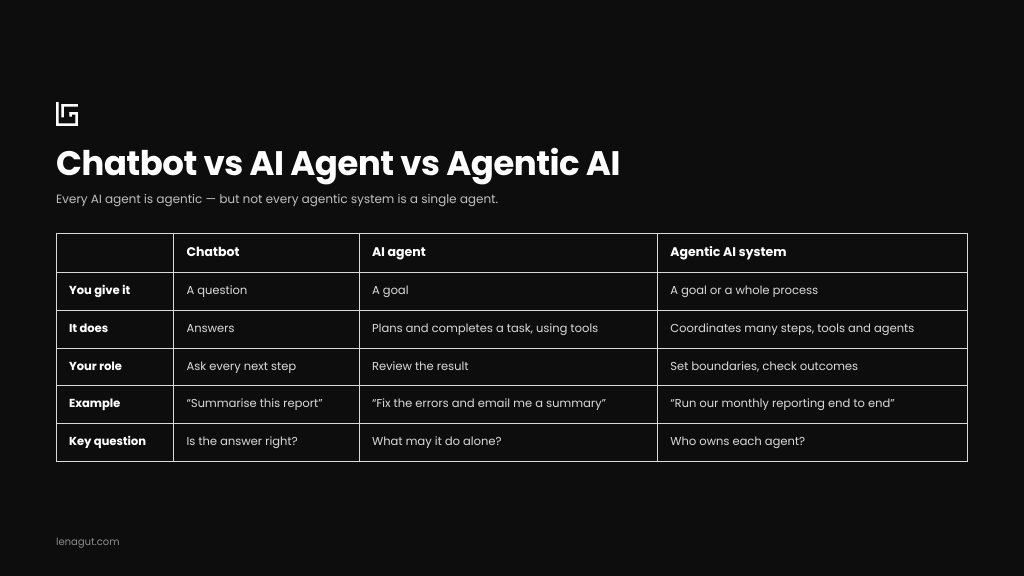
An AI agent is a single system that pursues a goal: a research agent, a coding agent, a customer-service agent.
Agentic AI is the broader approach — AI designed to plan, act and adapt with some autonomy. It can be one agent, or several agents working together, handing tasks to each other like a small team.
| Chatbot | AI agent | Agentic AI system | |
|---|---|---|---|
| What you give it | A question | A goal | A goal or a whole process |
| What it does | Answers | Plans and completes a task | Coordinates many steps, tools and agents |
| Your role | Asks every next step | Reviews the result | Sets boundaries and checks outcomes |
| Example | “Summarise this report” | “Fix the errors and email me” | “Run our monthly reporting end to end” |
In practice: every AI agent is agentic, but not every agentic system is a single agent.
The four abilities that make AI “agentic”
1. Planning
Agents split a goal into steps and decide what to do first. If a step fails, they try another route.
2. Tool use
Agents don’t just generate text. They browse the web, run code, query databases, and use your company’s software. Open standards like MCP (Model Context Protocol) let them plug into existing tools — I wrote about it in MCP for Products.
3. Memory
Agents keep track of what they’ve done, what worked, and what you prefer — across a task, and increasingly across weeks.
4. Autonomy (with limits)
Good agents know when to act and when to stop and ask you. That boundary — what the agent may do alone — is the most important design decision you’ll make.
Examples of agentic AI at work
Agentic AI sounds abstract until you see it in a normal working week. These are the kinds of use cases I see companies start with:
- Sales: an agent researches a prospect, summarises their recent news and drafts a tailored first email for a human to approve.
- Finance: an agent matches invoices to purchase orders, flags mismatches and prepares the exceptions list.
- HR: an agent answers policy questions, prepares onboarding plans and keeps new-hire checklists up to date.
- Operations: an agent monitors tickets, groups similar issues and suggests which problem to fix first.
- Product and engineering: coding agents write, test and document features while engineers review and decide.
Notice the pattern: repetitive, multi-step, digital work — with a human signing off on what matters.
What this means for leaders
You don’t need to build agents. You need to make three calls:
1. Which work becomes agent-shaped? Repetitive, multi-step, digital work goes first: reporting, research, triage, data cleanup, first-draft anything.
2. Where do humans stay in the loop? Decide what agents may do alone, what needs approval, and what stays human. Write it down. This is the new delegation.
3. Is your team ready? The skill that matters is not prompting tricks — it’s knowing how to specify a goal, review AI work critically, and give feedback. That’s trainable. It’s exactly what I teach in my free AI Crash Course.
The risks to take seriously
Agents are powerful because they act. That’s also why they need more care than a chatbot.
Small errors compound. A wrong assumption in step two can travel all the way to step ten. Build in review points.
Access is a security question. An agent that can send emails or change records needs the same thinking as a new employee’s permissions: least access first.
Accountability stays human. “The agent did it” is not an answer your customers or regulators will accept. Name an owner for every agent.
Over-trust creeps in. When something works nine times, we stop checking the tenth. Keep spot checks even when results look good.
Where agentic AI is heading
2026 is the year agents moved from demos to daily work: coding agents that ship real features, research agents that prepare briefings, operations agents that keep systems tidy.
The next step is teams of agents working together — and agents that understand not just language but the physical world.
The companies that win won’t be the ones with the fanciest models. They’ll be the ones that redesigned their work first. If you’re preparing your organisation, start with Preparing for AI Adoption and my AI adoption framework.
Agentic AI FAQ
Is ChatGPT or Claude agentic AI?
Both started as chat assistants and now include agentic features — they can search, use tools, write and run code, and complete multi-step tasks. Whether you use them as a chatbot or an agent depends on how you brief them.
Will agentic AI replace jobs?
It will replace tasks first. Roles built mostly on repetitive digital steps will change the most. The human work that grows is judgement, relationships and deciding what good looks like — I explore this in Jobs AI Can’t Replace.
How do I start with agentic AI in my company?
Pick one recurring, low-risk process, define what the agent may do alone and what needs approval, and run a 30-day pilot with a clear metric.
Start small this week
Pick one recurring task. Ask an AI tool to do the whole thing, not just answer questions about it. Watch where it succeeds and where it needs you.
That’s agentic thinking. And it’s a muscle.
Want to build it in a month? Join my free 30-Day AI Challenge — one short video a day, or start with What Is an LLM? if you want the foundations first.
Agents are just the latest chapter. See how AI evolved step by step in my artificial intelligence timeline.
Join the newsletter
Practical insights on AI, leadership and innovation — every week.