
August 23, 2026
AI Adoption Framework for Mid-Size Companies: A 5-Stage Checklist
Most companies don’t have an AI problem.
They have an adoption problem.
The tools are licensed, a pilot ran, someone gave a keynote — and six months later, work looks exactly the same. I’ve seen this pattern across the enterprises I work with, and I started documenting it in my AI adoption research. This post distils what actually works into one practical AI adoption framework you can run on a single page.
What is an AI adoption framework?
An AI adoption framework is a simple, shared structure for moving from “we bought AI” to “AI changed how we work”. It tells you what to decide first, what to build next, and how to know whether it’s working.
Without one, every team improvises. Marketing buys one tool, engineering blocks another, HR writes a policy nobody reads. Lots of activity. Very little change.
With one, the leadership team gets a common language. You can point at a stage and say: this is where we are, this is what’s missing, this is what we do next.
That sounds basic. It is. And it’s exactly what most companies are missing.
Why mid-size companies need a lighter approach
Large corporations have AI centres of excellence, big budgets and armies of consultants. Start-ups have small teams who simply try things on a Tuesday afternoon.
Mid-size companies sit in the uncomfortable middle.
You have enough complexity to get stuck — departments, legacy systems, works councils, customers who expect reliability — but rarely a dedicated AI team. The people driving AI usually have a day job too.
That’s why you don’t need a 60-page AI strategy. You need one page, five stages and clear owners.
The framework: five stages, one page
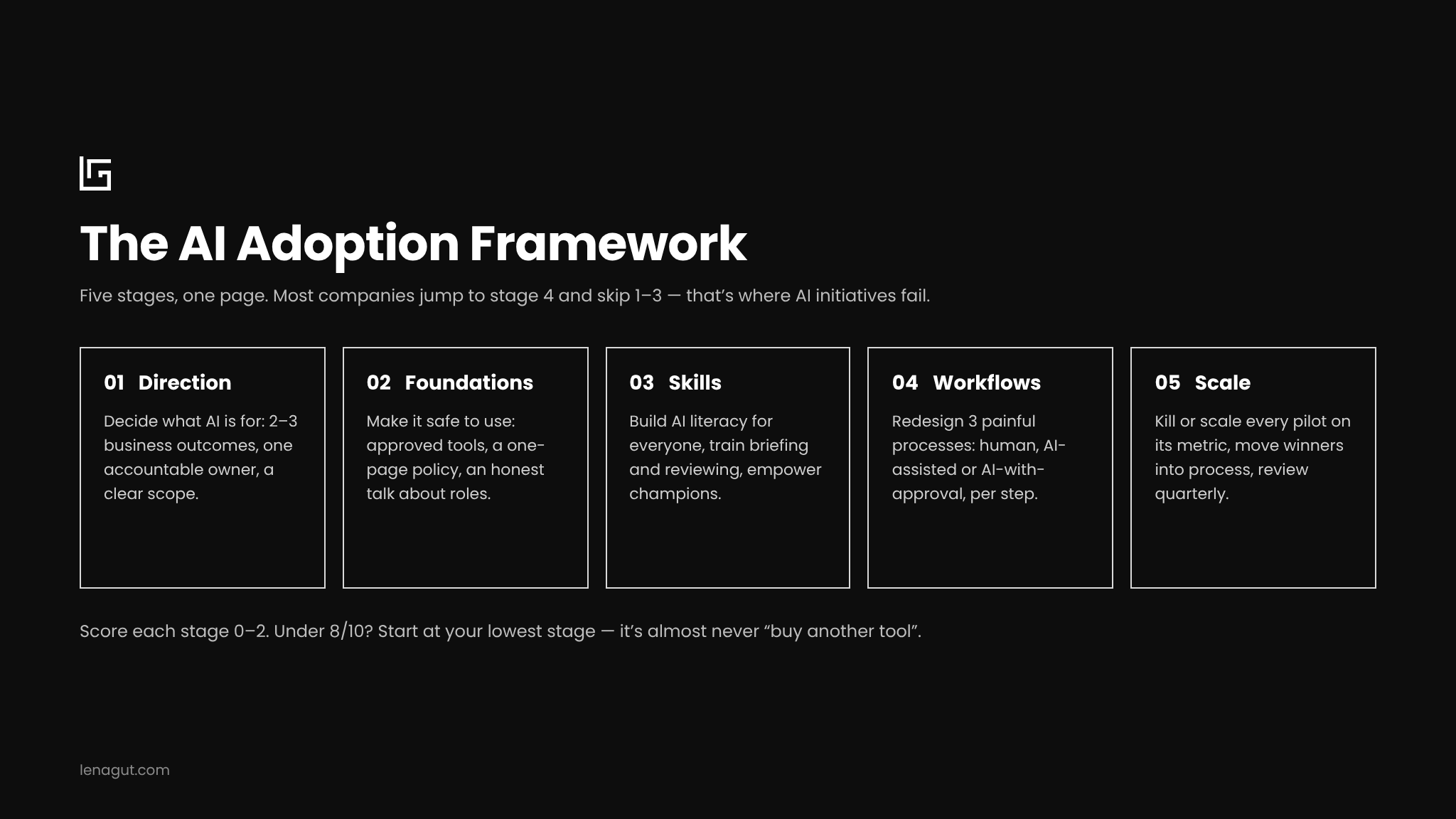
Use it as a checklist. Most mid-size companies discover they’ve jumped to stage 4 while skipping stages 1–3 — that’s the root of most failed AI initiatives.
Stage 1 — Direction: decide what AI is for
☐ Name the 2–3 business outcomes AI should serve this year (not “innovation” — outcomes: faster proposals, lower ticket backlog, better forecasts).
☐ Assign one accountable owner. Not a committee.
☐ Write down what you will not do yet. Scope is a decision.
What good looks like: every manager can explain in one sentence why the company is investing in AI — and it’s the same sentence in every department.
Stage 2 — Foundations: make it safe to use
☐ Approve a small set of tools people may use, and say clearly what data may go into them.
☐ Publish a one-page usage policy in human language — rules nobody reads are rules nobody follows.
☐ Answer the fear question out loud: what happens to roles? Silence breeds shadow AI and quiet resistance.
What good looks like: people know which tools they may use and what they may put into them. Nobody is hiding their AI use from their manager.
Stage 3 — Skills: build literacy before workflows
☐ Give everyone baseline AI literacy — what it can do, where it fails, how to direct it. (My free 10-day Crash Course exists exactly for this.)
☐ Train the deeper skill of briefing and reviewing AI work: prompting patterns.
☐ Find your internal champions — every team has two — and give them time and a stage.
What good looks like: everyone has the same baseline, and every team has at least one person colleagues go to when they get stuck.
Stage 4 — Workflows: redesign work, don’t sprinkle AI on it
☐ Pick 3 recurring, painful, digital processes. Map them step by step.
☐ Decide per step: human, AI-assisted, or AI-with-approval. That boundary is the design. (Agentic AI raises the stakes here.)
☐ Run 30-day pilots with a named owner and a before/after metric each.
What good looks like: three redesigned workflows, each with a number that moved — hours saved, turnaround time, error rate.
Stage 5 — Scale: make it stick
☐ Kill or scale every pilot on its metric — publicly. Learning requires visible verdicts.
☐ Move what worked into the standard process and onboarding.
☐ Review quarterly: models change fast; your map should too.
What good looks like: successful pilots are simply “how we work now”, and stopped pilots were shared as lessons, not buried as failures.
How to roll it out: the first 100 days
A framework only helps if it turns into a calendar. This is the rhythm I recommend to the leadership teams I work with.
Week 1: run the diagnostic together
Put the five stages on one slide. Ask every leader to score the company 0–2 per stage, on their own, before discussing. The differences between the scores are the most valuable part of the meeting.
Weeks 2–4: fix the foundations
Choose the tools, write the one-page policy, and have the honest conversation about roles. This is change management, not IT. I’ve written about the human side in Preparing for AI Adoption.
Months 2–3: skills and pilots in parallel
Launch baseline training for everyone and, at the same time, start your three workflow pilots. People learn fastest when they can apply a new skill to real work the same week.
Month 4 and beyond: verdicts and scale
Review every pilot against its metric. Scale what worked, stop what didn’t, and pick the next three workflows. Then repeat.
The three mistakes I see everywhere
Tools before skills. Licences are easy to buy; literacy has to be built. Reverse it and adoption stalls at the login page.
Pilots without verdicts. Eternal pilots are how organisations avoid deciding. Every pilot needs a date and a metric.
Delegating it to IT alone. AI adoption is a change-management project wearing a technology costume. Treat it like one.
Run the diagnostic
Score each stage 0–2 for your company and add them up.
| Score | What it means | Where to start |
|---|---|---|
| 0–4 | Activity without direction | Stage 1: agree on outcomes and one owner |
| 5–7 | Foundations and skills are patchy | Stages 2–3: policy, literacy, champions |
| 8–10 | Ready to redesign work | Stages 4–5: pilots with metrics, then scale |
Anything under 8/10 tells you exactly where to start — and it’s almost never “buy another tool”.
AI adoption framework: frequently asked questions
What is the best AI adoption framework?
The best one is the one your leadership team actually uses. Big consulting frameworks are thorough but heavy. For a mid-size company, a five-stage checklist — direction, foundations, skills, workflows, scale — covers what matters and fits on one page.
How long does AI adoption take?
You can see first results within 90 days if you run focused pilots. Real adoption — where AI is part of normal processes — usually takes 12 to 18 months, because it depends on habits, not software.
Who should own AI adoption?
One named leader with real authority, supported by IT, HR and the business. If everyone owns it, nobody does.
Do we need an AI strategy first?
You need direction, not a thick document. Stage 1 of this framework is your strategy in its most useful form: two or three outcomes, one owner and a clear scope.
Where to go from here
Want help working through the framework with your leadership team? That’s what my workshops and coaching are for. Or start smaller: forward the free Crash Course to your team today.
Related reading: Is AI a Bubble? Or the Start of Something Bigger?
Join the newsletter
Practical insights on AI, leadership and innovation — every week.