
February 10, 2026
AI Adoption in Enterprises – Starting my research journey

I’m researching what it actually takes for engineering teams to adopt AI. Here’s what I’ve found so far, and how you can help shape the conversation.
This is a topic that is close to my heart.
I am a creative by nature.
I’ve always been drawn to ideas, to making things, to imagining what could be.
And over the past couple of years, I’ve been genuinely blown away by the possibilities of AI: how it’s changing our work, our creative processes, and fundamentally reshaping the world around us.
At the same time, I’ve spent the last 15 years, my entire professional career, working in the context of transformations and the humans who navigate them.
Organizational change.
Adoption.
The messy, deeply human side of making new things work.
Being able to combine these two disciplines, the creative potential of AI and the human reality of change, feels like a gift.
The current state: We have a problem
Let me start with the uncomfortable numbers.
of AI initiatives fail to meet their expected outcomes in 2025
That’s not a typo. According to research from MIT, RAND, S&P Global, and others, the vast majority of AI projects are not delivering on their promise. MIT’s 2025 report on the State of AI in Business found that only about 5% of generative AI pilot programs achieve rapid, measurable impact on the P&L. RAND puts the broader AI project failure rate at around 80% — nearly double that of non-AI IT projects. And S&P Global shows that 42% of companies abandoned most of their AI initiatives in 2025, up sharply from 17% the year before.
We’re not talking about a small gap between ambition and execution. We’re talking about trillions of dollars invested, and most of it not translating to real value.
The usual suspects — poor data quality, unclear objectives, misaligned expectations — are part of the picture. But there’s something deeper going on, especially in certain professional domains. And engineering is one of them.
Why AI is a particular challenge in engineering
Engineering is different.
Not because engineers are less capable of learning new things — quite the opposite. But because of a specific dynamic that makes technological change feel more threatening in this profession than in many others.
In engineering, identity is deeply tied to expertise.
Research on engineering identity has consistently shown that engineers construct their professional sense of self around what they know and what they can do. Competence, mastery, technical depth — these aren’t just skills. They’re core to who engineers believe they are. Studies from engineering education research describe the process of becoming an engineer as fundamentally an identity development process: you don’t just learn engineering, you become an engineer.
This is powerful. It creates persistence, deep commitment, and the kind of technical rigor that makes complex systems possible.
But it also creates a vulnerability.
When a new technology comes along that changes how things are done — that automates parts of what you know, that shifts what expertise means, that reconfigures who holds power in the room — it doesn’t just feel like a process change. It can feel like an identity threat.
Research on digital transformation and professional groups has shown exactly this. Engineers experience transformation as something that triggers a heightened awareness of their professional identity.
If not handled carefully, can lead to adverse group dynamics, boundary-drawing behaviors, and resistance that can compromise the transformation.
This isn’t about stubbornness.
It’s about self-preservation.
When your professional worth is built on being the expert in the room, and the ground shifts underneath that expertise, the response is deeply human.
The speed problem: I don’t get it, I don’t like it, I don’t like you
There’s another layer to this.
AI transformation doesn’t just challenge identity.
It moves at a pace that most organizations and most people are not equipped to handle.
In the literature review I conducted for my research, a clear pattern emerged. Across studies on technology adoption, organizational change, and resistance to AI, people move through stages that are remarkably consistent.
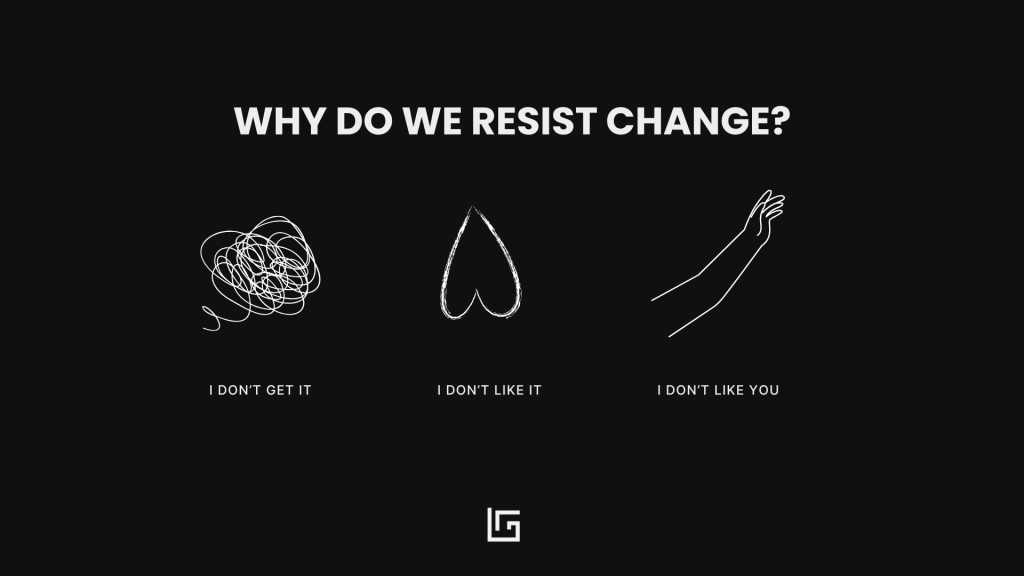
1. “I don’t get it.”
The first barrier is cognitive. People don’t understand what the technology does, what it means for their work, or how it fits into what they already know. This is especially true in engineering, where the bar for understanding is high and surface-level knowledge feels insufficient.
2. “I don’t like it.”
Once people understand what AI can do, the emotional response kicks in. Fear of replacement. Loss of autonomy. Skepticism about quality. Distrust of something that feels opaque, probabilistic, or unreliable things that run against everything engineers are trained to value.
3. “I don’t like you.”
When the change feels imposed with things like top-down mandates, unrealistic timelines, lack of involvement in decision-making, resistance transfers from the technology to the people driving it.
This is where change management fails most spectacularly, and where trust breaks down.
My literature review covered research on technology adoption models (TAM, UTAUT), professional identity theory, organizational change resistance, and AI-specific adoption challenges.
The pattern is clear: adoption is not a technology problem.
It’s a human problem.
And in engineering, the stakes — both personal and organizational — are unusually high.
So what does it actually take?
This is the question I’m trying to answer.
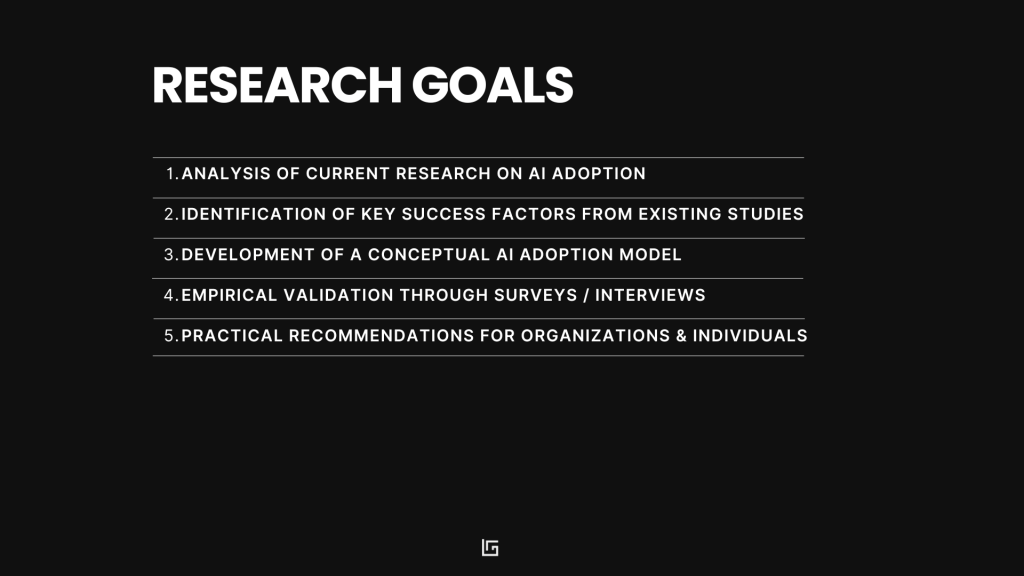
Based on my literature review and the conversations I’ve had with engineering leaders and practitioners, I’ve arrived at a working framework that looks at AI adoption in engineering across several dimensions: individual readiness (skills, mindset, identity), team dynamics (trust, psychological safety, collaboration), organizational factors (leadership, culture, infrastructure), and the nature of the technology itself (fit, transparency, reliability).
But frameworks are hypotheses until you test them with real people. Which brings me to where I am now.
My Research Plan
I’m conducting a two-phase research project on AI adoption in engineering:
Phase 1 — Survey: A quantitative survey designed to capture how engineers and engineering organizations are experiencing AI adoption right now. What’s working. What’s not. What’s getting in the way. I want to understand the patterns at scale.
Phase 2 — Interviews: Based on the survey results, I’ll conduct in-depth qualitative interviews to go deeper into the why behind the data. Real stories, real tensions, real insights.
The goal is to produce research that is both academically rigorous and practically useful — something that can help organizations and leaders navigate this transition in a way that actually works.
I’ve built a home for this research at aiadoptionlabs.com, where you can learn more about the project and follow along as it evolves.
I need your help
If you work in engineering, lead engineering teams, or are navigating AI transformation in a technical organization — your perspective matters. A lot.
Take the survey. Share it with your network. Help me build a picture of what’s really happening out there.
My intention with this research is to reflect the real experience of real people.
Thank you for reading.
And if this resonates please share it with someone who should see it.
This post is part of an ongoing research project on AI adoption in engineering. Follow the work at aiadoptionlabs.com.
Related reading: 5 Reasons This AI Enterprise Transformation Isn’t Like the Last Ones · Is AI a Bubble? Or the Start of Something Bigger?
Keep reading: AI Adoption Framework for Mid-Size Companies: A 5-Stage Checklist · Preparing for AI Adoption Across 3 Levels
Join the newsletter
Practical insights on AI, leadership and innovation — every week.