
September 13, 2026
7 unexpected things that can go wrong in workshops and what to do about them

Workshops are powerful, but they also come with a long list of potential workshop problems.
They help people align, make decisions, solve problems and create something together. They can move a team forward in a few hours in a way that weeks of meetings sometimes cannot.
But they are also unpredictable.
The moment you bring people into a room, you bring different expectations, personalities, cultures, hierarchies and energy with them. And even with a great agenda and careful preparation, things can go wrong.
My first workshop experience
My first real experience with workshops was about fifteen years ago, when I arrived in Germany.
I remember walking into a room with people from different departments, different countries, different cultures and very different backgrounds. We were there because we had to implement a new system, and we needed to figure out how to move forward together.
There were two facilitators leading the session. And they were incredible.
They knew how to manage the energy in the room. How to connect people who were very different from each other. How to make everyone participate, feel heard and, most importantly, feel part of what we were trying to achieve.
I left that workshop energised. So did everyone else.
And I remember thinking: I want to learn how to do this.
Since then, I’ve probably facilitated more than 200 workshops. And I still learn something new every time. Because facilitating a workshop is one of the hardest things I know. You can prepare the agenda, the exercises and the timing. But you cannot completely control the people, the energy or the dynamics in the room.
And sometimes, things simply go wrong.
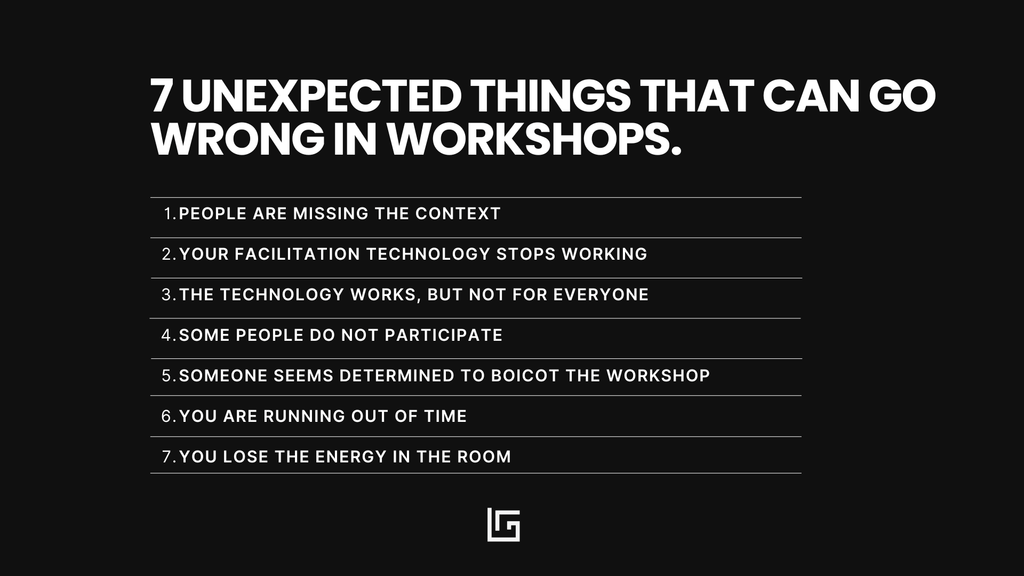
So, here are seven unexpected things I’ve experience that can go wrong in a workshop and what you can do about them.
7 Workshop problems I have experienced and what to do about it
1. People arrive without knowing why they are there
The workshop problem
Sometimes the problems start before the workshop has even started.
People arrive without really knowing why they have been invited, what you are trying to achieve or what you expect from them.
This is important.
If people do not understand the context, it is much harder for them to give you the right input. They may participate less, focus on the wrong questions or spend the first part of the workshop simply trying to understand what everyone else already seems to know.
As facilitators, we often forget how much context we have. We may have spent weeks preparing the session. A participant may have opened the calendar invitation five minutes before joining.
What to do about it
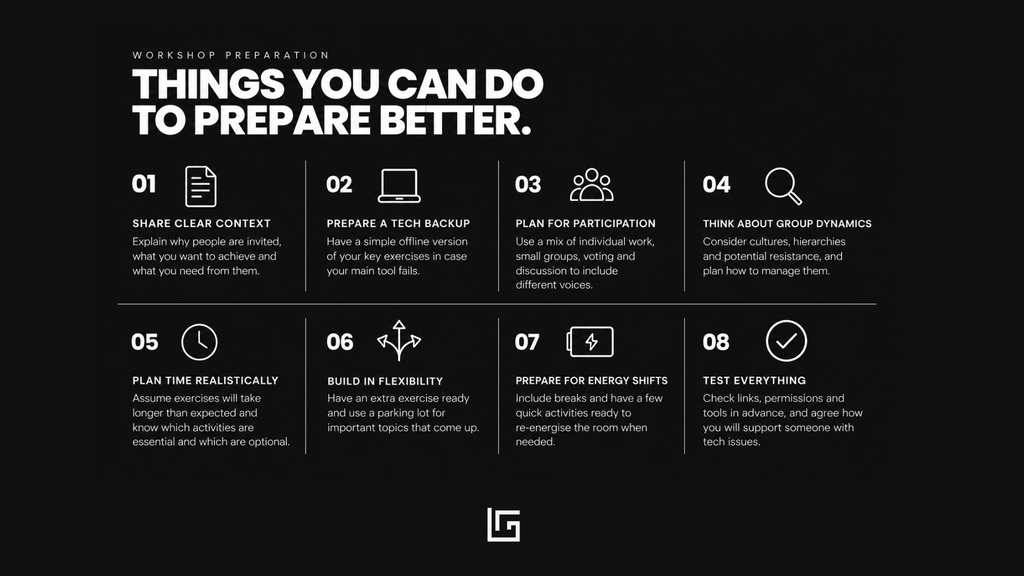
Always make space at the beginning to explain why you are there, what you want to achieve and what you need from the people in the room.
Do not assume that people have read everything in advance.
A few minutes of context at the beginning can completely change the quality of the workshop.
2. Your facilitation technology stops working
The workshop problem
This happened to me in one of the first online workshops I facilitated.
It was an online workshop with people joining from four different locations. We had prepared the whole session in Miro.
And on that particular day, Miro stopped working.
I was freaking out.
Everything I had prepared was there. The exercises, the questions, the voting. I did not have another plan.
Luckily, my customer had much more workshop experience than I did and she simply took control.
She asked the question. People shared their answers. She collected them and counted the votes manually.
And the workshop continued.
What to do about it
That experience taught me something important: the tool is not the workshop.
Today, when I facilitate an important session, I normally prepare a backup version of the key exercises in PowerPoint and it definitely makes me feel safer.
When you know you have a backup, it is much easier to stay calm when technology decides not to cooperate.
3. The technology works, but not for one participant
The workshop problem
Sometimes everything works perfectly for you and for 19 other people.
But one participant cannot open the link.
Or they cannot add a sticky note.
Or they cannot access the board.
Or something simply looks completely different on their screen.
The danger is stopping the whole workshop while everyone watches one person troubleshoot.
What to do about it
If the rest of the group is working on an exercise, use that moment to contact the person privately.
Ask them to share their screen. you have a co-facilitator, even better. They can help while you continue running the session.
And sometimes you simply cannot solve the technical problem.
That is also fine.
Ask the participant to send their ideas verbally or through chat and add the sticky notes for them.
4. Some people simply do not participate
The workshop problem
This is something I see particularly often in international workshops.
Put ten people from different countries, cultures, functions and levels of seniority in the same room and you will very quickly see very different ways of participating.
Some people think by talking.
They are comfortable jumping into a conversation, disagreeing openly and sharing an idea before it is completely formed.
Other people need time.
They want to think first. They may feel less comfortable speaking in a large group. In some cultures, openly challenging another person, particularly someone senior, is much less natural.
If you only facilitate through open discussion, you can easily end up hearing the same three voices again and again.
That does not mean the other seven people have nothing to say.
What to do about it
Create different ways for people to participate.
Give people a few minutes to think individually. Ask everyone to write sticky notes before discussing them. Use smaller groups. Use voting. Give people opportunities to contribute without having to fight for airtime.
And sometimes, directly invite someone into the conversation.
“We haven’t heard your perspective yet, X. What do you think?”
Be intentional about making sure there is space for more than the loudest voices in the room.
5. Someone seems determined to boicot the workshop
The workshop problem
And then there is the participant who does participate.
A lot.
They disagree with the initiative.
They question every exercise.
They repeatedly explain why something is not going to work.
And after a while, their negativity can start influencing the whole room.
The natural reaction can be to push back.
But that usually does not help.
What to do about it
First, try to understand what is behind the resistance.
A difficult comment can contain important information. Maybe that person sees a risk you have missed. Maybe they have experienced a similar project before and it went badly. Maybe they simply do not feel heard.
Resistance is often useful data.
But listening does not mean allowing one person to take over the workshop.
Acknowledge the concern, capture it and then move on.
A parking lot is incredibly useful for this.
You can say: “This is clearly an important concern. Let’s capture it because I don’t want to lose it. But I also want us to finish this exercise and hear what the rest of the group thinks.”
And sometimes a little humour helps too.
The important thing is not to become defensive.
You are there to facilitate the conversation, not to win it.
6. You are running out of time
The workshop problem
I still struggle with this one.
You plan 20 minutes for an exercise and suddenly you look at the clock and 40 minutes have passed.
Sometimes it is obvious that you need to move on.
But sometimes the conversation is really good.
People are finally discussing the thing nobody has been willing to discuss. Different perspectives are coming out. Something important is happening.
And then you have to decide whether to interrupt it because your agenda says it is time for the next exercise.
There is no perfect answer.
What to do about it
Part of becoming a better facilitator is developing a feeling for when a conversation is creating enough value to justify changing the plan.
I often ask myself: is this conversation more valuable than what I had planned next?
One practical thing that has helped me a lot is planning conservatively.
Exercises almost always take longer than you think.
So I try not to create an agenda where everything has to run perfectly to the minute for the workshop to finish on time.
I also prepare an extra exercise.
If the workshop moves faster than expected, I have something useful ready. If things take longer, I know which activities can be shortened or removed.
I also use a parking lot for valuable conversations that we simply cannot finish.
Good time management is not about following your agenda perfectly.
It is about knowing what to protect, what to shorten and what to let go.
7. You lose the energy in the room
The workshop problem
Sometimes nothing has gone wrong.
The technology works.
People understand the exercise.
Nobody is trying to derail the conversation.
But the room is dead.
It often happens after lunch. Or after a long discussion. Or when people have simply been sitting and listening for too long.
You can feel it.
People start looking at their phones. Online, cameras begin disappearing. Answers become shorter. Nobody volunteers.
At that point, continuing exactly as planned is rarely the answer.
What to do about it
Change something.
Take a break. Put people into pairs. Ask them to stand up. Move from talking to doing. Shorten the activity. Change the format. Ask a provocative question.
Sometimes five minutes is enough to completely reset the room.
One of the biggest things I have learned from facilitation is that you have to pay attention to what is actually happening, not only to what your agenda says should be happening.
Your agenda is a plan.
The room is reality.
Workshop facilitation is a superpower
Last week, I was talking to a candidate who told me that presentations were not really her strength, but that she was very good at workshops.
I remember thinking: I’m not sure I believe you.
Facilitating a workshop is one of the hardest things I’ve done. For me, it is much harder than presenting to 500 people.
You need practice, confidence and a lot of feeling for the room.
But once you develop that skill, it becomes a superpower.
Because bringing very different people together, making them feel heard and helping them move forward is an incredibly powerful thing.
Related reading: The 7 Hard Truths I Learned About Making Projects Actually Work · Get Buy-In Before Kickoff: The Project Compass Canvas · Nail Your Next Talk: The simple presentation structure that works every time
Join the newsletter
Practical insights on AI, leadership and innovation — every week.