
August 23, 2026
The AI Glossary: 50 AI Terms Every Leader Should Know

Every AI conversation is full of jargon. This AI glossary is the antidote: 50 AI terms every leader should know, each explained in one or two plain sentences. Bookmark it, share it with your team, and follow the links when you want the full story.

Why AI literacy starts with vocabulary
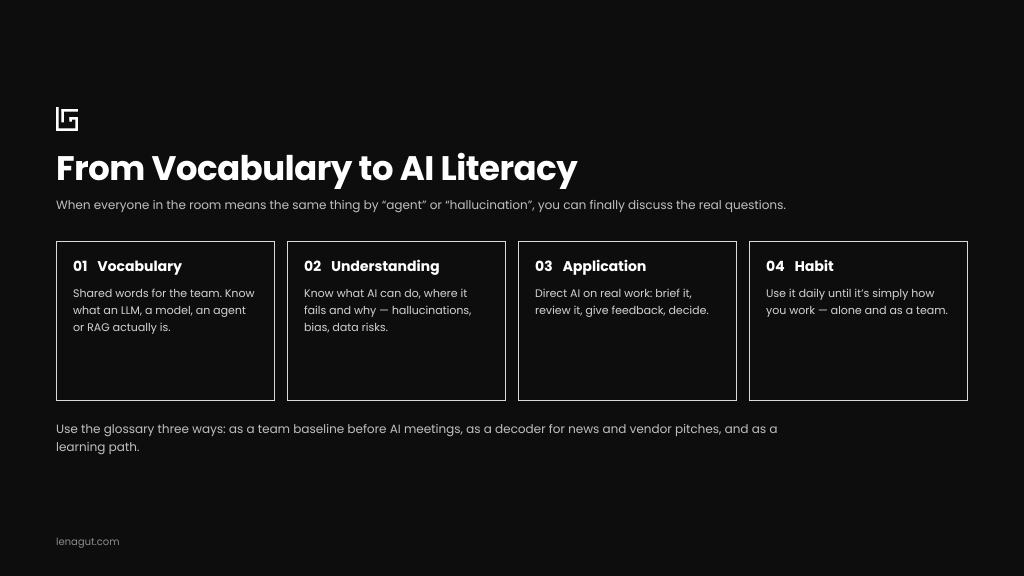
AI literacy is the baseline every professional now needs: knowing what AI can do, where it fails and how to direct it. And it almost always starts with words.
In the workshops I run, I see the same thing again and again. A leadership team wants to talk about AI strategy, but half the room quietly wonders what an “LLM” or a “hallucination” really is. Nobody asks. The conversation stays vague. Decisions get postponed.
A shared vocabulary fixes that. When everyone in the room means the same thing by “agent”, “fine-tuning” or “RAG”, you can finally discuss the real questions: which work should change, what is safe, and where to start.
That’s why I wrote this glossary. Use it in three ways:
- As a team baseline: share it before your next AI meeting so everyone starts from the same page.
- As a decoder: keep it open when you read AI news or vendor pitches.
- As a learning path: follow the links to the deeper guides when a term matters for your work.
If you want to go from vocabulary to real AI literacy — using these concepts in your daily work — my free 10-day AI Crash Course is the next step.
AI glossary basics
Artificial intelligence (AI) — Machines doing things that normally require human intelligence — understanding language, recognising images, making decisions.
Machine learning (ML) — The main way we build AI today: instead of writing rules, we let systems learn patterns from data. See AI vs ML vs Deep Learning.
Deep learning — Machine learning with many-layered neural networks that learn their own features from raw data. The engine behind the current AI boom.
Neural network — A model made of layers of simple units that pass signals to each other, loosely inspired by the brain.
Algorithm — A recipe: the step-by-step procedure a computer follows.
Model — What you get after training: the learned “brain” that turns inputs into predictions or text.
Training — The process of showing a model data so it can learn patterns.
Inference — Using a trained model to get answers. Training is school; inference is the job.
How machines learn
Supervised learning — Learning from labelled examples — the machine sees inputs and correct answers. My guide: Supervised Learning.
Unsupervised learning — Finding structure in unlabelled data, like grouping similar customers. Guide: Unsupervised Learning.
Semi-supervised learning — A practical middle path: a few labels, lots of unlabelled data. Guide: Semi-Supervised Learning.
Reinforcement learning (RL) — Learning by trial and error, guided by rewards — how AI mastered Go and how chatbots are refined. Guide: Reinforcement Learning.
Classification — Predicting a category: spam or not, churn or stay. Guide: Classification Models.
Regression — Predicting a number: a price, a forecast, a risk score. Guide: Regression Explained.
Training data — The examples a model learns from. Its quality sets the ceiling on the model’s quality.
Overfitting — When a model memorises its training data instead of learning the pattern — great in the lab, useless in the wild.
Bias (in AI) — Systematic unfairness a model picks up from its data or design.
Language models & chatbots
Large language model (LLM) — A deep learning model trained on huge amounts of text to understand and generate language. Full guide: What Is an LLM?
Generative AI — AI that creates new content — text, images, audio, video, code — rather than just analysing what exists.
Prompt — What you type to an AI: the instruction plus context. The quality of the prompt shapes the quality of the answer.
Prompt engineering — The craft of writing prompts that get great results. My 10 patterns: Prompt Engineering Basics.
Token — The chunks of text a model actually reads and writes — roughly three-quarters of a word each. Pricing and limits are counted in tokens.
Context window — How much a model can “keep in mind” at once. Bigger windows mean longer documents and conversations.
Hallucination — When AI states something false with full confidence (more on AI hallucination). The reason review stays human.
Fine-tuning — Continuing a model’s training on your own examples so it adopts your domain or style.
RAG (retrieval-augmented generation) — Letting a model look things up in your documents before answering — fresher and more grounded than memory alone.
RLHF — Reinforcement learning from human feedback: humans rate answers, and the ratings teach the model to be more helpful and safe.
System prompt — The standing instructions a model receives before your message — its job description.
Multimodal AI — Models that handle more than text: images, audio, video, code — in and out.
Agents & the new stack
This is the fastest-moving part of the AI glossary — the terms below are the ones changing how work actually gets done.
AI agent — AI that pursues a goal: it plans, uses tools, checks results and iterates. Guide: What Is Agentic AI?
Agentic AI — The umbrella term for this shift from answering to acting.
MCP (Model Context Protocol) — The open standard that lets AI plug into tools and data — USB-C for AI. Guide: What Is MCP?
Tool use / function calling — A model’s ability to operate software — search, run code, update a CRM — instead of only writing text.
Orchestration — Coordinating multiple models, tools and agents into one working system.
Human-in-the-loop — Workflow design where people approve or correct AI output at defined checkpoints. The heart of responsible automation.
Guardrails — The limits and checks that keep AI systems inside safe, intended behaviour.
Reasoning model — A model trained to think step by step before answering — slower, but stronger on hard problems.
World model / spatial intelligence — AI that understands the physical, 3D world rather than just text — the frontier behind robotics.
Capability levels & big-picture terms
AGI (artificial general intelligence) — Hypothetical AI matching human ability across most domains. Compared in AI vs AGI vs ASI.
ASI (artificial superintelligence) — The step beyond AGI: exceeding human ability across the board.
Narrow AI — Today’s reality: systems brilliant at specific tasks, clueless outside them.
Alignment — The research problem of making powerful AI reliably pursue what humans intend.
Turing test — Alan Turing’s 1950 question: can a machine converse indistinguishably from a person? See the whole story in my AI Timeline.
Compute — The processing power used to train and run models — the physical fuel of AI, measured in chips and energy.
GPU — The chip family that made deep learning practical; the pickaxe of the AI gold rush.
Open vs. closed models — Open models publish their weights for anyone to run and adapt; closed models are accessed through an API.
API — The doorway developers use to build products on top of someone else’s model.
AI at work
Automation — Technology doing a task without a human. AI expands what can be automated from the routine to the cognitive.
Augmentation — AI making people better at their jobs rather than replacing them — the framing I find most useful for teams. More in Jobs AI Can’t Replace.
AI adoption — The organisational work of getting real value from AI: skills, workflows, governance — not just licences. Start here: Preparing for AI Adoption.
AI literacy — The baseline understanding every professional now needs: what AI can do, where it fails, how to direct it. It’s what I teach in the free AI Crash Course.
Shadow AI — Employees using unapproved AI tools under the radar — a signal of demand, and a governance to-do.
Keep learning
This AI glossary is the map, not the territory.
If you want the territory: take the free 10-day AI Crash Course, join the 30-Day AI Challenge, or start with What Is an LLM? — the term behind all the others.
Want to go beyond definitions? These are the top AI blogs I follow to understand what is really happening.
Join the newsletter
Practical insights on AI, leadership and innovation — every week.